

Roofing Subcontractor Injury With No Workers Comp: 7 Costly Problems
A roofing subcontractor injury with no workers comp can spread fast. The hiring roofer, general contractor, property owner, and multiple insurance policies may all get pulled into the question of who pays.
Key Takeaways
- A roofing subcontractor injury with no workers comp can create exposure for the hiring roofer, GC, property owner, and other upstream parties.
- General liability usually is not designed to pay for injuries to workers on the job.
- A 1099 label does not automatically prove someone is outside workers compensation.
- Missing or expired subcontractor COIs can create claim problems, audit bills, renewal issues, and fewer carrier options.
- The best prevention is to verify coverage before work starts and recheck it during longer jobs.
Quick Answer
A roofing subcontractor injury with no workers comp can create exposure for the hiring contractor if the injured person is treated as an employee, statutory employee, or uninsured labor exposure.
It can also trigger lawsuits against the general contractor, property owner, or other parties connected to site control.
Bottom line: do not rely on “they are a 1099” or an old certificate. The facts, contracts, policy language, coverage dates, and state law matter.
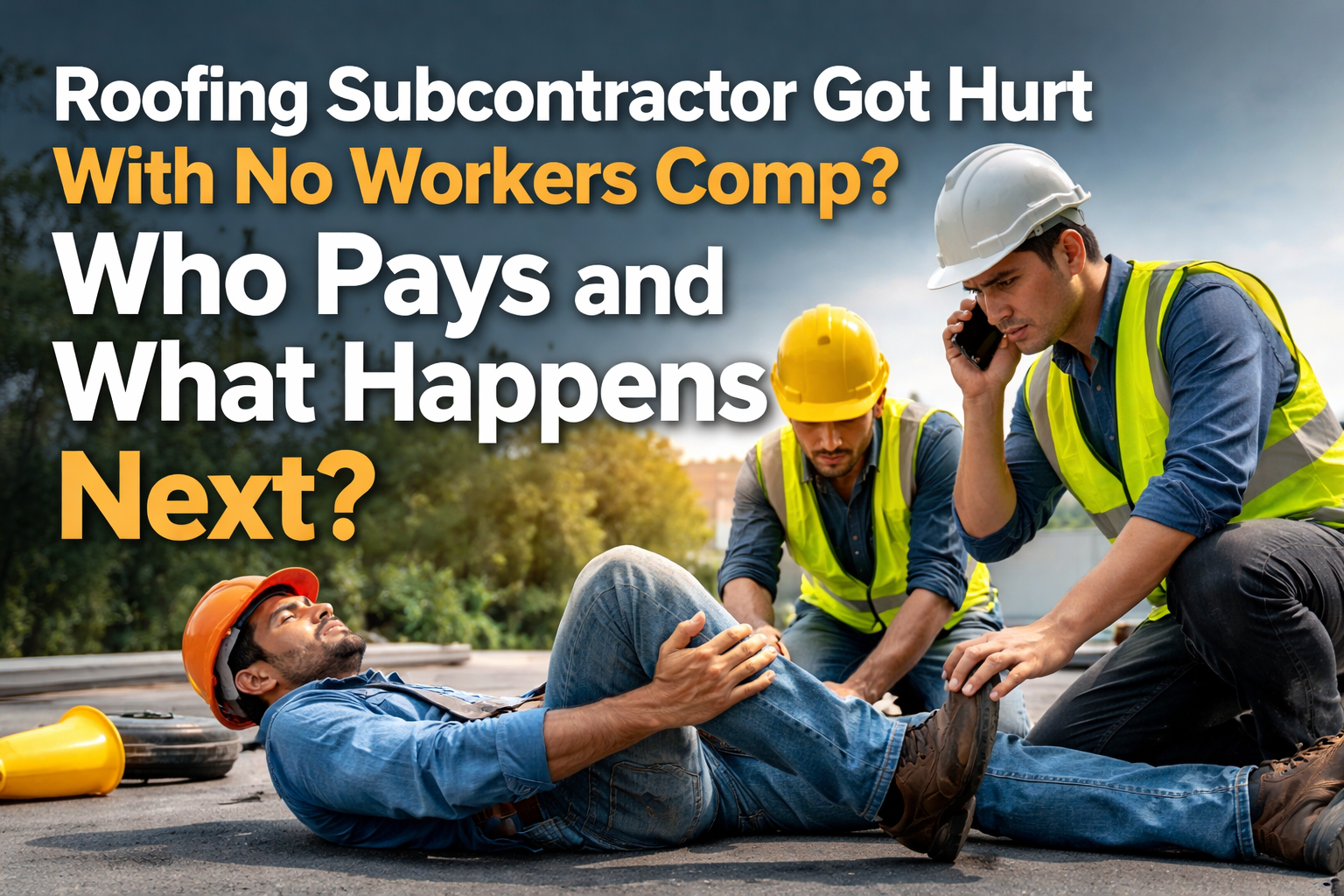
A roofing subcontractor injury with no workers comp is one of the fastest ways a roofing job can turn into a financial and legal mess.
The scenario is simple. A subcontractor falls. Ambulance. Emergency room. Broken pelvis, back injury, head injury, or worse.
Then someone asks the question that changes everything:
Do they have workers compensation?
And the answer is no.
Simple point: When an uninsured roofing subcontractor gets hurt, the injury may not stay inside the subcontractor’s business. The claim can spread to the hiring roofer, general contractor, property owner, audits, renewals, and multiple insurance policies.
Workers Comp vs. General Liability vs. Umbrella
Many contractors assume their general liability insurance covers any injury on a jobsite. That is usually not how it works.
Workers Compensation
Designed to pay medical bills, lost wages, rehabilitation, and related benefits for injured workers when workers compensation applies.
General Liability
Designed mainly for third-party bodily injury and property damage claims. It usually is not meant to replace workers compensation for worker injuries.
Where Umbrella Coverage Fits
An umbrella or excess liability policy may provide extra limits above certain underlying policies. But an umbrella usually does not create coverage when the underlying policy does not respond.
Practical example: If a worker injury exclusion blocks a general liability claim, do not assume the umbrella automatically fixes it. The umbrella language and underlying coverage have to be reviewed.
Have uninsured subs or stale COIs?
That is the type of issue worth reviewing before an injury, audit, renewal, or contract requirement turns it into a larger problem.
- Workers comp certificates
- General liability certificates
- Subcontractor agreements
- Audit and renewal exposure
- Contract insurance requirements

A short review can catch problems before a claim or audit does.
The 1099 and Statutory Employee Trap
In roofing, the 1099 label can create false confidence. A contractor may think, “They are a sub, so they are not my problem.”
That is not always true.
The facts matter more than the label. If the injured subcontractor looks like your employee in real life, the claim can push toward workers compensation exposure.
Facts That Can Create Trouble
- You provided the ladders, harnesses, nail guns, dump trailer, or other equipment.
- You controlled the daily schedule.
- You directed how the roofing work was performed.
- You supervised safety practices closely.
- The worker mainly or exclusively worked for you.
- The worker did not operate like a separate business.
- The worker had no active workers compensation coverage of their own.
If those facts point toward employee-like control, a roofing subcontractor injury with no workers comp becomes much more dangerous.
North Carolina Workers Comp Specifics
North Carolina has its own workers compensation rules. The North Carolina Industrial Commission employer guidance says the North Carolina Workers’ Compensation Act generally requires businesses with three or more employees to obtain workers compensation insurance or qualify as self-insured.
For roofing contractors, the practical standard is often stricter than the legal minimum. General contractors, builders, property owners, and project owners may require workers compensation insurance even when a contractor believes they are under the legal threshold.
Roofing reality: If someone is going onto a roof for pay, workers compensation needs to be handled correctly before the work starts. The fall risk is too severe to treat this as paperwork only.
The Moment the Fall Happens
When a roofing subcontractor falls, three things start happening at the same time.
1. Medical Care
The immediate priority is the injured person. Ambulance, emergency room, surgery, rehab, follow-up care, and lost wages can create large costs very quickly.
2. Legal Facts
Attorneys and adjusters look at who hired whom, who controlled the work, what safety setup existed, who supplied equipment, who gave instructions, and whether the subcontractor was really independent.
3. Insurance Positioning
Carriers review what policies exist, what exclusions apply, whether workers compensation should respond, whether general liability is triggered, and whether other parties are asking for defense or indemnity.
Most contractors focus on the emergency. Carriers and attorneys focus on the facts and the paperwork.
7 Costly Problems After an Uninsured Roofing Subcontractor Injury
This is the chain reaction many roofing contractors never see coming.
Problem 1: Medical Bills and Payment Pressure
Hospitals, doctors, rehab providers, and collection departments want payment. If the injured person cannot pay, pressure often moves upstream to the parties connected to the job.
Problem 2: Everyone Gets Named
A personal injury attorney may name every connected party to find available insurance and legal responsibility.
- The hiring roofing contractor.
- The general contractor.
- The property owner.
- The project manager.
- Other trades tied to jobsite conditions.
Problem 3: General Liability May Not Respond the Way You Expected
General liability policies often contain worker injury exclusions, employer liability exclusions, subcontractor conditions, or roofing-specific endorsements that affect how the claim is handled.
Being sued does not automatically mean the policy will defend every allegation. The policy language matters.
Problem 4: Certificate Timing Can Break Your Defense
This is one of the most common real-world failures. You collected a certificate once. The subcontractor’s policy canceled later. The injury happened after cancellation. Your file still has a piece of paper, but the coverage may no longer be active.
A certificate of insurance is a snapshot, not a guarantee. For a deeper breakdown, read Certificate of Insurance for Roofers: Why a COI Does Not Guarantee Coverage.
Problem 5: The Audit Bill Shows Up Later
Even if there is no lawsuit, the audit can still hurt.
If you cannot prove a subcontractor carried workers compensation, the carrier may treat that uninsured labor as part of your exposure. That can create:
- An audit bill.
- A higher renewal premium.
- Class code disputes.
- Fewer carrier options next year.
For more detail on this, read Roofing Insurance Audits: Why Your Premium Changes After the Policy Starts.
Problem 6: Renewal Gets Harder
Carriers do not only look at the claim. They look at your controls. If your file shows weak subcontractor documentation, no verification process, missing COIs, or repeated uninsured labor, your renewal may become more expensive or harder to place.
Problem 7: The Same Gap Repeats
The worst outcome is not just one injury. It is fixing nothing afterward. If the subcontractor process does not change, the same exposure can show up again through another injury, audit, lawsuit, or contract review.
What Insurance Adjusters Look For
Insurance adjusters do not decide claims based on what contractors meant to do. They review facts, documents, policy language, and exclusions.
They may look for:
- Workers compensation policy status.
- General liability policy language.
- Worker injury exclusions.
- Employer liability exclusions.
- Subcontractor warranties or conditions.
- Height restrictions or roofing-specific endorsements.
- Safety requirements.
- Written subcontract agreements.
- Certificates of insurance.
- Additional insured and waiver wording.
- Who controlled the work.
- Who provided tools and safety equipment.
Practical test: If your file does not prove what happened, the carrier may assume the worst version of the facts. Documentation gives you leverage.
What Roofers Should Collect Before Any Sub Starts
Prevention is not complicated. It just has to be consistent.
Before the Job
- Active workers compensation certificate.
- Active general liability certificate.
- Policy effective and expiration dates.
- Named insured that matches the subcontractor entity.
- Trade description that matches the work being performed.
- Written subcontract agreement.
- Insurance requirements in the subcontract.
During the Job
- Reverify coverage if the job lasts more than 30 days.
- Track policy expiration dates.
- Document which crew was on which job.
- Keep invoices that separate labor and materials.
- Document any change in scope or safety responsibility.
After the Job
- Store COIs by project.
- Keep subcontract agreements.
- Keep invoices and payment records.
- Keep notes about work dates.
- Save records for audits and completed operations issues.
The Subcontractor Verification Process That Actually Works
A simple system is better than a perfect system nobody follows.
Step 1: Collect the Certificate Before Work Starts
Do not let the crew start and hope the paperwork catches up later. Once someone is hurt, it is too late to fix an expired certificate.
Step 2: Check Dates Against the Job Window
The policy must be active during the dates the subcontractor is working. A certificate from last month does not prove the policy is still active today.
Step 3: Confirm the Coverage Matches the Work
A certificate for a different trade, different entity, or different operation may not help when the injured person was performing roofing work.
Step 4: Use a Written Subcontract Agreement
The subcontract should explain insurance requirements, indemnification, safety responsibilities, and documentation expectations.
Step 5: Recheck Long Jobs
If a job runs longer than expected, reverify coverage. Mid-term cancellations and nonpayment cancellations are real.
Step 6: Store Everything by Project
When a claim happens, you need to find the documents fast. Project folders make the claim and audit process cleaner.
Why This Matters for General Contractors Too
This is not only a roofer problem. General contractors can get pulled in because they sit upstream from the subcontractors. If a roofing subcontractor gets hurt, the lawsuit may name the roofer, the general contractor, and the property owner.
General contractors should have a subcontractor insurance process that includes:
- COIs before site access.
- Workers compensation verification.
- General liability verification.
- Additional insured requirements when appropriate.
- Written subcontract agreements.
- Expiration tracking.
- Project-specific document storage.
For broader contractor coverage planning, see the General Contractor Insurance Checklist.
Related Roofing Insurance Resources
- Roofing insurance coverage and requirements
- Workers compensation insurance
- General liability insurance
- Commercial umbrella insurance
- Certificate of Insurance for Roofers
- Roofing Insurance Audits
- General Contractor Insurance Checklist
Frequently Asked Questions About a Roofing Subcontractor Injury With No Workers Comp
What happens if a roofing subcontractor gets hurt with no workers comp?
If a roofing subcontractor gets hurt with no workers comp, the claim may spread to the hiring roofer, general contractor, property owner, and multiple insurance policies. The result depends on worker status, control of the work, contract language, available coverage, exclusions, and state workers compensation law.
Will general liability pay if a subcontractor gets hurt on a roofing job?
Usually not for the injured worker’s own medical bills or lost wages. General liability is mainly designed for third-party bodily injury and property damage claims. Worker injuries are usually a workers compensation or employer liability issue, depending on the facts and policy language.
Can a roofing contractor be responsible for an uninsured subcontractor injury?
Yes. A roofing contractor may be exposed if the injured person is treated as an employee or statutory employee, if the contractor controlled the work, if the subcontractor was uninsured, or if contract and jobsite facts point responsibility upstream.
Does a 1099 mean a roofing subcontractor is not covered by workers comp?
No. A 1099 label does not automatically decide workers compensation status. The actual facts matter, including who controlled the work, who supplied tools, whether the person worked independently, and how the job was performed.
Why do uninsured subcontractors create roofing insurance audit bills?
Uninsured subcontractors can create audit bills because the insurance carrier may charge their labor as part of the roofing contractor’s exposure if the contractor cannot prove the subcontractor had proper workers compensation or general liability coverage during the work period.
What should roofers collect from subcontractors before work starts?
Roofers should collect active workers compensation and general liability certificates, verify policy dates, confirm the subcontractor’s work matches the coverage, use a written subcontract agreement, track expiration dates, and keep records by project.
How can roofers reduce the risk of uninsured subcontractor injury claims?
Roofers can reduce risk by verifying subcontractor coverage before work starts, rechecking coverage on longer jobs, using written contracts, documenting jobsite responsibilities, separating employee and subcontractor roles, and keeping COIs, agreements, invoices, and work dates organized.
Stephen Ellias is a North Carolina commercial insurance advisor and founder of Carolina Risk Partners in Wake Forest. He helps contractors and business owners understand workers compensation, general liability, subcontractor COIs, audit exposure, contract insurance requirements, and roofing risk before they become expensive problems.
Want help tightening up subcontractor risk before the next job?
Carolina Risk Partners helps roofing contractors review workers compensation, general liability, subcontractor certificates, audit exposure, and contract requirements so one injury does not expose a coverage gap.
Start My Roofing Insurance ReviewEducational resource only. This article is not legal, tax, claim, medical, audit, or insurance advice. Workers compensation responsibility, worker classification, coverage, exclusions, defense, indemnity, and claim outcomes depend on the actual facts, policy language, contracts, state law, carrier interpretation, and claim handling. Speak with a licensed professional about your specific situation.