

Roofing Insurance Audits: 7 Costly Premium Surprises to Avoid
Roofing insurance audits are where the carrier compares your estimated payroll, sales, subcontractor costs, and class codes against what actually happened during the policy term. That is why the price at binding may not be the final bill.
Key Takeaways
- Roofing insurance audits compare estimated numbers against actual numbers.
- The premium you pay at the start is often a deposit premium, not the final cost.
- Workers compensation audits usually focus on payroll, duties, class codes, overtime, and subcontractor proof.
- General liability audits may use sales, payroll, subcontractor costs, or another exposure basis.
- Missing subcontractor COIs are one of the fastest ways roofers get hit with audit bills.
- The best defense is to build the audit file all year, not after the auditor calls.
Roofing Insurance Audits: Quick Answer
Roofing insurance audits are carrier reviews used to compare your estimated exposure against your actual exposure. For roofers, that usually means payroll, sales, subcontractor costs, job duties, class codes, and proof that subcontractors carried their own coverage.
If actual exposure is higher than estimated, the carrier may send an additional premium bill. If actual exposure is lower than estimated, you may receive return premium, depending on policy terms and minimum premium rules.
Bottom line: this is usually a true-up process. The audit bill may feel random, but it often comes from payroll, sales, subcontractor, or class-code changes that were not handled during the year.
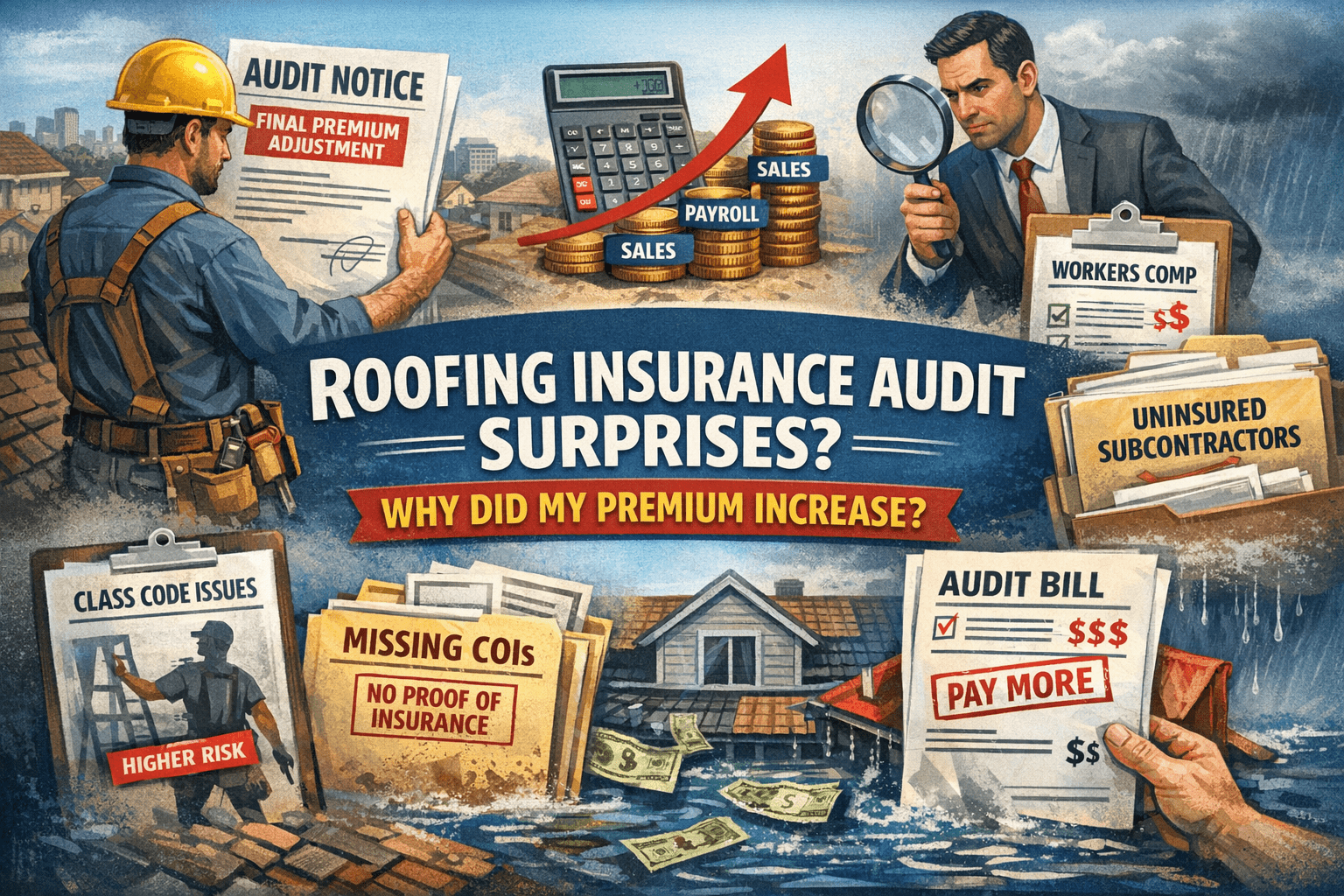
Roofing insurance audits are one of the most frustrating surprises for roofing contractors because they happen after the policy starts. You bind coverage, pay the down payment, get the certificates, start working, and assume the price is settled.
Then the audit bill shows up.
The reason is simple. Many roofing insurance policies are priced on estimates at the beginning of the policy. After the policy term ends, the carrier audits the actual numbers and recalculates the final premium.
Important point: the number you see when the policy starts may not be the final premium. For many roofers, it is a deposit premium based on estimated payroll, estimated sales, estimated subcontractor costs, and estimated job duties.
Got a roofing audit bill that does not look right?
Before you just pay it, review the audit worksheets, payroll totals, subcontractor charges, class codes, and COIs. A clean review can help you understand whether the bill makes sense and how to prevent the same problem next year.
Why Roofers Get Blindsided by Audits
Most roofing contractors think the policy price is locked once they sign the paperwork. That is understandable, but it is often wrong for workers compensation insurance and sometimes wrong for general liability insurance.
Roofing insurance is rated on exposure. Exposure changes during the year.
- You hire another crew.
- You use more overtime than expected.
- You pay more labor-only subcontractors.
- Your sales grow faster than expected.
- An estimator starts climbing ladders or visiting jobsites.
- You cannot prove a subcontractor had workers compensation.
Each of those changes can affect the audit.
Step 1: What an Insurance Audit Means for Roofers
An insurance audit is the carrier verifying what actually happened during the policy year.
For roofing companies, audits usually hit two places: workers compensation and general liability.
Workers Compensation Audit
Usually driven by payroll, employee duties, class codes, owner payroll, overtime, and subcontractor workers compensation proof.
General Liability Audit
Often driven by gross sales, receipts, payroll, subcontractor costs, or another exposure basis listed in the policy.
Step 2: Workers Compensation Audits for Roofing Companies
A roofing workers compensation audit is usually payroll driven. The carrier checks how much payroll you actually paid and what type of work each person performed.
The auditor may review:
- Total payroll paid during the policy term.
- Which workers performed roofing labor.
- Which workers were truly clerical.
- Whether estimators, supervisors, or salespeople visited jobsites.
- Overtime records and how the premium portion was handled.
- Owner payroll and officer inclusion or exclusion.
- Subcontractors and whether they had their own workers compensation.
North Carolina has its own workers compensation rules. The North Carolina Industrial Commission employer guidance says the North Carolina Workers’ Compensation Act generally requires businesses with three or more employees to obtain workers compensation insurance or qualify as self-insured.
Contract requirements can be stricter than the legal threshold. A roofing contractor may need workers compensation because a builder, project owner, or general contractor requires it, even if the law would not otherwise force the issue.
Why Workers Compensation Audits Feel Personal
Workers compensation audits feel personal because they follow the reality of how you staffed the company during the year.
- If payroll went up, premium may go up.
- If helpers moved into roofing labor, premium may go up.
- If office employees helped in the field, premium may go up.
- If uninsured subcontractors were used, premium may go up.
That is why roofing insurance audits are not just accounting events. They are a reflection of how the business actually operated.
Step 3: General Liability Audits for Roofing Companies
General liability can audit too. Many roofers think general liability is a fixed flat price. Sometimes it is. Often, it is not.
Depending on the policy, roofing general liability premium may be based on:
- Gross sales or receipts.
- Payroll.
- Subcontractor costs.
- Project type.
- Residential vs. commercial mix.
- Type of roofing work performed.
If your general liability policy was priced on $900,000 in estimated sales, but you finished the year at $1,400,000 in sales, the audit may true up the difference.
This is why your roofing insurance program should be built around realistic numbers at the beginning of the year, not guesses that look good on a quote.
Step 4: The Simple Math Behind Roofing Insurance Audits
You do not need to love insurance math. You just need to know which levers move the bill.
Workers Compensation Premium Math
Workers compensation premium is commonly driven by payroll, rate, classification, experience modification, and carrier adjustments.
- Higher payroll usually means higher premium.
- Higher-rated roofing class codes usually mean higher premium.
- A worse experience mod can increase premium.
- Bad class code splits or missing documentation can increase premium.
General Liability Premium Math
General liability premium may be driven by sales, payroll, subcontractor cost, or another exposure basis.
Same idea: estimates first, true-up later.
Example: a roofer estimates $500,000 in payroll and $1,000,000 in sales. The company has a strong year and finishes with $725,000 in payroll and $1,450,000 in sales. Even if nothing went wrong, the audit may create additional premium because the actual exposure was higher than the estimate.
Step 5: Roofing Class Codes and Why Job Duties Matter
Roofing class codes can create major audit swings because roofing field work is high hazard. If someone is truly clerical, that may be rated differently than roofing labor. But the separation has to be real and provable.
Roofers often ask: “My office person is not on the roof. Why are they being charged roofing rates?”
The answer usually comes down to job duties and proof.
The Three Buckets That Matter Most
- Roofing labor: field work, tear-off, install, repair, measuring, supervision, material handling, and jobsite activity.
- Clerical: office-only work with no jobsite exposure, no material handling, and no field duties.
- Almost clerical: the audit trap where someone has an office title but still performs field-related work.
“Almost clerical” is where roofing insurance audits can explode.
Common Class Code Audit Traps
- A project manager who visits jobsites.
- A salesperson who climbs ladders to measure roofs.
- A dispatcher who also delivers materials.
- An estimator who supervises tear-offs.
- A warehouse worker who loads materials and helps crews when the company is short staffed.
If the employee steps into field duties, many carriers may classify that payroll into the governing roofing code unless you can prove a clean separation.
Step 6: The Subcontractor COI Trap That Creates Audit Bills
This is the biggest roofing insurance audit surprise for many contractors.
The roofer believes: “I used subcontractors, not employees, so workers compensation should not care.”
The carrier may see it differently. If you cannot prove a subcontractor had their own workers compensation coverage, the auditor may treat that labor as part of your exposure for premium purposes.
That is why collecting certificates is not optional. It is audit protection.
What to Keep for Every Roofing Subcontractor
- Certificate of insurance showing workers compensation in force.
- Certificate of insurance showing general liability in force.
- Policy number and effective dates.
- Subcontract agreement.
- Invoices that clearly split labor and materials.
- Dates the subcontractor worked for you.
- Proof the COI was current during the dates they worked.
Audit warning: a certificate of insurance is proof that a policy existed when the certificate was issued. It does not guarantee coverage, does not prove the policy stayed active all year, and does not replace good subcontractor documentation.
For a deeper breakdown of that issue, read Certificate of Insurance for Roofers: Why a COI Does Not Guarantee Coverage.
Step 7: Real Roofing Audit Scenarios
Roofing insurance audits feel sudden because the bill arrives after the work already happened. These are the situations that create the most frustration.
Scenario 1: You Scaled Faster Than Your Estimates
You started workers compensation with $400,000 in estimated payroll. You finished the year at $650,000 in payroll. The audit applies the rate to the real payroll.
Scenario 2: One Employee Was Misclassified
You listed an estimator as clerical. The auditor finds the estimator climbs ladders, measures roofs, supervises tear-offs, and trains crew leads. That payroll may move into roofing.
Scenario 3: You Used Labor Subs Without Tracking COIs
You paid $300,000 to labor-only subs. You can only prove proper coverage for $120,000 of that amount. The remaining labor may be charged as exposure.
Scenario 4: Your General Liability Audit Picked Up More Revenue
You estimated $900,000 in gross sales. You finished at $1,400,000. Your general liability audit may adjust the premium to reflect the higher sales.
Scenario 5: Your Job Mix Changed During the Year
You started the year doing mostly repair work, then took on larger tear-off jobs, steeper roofs, or more subcontracted labor. That may change how the carrier views the risk.
Scenario 6: Open Roof Claims Tightened Underwriting
This is not always audit math. Sometimes open roof exposure, water intrusion losses, or poor safeguards cause the carrier to tighten underwriting at renewal. That can feel like an audit problem, but it may really be an underwriting problem.
Scenario 7: Payroll Was Split Without Proof
You tried to split one employee between office and field duties. Without time records, job descriptions, and proof of separation, the auditor may put all payroll into the higher-rated classification.
Roofing Insurance Audit Checklist
Use this roofing insurance audit checklist before the auditor calls. The cleaner your file is, the easier it is to defend your numbers.
Payroll File
Keep quarterly payroll reports, year-end payroll summaries, overtime records, owner payroll details, employee job descriptions, and notes on who worked in the field vs. office only.
Class Code Separation Proof
Keep written job descriptions, office-only proof for clerical staff, time records when duties are split, and documentation for estimators, project managers, supervisors, and sales staff.
Subcontractor Audit Folder
Keep workers compensation COIs, general liability COIs, subcontract agreements, invoices showing labor and materials separately, dates worked, and proof the COI was valid during those work dates.
General Liability Audit File
Keep year-end revenue reports, subcontractor cost reports, residential vs. commercial job mix, repair vs. replacement job mix, steep slope vs. low slope notes, and tear-off volume details.
What to Do If You Already Got a Surprise Audit Bill
Do not ignore it. Audit bills can turn into collections problems, cancellation problems, or renewal problems if they are mishandled.
Instead, slow down and review the details.
- Request the audit worksheets.
- Review the classifications used.
- Compare payroll totals against your records.
- Check the subcontractor list and match COIs by date.
- Challenge missing COIs by producing actual proof.
- Review labor and materials splits.
- Ask whether the audit applied the correct exposure basis.
- Fix the process for next year so the same bill does not repeat.
For workers compensation specifically, also review how claims, payroll, and classifications may affect your experience mod. This connects closely with Workers Comp for Roofers: How One Claim Can Change Your Business.
How to Prevent the Next Roofing Audit Surprise
The best time to prevent a surprise audit bill is when the policy starts.
1. Estimate Honestly at the Beginning
Do not lowball payroll or sales just to make the quote look better. If the business is growing, price the policy around realistic growth.
2. Update the Policy During the Year
If you add crews, take on a major project, or dramatically increase subcontractor use, ask whether the policy estimates should be updated before audit.
3. Build the Audit File Weekly
Do not wait until the auditor asks. Save COIs, contracts, invoices, payroll reports, and class code notes as the year goes.
4. Keep Field and Office Duties Clean
If an employee is truly clerical, keep them clerical. If they visit jobsites, climb ladders, deliver materials, or supervise field work, assume the audit may care.
5. Require COIs Before Subs Start Work
Do not collect subcontractor certificates after the fact. Get them before the job starts and make sure the dates match the work period.
6. Separate Labor and Materials on Invoices
If subcontractor invoices do not separate labor and materials, the auditor may have less reason to give you credit for materials.
7. Review the Audit Before You Pay It
An audit bill is not always wrong, but it should be reviewed. Check the assumptions, classifications, totals, and subcontractor credits before you pay.
Make next year’s audit easier
If your audit bill was a surprise, the fix is not just shopping the next policy. It is cleaning up estimates, payroll, class codes, subcontractor COIs, and documentation before the next audit starts.
Related Roofing Insurance Resources
- Roofing insurance coverage and requirements
- Workers compensation insurance
- General liability insurance
- Commercial auto insurance
- Commercial umbrella insurance
- Inland marine insurance
- Certificate of Insurance for Roofers
- Roofing Insurance Non-Renewal
Frequently Asked Questions About Roofing Insurance Audits
What are roofing insurance audits?
Roofing insurance audits are carrier reviews that compare the estimated numbers used to start the policy against what actually happened during the policy term. The auditor may review payroll, job duties, class codes, sales, subcontractor costs, and certificates of insurance.
Why did my roofing insurance premium increase after the policy started?
Your premium may increase after the policy starts because the original price was based on estimates. If actual payroll, sales, subcontractor costs, or higher-rated job duties are greater than estimated, the audit can create an additional premium bill.
What is a roofing workers compensation audit?
A roofing workers compensation audit is a review of payroll, employee duties, owner payroll, overtime, class codes, and subcontractor documentation. The carrier uses the audit to calculate final workers compensation premium based on actual exposure.
Can general liability insurance be audited for roofing companies?
Yes. Roofing general liability insurance can be audited when premium is based on sales, payroll, subcontractor costs, or another exposure basis. If actual sales or subcontractor costs are higher than estimated, the final premium can increase.
Why do uninsured subcontractors create roofing audit bills?
Uninsured subcontractors can create audit bills because the carrier may charge their labor as part of the roofing company’s exposure if the contractor cannot prove the subcontractor had proper workers compensation or general liability coverage during the time they worked.
How can roofers avoid surprise insurance audit bills?
Roofers can reduce audit surprises by estimating payroll and sales accurately, updating the policy during the year, separating office and field duties, collecting subcontractor certificates before work starts, keeping contracts and invoices, and building an audit file from day one.
What documents should roofers keep for an insurance audit?
Roofers should keep payroll reports, overtime records, owner payroll details, job descriptions, subcontractor certificates of insurance, subcontract agreements, invoices showing labor and materials, dates worked, revenue reports, and notes about project mix.

Stephen Ellias is the founder of Carolina Risk Partners in Wake Forest, North Carolina. He helps contractors and business owners review general liability, workers compensation, commercial auto, audit issues, subcontractor COIs, and insurance requirements before they become expensive problems.
Want help avoiding the next roofing audit surprise?
Carolina Risk Partners helps roofing contractors review audit bills, payroll estimates, class codes, subcontractor COIs, and policy setup so premium surprises do not keep repeating year after year.
Start My Roofing Insurance ReviewEducational resource only. This article is not legal, tax, accounting, audit, claim, or insurance advice. Final premium depends on the actual policy language, rating basis, payroll, classifications, subcontractor documentation, carrier audit rules, endorsements, state law, and facts of the account. Speak with a licensed professional about your specific situation.