
Certificate of Insurance for Roofers: Why a COI Does Not Guarantee Coverage
A certificate of insurance for roofers can prove a policy exists. It does not prove the claim will be covered, add additional insured status, or reveal the exclusions that matter when something goes wrong.
Key Takeaways
- A certificate of insurance proves a policy existed when the certificate was issued. It does not guarantee claim payment.
- Certificate holder status is not the same thing as additional insured status.
- Roofing claims often turn on endorsements, exclusions, completed operations wording, and the type of policy involved.
- Open roof water damage, hot work, height limits, employee injuries, vehicle accidents, and tool theft may involve coverage details that never appear on a COI.
- Roofing contractors should verify actual policy endorsements and exclusions before relying on a certificate.
Quick Answer
A certificate of insurance for roofers is proof that an insurance policy existed at the time the certificate was issued. It is not a guarantee that a claim will be covered. It does not change the policy, remove exclusions, or automatically make a contractor, owner, property manager, or general contractor an additional insured.
Bottom line: the COI is the starting point. The real coverage answer comes from the policy, endorsements, exclusions, contract wording, and facts of the loss.
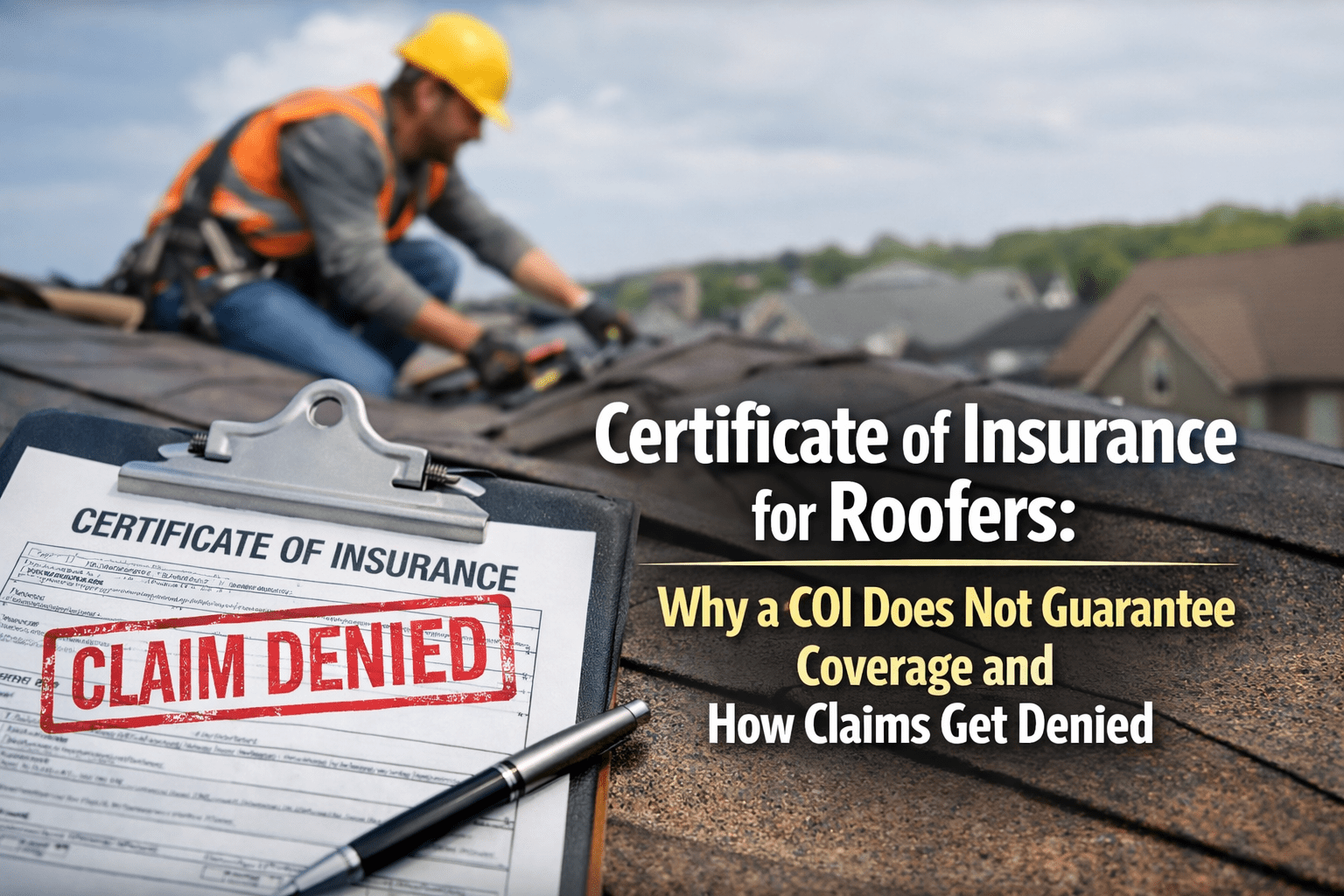
Roofers get asked for certificates of insurance all the time. General contractors request them before a subcontractor starts work. Property managers ask for them before site access. Homeowners may want proof of coverage before signing a roof replacement agreement.
The problem is simple. A certificate of insurance is often treated like a shield, but it is closer to a receipt. It may show that a policy exists. It does not show every condition that decides whether a roofing claim is actually covered.
Direct point: A COI does not rewrite the policy. It does not remove exclusions. It does not add missing endorsements. It does not turn the certificate holder into an additional insured by itself.
Why Roofing COIs Create False Security
Most roofing contractors send a certificate because someone asked for proof of insurance. The other party sees carrier names, policy numbers, effective dates, and limits. Everyone feels like the job is protected.
Then a claim happens.
- A worker falls during tear off.
- Rain enters the building while the roof is open.
- A bundle of shingles slides off the roof and damages a vehicle.
- A leak appears months after installation.
- A general contractor gets sued and expects protection under the roofer’s policy.
That is when the real question shows up: why is the claim being disputed or denied if the roofer provided a COI?
Need a certificate or contract requirement checked?
Send the COI request, contract insurance section, or current policy concern. Carolina Risk Partners can help you review the requirement before it turns into a coverage problem.
What a Certificate of Insurance Actually Does
A certificate of insurance is a summary document. It gives basic information about the policies listed on the certificate. It usually shows the insured name, policy period, carrier, policy number, and limits.
That is useful, but it is not the same thing as policy language.
Standard certificate wording usually says the certificate is issued for information only, does not give rights to the certificate holder, and does not amend, extend, or alter coverage. In simple terms, the certificate does not create coverage that the policy itself does not provide.
What this means for roofers: If the actual policy excludes certain hot work, limits water damage from open roof conditions, restricts work above certain heights, or lacks a required additional insured endorsement, the COI does not fix that problem.
Certificate Holder vs. Additional Insured
This is one of the most common COI traps in roofing insurance.
Certificate Holder
The certificate holder is the person or organization receiving the certificate. Being listed as certificate holder may help document that a certificate was issued. Depending on policy language and carrier process, the certificate holder may also be connected to cancellation notice handling. But certificate holder status alone does not give liability protection under the policy.
Additional Insured
An additional insured is a person or organization that may receive liability protection under your policy when a proper endorsement grants that status. The endorsement language matters. The edition date matters. The type of work and timing of the claim matter.
Important distinction: Listing a general contractor, owner, or property manager on the COI does not automatically make that party an additional insured. Additional insured status requires an actual endorsement.
A Roofing Claim Scenario That Exposes the Gap
A roofing subcontractor works on a commercial building. The general contractor requires proof of insurance before the job starts. The roofer sends a COI listing the general contractor as certificate holder.
During tear off, falling debris injures a pedestrian. The injured party sues both the roofer and the general contractor. The general contractor expects the roofer’s policy to defend them because they were listed on the certificate.
The carrier reviews the file and finds:
- The general contractor is listed as certificate holder.
- The policy does not include the needed additional insured endorsement.
- The COI did not create additional insured status by itself.
Result: the general contractor may have no protection under the roofer’s policy and may need to rely on its own coverage.
Ongoing Operations vs. Completed Operations
Even when a roofer has an additional insured endorsement, the timing of the claim matters. Roofing claims can happen while the job is in progress or after the work is complete.
Ongoing Operations
These are claims connected to work being performed during the job. Examples include falling debris, ladder damage, water intrusion during tear off, and third party injuries at the job site.
Completed Operations
These are claims connected to finished work. Examples include leaks discovered months later, failed flashing, mold growth from water intrusion, or damage caused by alleged installation problems.
Many construction contracts require additional insured coverage for both ongoing operations and completed operations. The COI may not clearly prove that both are included. You need to verify the endorsement forms and wording.
Why Completed Operations Matters So Much for Roofers
Roofing problems often appear after the job is finished. A roof may look fine when the crew leaves. The issue may not show up until the next heavy rain, wind event, or seasonal change.
That creates a major insurance problem when the contract required completed operations coverage but the roofer only has an endorsement that applies to ongoing operations.
Example: A roofer completes a commercial re-roof in July. Six months later, water enters the building and damages inventory, flooring, and equipment. If the additional insured endorsement only applies to ongoing operations, the building owner may not have the protection they expected under the roofer’s policy.
Open Roof Water Damage Is the Roofing Exposure COIs Do Not Show
Roofers face a unique risk. During normal operations, you may remove the building’s waterproof barrier. That means weather planning, tarping, sequencing, and protective safeguards can become claim issues.
A COI may show a $1,000,000 general liability limit. But it will not show every water damage limitation, protective safeguards requirement, or open roof exclusion that could affect the claim.
Questions Roofers Should Ask Their Agent
- Does the policy contain any open roof water damage limitation?
- Are there protective safeguards requirements for tarping, weather monitoring, or overnight protection?
- Are there exclusions tied to failure to protect property?
- Does coverage change based on how long the roof is open?
- Are there restrictions for certain roofing materials, torch down work, or hot work?
When the Claim Is Not a General Liability Claim
Another reason roofers get surprised is that they use the phrase insurance too broadly. Different losses require different policies. A general liability certificate does not mean every loss is a general liability claim.
- Employee injury: usually a workers compensation insurance issue, not general liability.
- Owned truck accident: usually a commercial auto insurance issue, not general liability.
- Tool or equipment theft: usually an inland marine insurance or tools and equipment issue.
- Damage to the work itself: may involve builder’s risk, installation coverage, or policy-specific exclusions.
- Design or specification error: may require professional liability, depending on the work performed.
This is why COI-only thinking creates blind spots. The certificate may exist, but the loss may belong under a different policy.
How to Review a Roofing COI Request
Confirm the named insured
The named insured should match the roofing entity doing the work. If the wrong LLC, trade name, or related entity is shown, fix that before the job starts.
Check the project dates
Make sure the policy period covers the work period. If the project extends beyond the policy expiration date, plan for renewal certificates.
Verify additional insured status
Do not rely only on the certificate note. Ask whether the actual additional insured endorsement is attached or confirmed.
Confirm completed operations
If the contract requires completed operations, make sure the endorsement includes it. Many roofing claims show up after the job is done.
Review roofing exclusions and limitations
Ask about hot work exclusions, height restrictions, open roof limitations, residential restrictions, subcontractor conditions, and protective safeguard requirements.
What Roofing Contractors Should Verify Instead of Only Relying on COIs
A better process is to treat the certificate as the starting point, not the finish line.
1. Verify the Actual Additional Insured Endorsement
Do not rely only on a certificate notation. Ask for the endorsement form number, edition date, and confirmation that it matches the contract requirement.
2. Confirm Ongoing and Completed Operations
If the contract requires both ongoing and completed operations, make sure both are addressed by the policy endorsement.
3. Review Roofing Exclusions and Limitations
Ask specifically about hot work exclusions, height restrictions, open roof water damage limitations, residential exclusions, subcontractor restrictions, and coverage territory.
4. Match Limits to the Contract
Some contracts require higher limits than the base policy provides. A roofer may need a commercial umbrella insurance policy or excess liability policy to meet the requirement.
5. Separate Contract Compliance From Real Coverage
A certificate may help satisfy a paperwork requirement. That does not automatically mean the insurance program is strong enough for the actual work being performed.
Why This Matters for North Carolina Roofing Contractors
North Carolina roofers often work for general contractors, property managers, builders, commercial owners, and homeowners who ask for proof of insurance before the work starts. That request is normal. The dangerous part is assuming the certificate tells the whole coverage story.
For roofing contractors, the expensive questions usually appear after the job starts:
- Was the right entity named as additional insured?
- Was completed operations included?
- Did the policy exclude part of the roofing work?
- Were subcontractors properly insured?
- Did the claim involve general liability, workers compensation, commercial auto, inland marine, or builder’s risk?
The best time to answer those questions is before the job, not after a denial letter.
Roofing COI Review Checklist
- Named insured matches the actual roofing entity doing the work.
- Policy dates cover the project period.
- General liability limits match the contract.
- Umbrella or excess limits are included when required.
- Additional insured endorsement is attached or confirmed in writing.
- Completed operations is included if the contract requires it.
- Waiver of subrogation is confirmed if required.
- Primary and noncontributory wording is confirmed if required.
- Roofing exclusions, height limits, hot work exclusions, and open roof limitations are reviewed.
- Workers compensation, commercial auto, and inland marine are reviewed separately.
Frequently Asked Questions About Certificates of Insurance for Roofers
Is a certificate of insurance proof of coverage for roofing contractors?
A certificate of insurance proves that a policy existed when the certificate was issued. It does not guarantee that coverage applies to a specific roofing claim. Coverage depends on the actual policy terms, exclusions, endorsements, and facts of the loss.
Does listing someone on a COI make them additional insured?
No. Listing someone as certificate holder does not make them additional insured. Additional insured status requires an actual policy endorsement. Without the endorsement, the certificate holder may have no liability protection under the roofer’s policy.
What is the difference between certificate holder and additional insured?
A certificate holder is the person or organization receiving proof that insurance exists. An additional insured is a party that may receive liability protection under the policy when a proper endorsement grants that status.
What endorsements matter most for roofers working as subcontractors?
Roofers working as subcontractors often need additional insured endorsements for ongoing operations and completed operations. Ongoing operations can apply while work is being performed. Completed operations can apply after the job is finished, depending on the endorsement and policy language.
Why do roofing insurance claims get denied even when the roofer has a COI?
Claims may be denied because the needed endorsement is missing, the wrong coverage type applies, the policy contains exclusions, limits are not high enough, or the loss falls outside the policy terms. A COI does not show every condition that controls claim payment.
Does general liability insurance cover water damage from an open roof?
It depends on the policy language, exclusions, endorsements, protective safeguards, and facts of the claim. Roofers should ask their agent to confirm whether open roof water damage limitations, weather monitoring requirements, or tarping requirements apply.

Stephen Ellias is the founder of Carolina Risk Partners in Wake Forest, North Carolina. He helps contractors and business owners understand general liability, workers compensation, commercial auto, bonds, certificates, and policy requirements before they become expensive problems.
Want a second look before the next certificate goes out?
Carolina Risk Partners helps roofing contractors review certificate requests, contract insurance requirements, endorsements, exclusions, and coverage gaps before a claim exposes the problem.
Review My COI RequestEducational resource only. This article is not legal, insurance, or claim advice. Coverage depends on the actual policy language, endorsements, exclusions, facts of the claim, carrier interpretation, and applicable law. Speak with a licensed professional about your specific situation.