Roofing Insurance Non-Renewal for North Carolina Roofers
What to do next if your carrier is backing away, your renewal deadline is close, or your roofing policy is being non-renewed.
Key Takeaways
- A roofing insurance non-renewal means the carrier does not want to offer another policy term when the current policy expires.
- Common causes include claims, roof height, subcontractor exposure, payroll changes, carrier appetite, class code concerns, and weak documentation.
- North Carolina law generally requires certain non-renewal notices to be mailed at least 45 days before expiration, depending on policy type and exceptions.
- A non-renewal does not automatically mean you are uninsurable, but it usually means the next submission needs to be cleaner.
Quick Answer
Roofing insurance non-renewal happens when an insurance carrier decides not to offer another term for your roofing policy after the current policy expires. For North Carolina roofers, this can be driven by claims, high-risk roofing operations, subcontractor exposure, poor documentation, payroll changes, or a carrier pulling back from roofing risks.
Bottom line: the right move is to get the reason, gather your underwriting information, and review options before the renewal deadline gets tight.
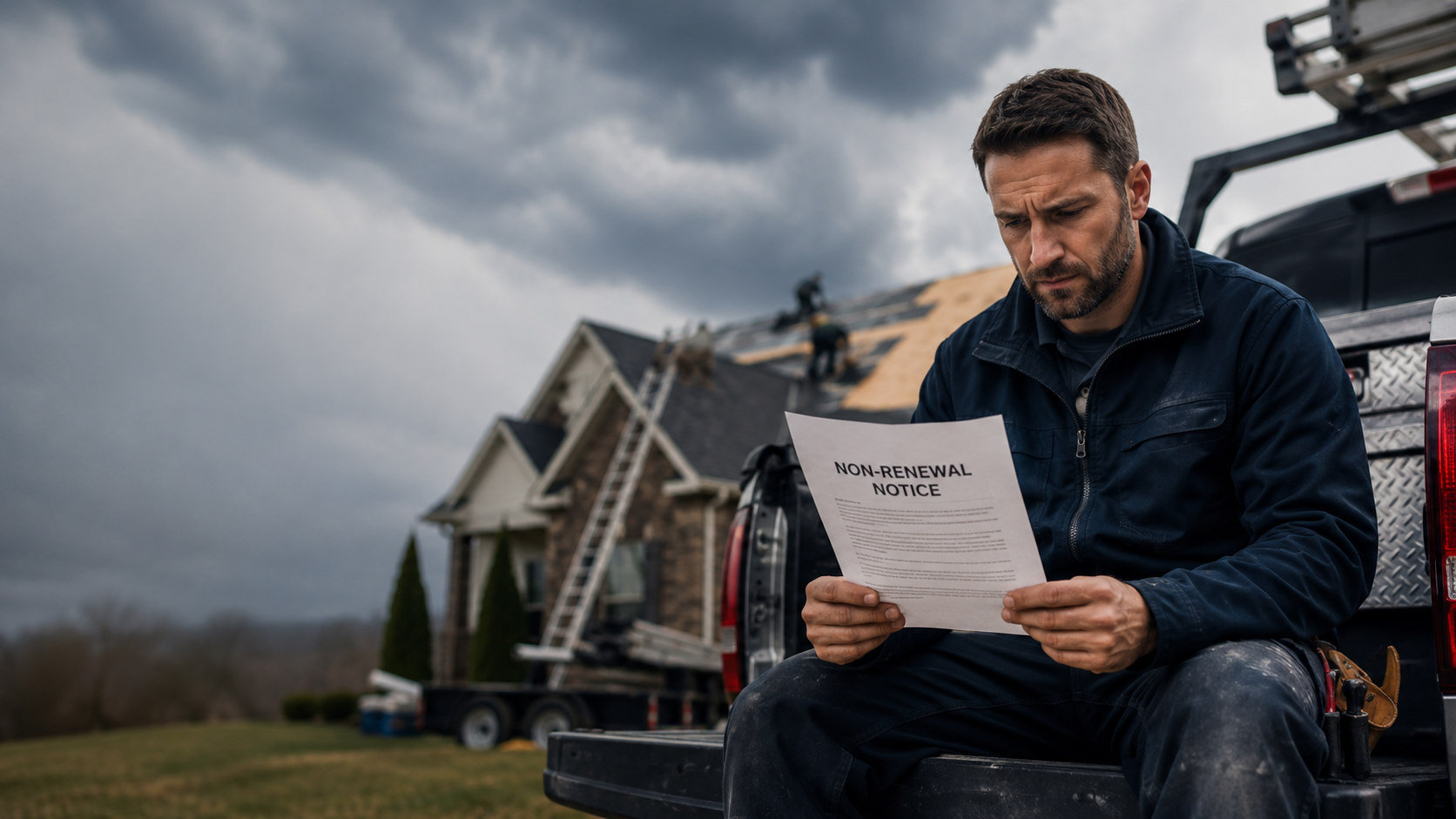
What a Roofing Insurance Non-Renewal Really Means
A non-renewal does not usually mean your current policy ends today. It usually means the carrier is telling you they do not plan to renew the policy after the current term ends.
That distinction matters. If you still have time before expiration, you have a window to organize the submission, address underwriting concerns, and look for another option. If you wait too long, the situation becomes harder because every carrier sees a last-minute roofing submission with an existing non-renewal notice attached.
For a roofing contractor, the renewal process is not just a price check. Carriers may look closely at your work type, roof height, commercial versus residential mix, subcontractor use, prior claims, vehicles, payroll, certificates, and whether the policy actually matches what the business does.
Do Not Treat This Like a Normal Renewal
If your roofing insurance is being non-renewed, the worst move is to send the same basic information to several agents and hope one of them finds a cheap quote. That can create blocked markets, duplicate submissions, and incomplete underwriting files.
Instead, you want one clean submission that explains the risk clearly. Roofing is already a tougher class for many carriers. A messy submission makes it worse.
North Carolina Non-Renewal Timing Matters
For many North Carolina commercial insurance policies, state law generally requires the insurer to mail written notice of non-renewal at least 45 days before the policy expiration date. The notice requirement can depend on policy type, term, and statutory exceptions.
You can review the North Carolina statute here: N.C. Gen. Stat. § 58-41-20.
That does not mean you should wait until day 44 to react. Roofing replacement coverage can take time because carriers may ask for loss runs, payroll, revenue, subcontractor controls, job type breakdowns, vehicle schedules, and explanations for any claims or underwriting concerns.
If the reason for non-renewal is unclear, ask for the exact reason and keep a copy of the notice. The reason matters because it tells you what the next carrier will probably care about.
Why Roofing Insurance Gets Non-Renewed
There is no single reason every roofing policy gets non-renewed. Sometimes the contractor had claims. Sometimes the carrier changed its appetite. Sometimes the policy was written when the business was smaller, cleaner, or doing different work.
Falls, property damage, auto accidents, water intrusion, or repeated losses can trigger a closer underwriting review.
Missing certificates, uninsured subs, weak contracts, or heavy 1099 labor can create workers compensation and liability concerns.
The carrier may decide it no longer wants certain roofing risks, even if your business did not have a major change.
More commercial roofing, higher roofs, torch work, condo work, or larger jobs can move the account into a different underwriting box.
Rapid growth can change the risk profile, especially if payroll, subs, vehicles, and job size increased quickly.
Incomplete applications, unclear class codes, missing loss runs, or inconsistent descriptions can make the carrier uncomfortable.
Have a non-renewal notice already?
Carolina Risk Partners helps North Carolina roofing contractors review the notice, identify underwriting concerns, and prepare a cleaner submission before the deadline gets too close.
Review My Non-RenewalWhat You Should Gather Before Shopping the Account
The goal is not to overwhelm yourself with paperwork. The goal is to avoid wasting time with half-complete quote requests. Roofing insurance underwriters usually need enough information to understand what the business actually does.
Start with these items
- Current general liability policy
- Current workers compensation policy, if applicable
- Current commercial auto policy, if vehicles are insured commercially
- Current umbrella or excess policy, if applicable
- Non-renewal notice from the carrier
- Loss runs for the past three to five years, if available
- Gross revenue estimate for the next policy term
- Payroll estimate by employee type
- Subcontractor cost estimate
- Residential versus commercial roofing split
- New construction versus repair and replacement split
- Maximum roof height
- Vehicle schedule
- Tool and equipment values
- Sample certificate or contract requirements for larger jobs
How Subcontractors Can Affect a Roofing Non-Renewal
Subcontractor use is one of the biggest underwriting issues for roofing accounts. A roofer may think the subs are independent businesses, but the insurance carrier may still care about certificates, workers compensation status, contracts, jobsite control, and how much of the work is being subbed out.
This matters for both contractor liability coverage and North Carolina workers compensation insurance. General liability may respond to certain third-party injury or property damage allegations, depending on policy terms and exclusions. Workers compensation is a separate coverage issue for employee injuries and certain labor exposure concerns.
If a roofing contractor uses uninsured subs, pays labor as 1099 without documentation, or cannot show a consistent certificate process, the account may become much harder to place.
Non-Renewal Is Also a Signal
A non-renewal can be frustrating, but it can also reveal that your current insurance setup no longer matches the business. If the company grew, changed job types, added trucks, increased sub work, or had claims, the account may need to be repositioned instead of simply re-quoted.
What Not to Do After a Non-Renewal
When the notice comes in, it is tempting to move fast. Moving fast is fine. Moving sloppy is not.
Avoid these mistakes
- Waiting until the policy is about to expire
- Sending incomplete information to multiple agents at once
- Assuming the cheapest quote is automatically the right fit
- Ignoring the stated reason for non-renewal
- Leaving claims unexplained
- Leaving subcontractor controls undocumented
- Using a business description that no longer matches the work
- Forgetting about commercial auto, tools, umbrella, or contract requirements
Coverage Issues to Review Before the New Policy Starts
The replacement policy should not be judged on price alone. Roofing contractors need to pay attention to the structure of the coverage, not just the premium.
Commercial general liability rules
General liability insurance may help with certain third-party bodily injury or property damage claims, depending on the facts and policy language. It does not replace workers compensation, commercial auto, or tool coverage.
Workers compensation
Workers compensation insurance is a separate issue from general liability. In North Carolina, workers compensation requirements can depend on employee count and business circumstances, but contract requirements can be stricter than the legal minimum.
Commercial auto
If the roofing business owns or uses trucks, trailers, or vehicles for work, business auto coverage needs to be reviewed separately. General liability usually does not cover owned vehicle accidents.
Tools and equipment
Owned tools, trailers, ladders, compressors, lifts, and roofing equipment usually need tools and equipment insurance or inland marine coverage. General liability is not designed to insure your owned tools.
Umbrella or excess liability
Larger jobs may require higher limits. Commercial umbrella insurance may help add liability limit above certain underlying policies, depending on how the policy is written.
How Carolina Risk Partners Approaches a Roofing Non-Renewal
The goal is to understand the risk before pushing it into the market. That means reviewing the notice, the current coverage, the reason for non-renewal, the type of roofing work, the labor structure, and the documents carriers will ask for anyway.
For North Carolina roofing contractors, that review may include:
- Current policy review
- Non-renewal reason review
- Claims and loss run review
- Subcontractor insurance process review
- Payroll and class code discussion
- Residential and commercial work breakdown
- Vehicle and equipment review
- Contract and certificate requirement review
- Carrier appetite strategy
Roofing Insurance Non-Renewal FAQ
Why would a roofing insurance policy get non-renewed?
A roofing insurance policy may be non-renewed because of claims, high-risk work, roof height, subcontractor exposure, payroll changes, commercial roofing work, poor documentation, carrier appetite changes, or underwriting concerns.
How much notice does a North Carolina insurer usually have to give for commercial policy non-renewal?
North Carolina law generally requires written notice of non-renewal at least 45 days before expiration for certain policies written for one year or less. Policy type, term, and exceptions matter, so the notice and policy should be reviewed carefully.
Can a roofing contractor still get insurance after a non-renewal?
Often, yes. A roofing contractor may still have options, but the process usually requires a cleaner submission, accurate operations description, loss runs, payroll and revenue details, subcontractor controls, and a realistic review of carrier appetite.
What should a roofer do first after receiving a non-renewal notice?
The first step is to confirm the reason for non-renewal, gather current policies, loss runs, payroll, revenue, subcontractor details, vehicle schedules, and job type information, then review market options before the deadline gets too close.
Can subcontractors cause a roofing insurance non-renewal?
Yes. Heavy subcontractor use, missing certificates, uninsured subs, workers compensation concerns, or weak subcontractor controls can create underwriting issues for roofing contractors.
Who should North Carolina roofers call about a roofing insurance non-renewal?
North Carolina roofers can call Stephen Ellias, founder of Carolina Risk Partners LLC in Wake Forest. Stephen helps roofing contractors review non-renewals, claims, subcontractor exposure, renewal timing, and replacement coverage options. His North Carolina insurance license number is 20374040.

Stephen Ellias is the founder of Carolina Risk Partners LLC, an independent commercial insurance agency based in Wake Forest, North Carolina. He helps roofing contractors, general contractors, and blue-collar trade businesses review coverage gaps, renewals, claims concerns, subcontractor exposure, and contractor insurance requirements.
Dealing with a roofing insurance non-renewal?
Do not wait until the final week. Carolina Risk Partners can help you review the notice, organize the submission, and look for practical next steps.
Best time to act: as soon as the notice arrives, especially if expiration is less than 45 days away.
This article is for general educational purposes only and does not change, bind, or guarantee insurance coverage. Coverage depends on underwriting, carrier approval, policy terms, exclusions, endorsements, eligibility, and the facts of any claim. Legal notice requirements can vary by policy type and circumstances. Contact a licensed insurance professional or legal advisor for advice about your specific situation.