
Roofing Insurance North Carolina: Complete Guide for Roofing Contractors
Roofing insurance is expensive because roofing is one of the highest-risk trades in construction. This guide explains what North Carolina roofing contractors usually need, why carriers price roofing differently, and where coverage gaps show up.
No obligation. No spam. A local North Carolina agent reviews your request.
- Roofing insurance usually needs more than one policy. General liability alone is not enough.
- Workers compensation is often the largest insurance cost for roofing contractors because fall claims can be severe.
- North Carolina roofing workers compensation classification often involves NCRB class code 5551, depending on actual operations.
- General liability may help with third-party injury, property damage, and completed operations claims, but it does not cover everything.
- Commercial auto and inland marine are major gaps for roofing companies with trucks, trailers, tools, ladders, and mobile equipment.
- Contract wording matters. Additional insured, CG 20 10, CG 20 37, waiver of subrogation, and primary and noncontributory requirements should be reviewed before the job starts.
What is roofing insurance?
Roofing insurance North Carolina is not one single policy. A strong roofing insurance program usually starts with general liability, workers compensation, commercial auto, inland marine for tools and equipment, and commercial umbrella insurance for higher liability limits.
Bottom line: roofers need coverage that matches the work, crews, vehicles, tools, subcontractors, certificates, audits, and contracts they deal with every day.
Why Roofing Insurance Is Different
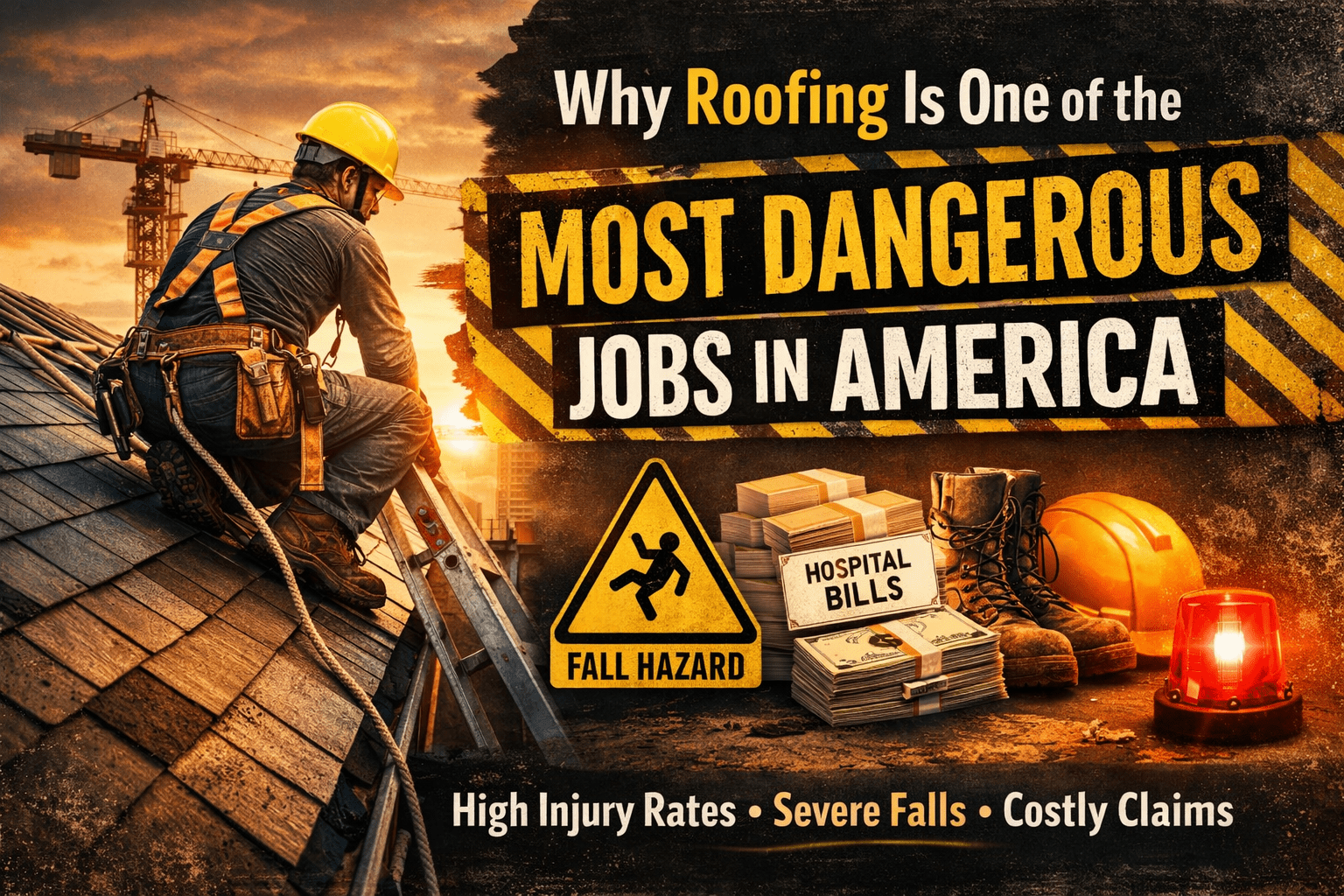
Bottom line: roofing insurance is priced differently because one roofing loss can become severe very quickly.
Roofing is different from many other trades because the risk is built into the work itself. Roofers work at height, handle heavy materials, drive trucks and trailers, deal with weather, and often coordinate crews across multiple jobsites.
That is why a roofing contractor can have a clean year with no claims and still see high insurance pricing. Carriers are not only looking at what happened last year. They are looking at what could happen if a fall, water intrusion claim, auto accident, fire, coastal wind event, or subcontractor injury turns serious.
Roofing insurance is not expensive because carriers dislike roofers. It is expensive because one roofing loss can be financially severe. A fall from elevation, an open-roof water intrusion claim, a trailer accident, or a fire during roofing work can turn into a major claim quickly.
Why Roofing Is Treated as a High-Risk Trade
Bottom line: roofers face height, weather, auto, tool, subcontractor, and completed operations risks at the same time.
Roofing has several risk factors that stack on top of each other. One of those risks by itself may be manageable. Together, they create one of the toughest insurance profiles in construction.
Roofers work from ladders, scaffolds, steep slopes, edges, and roof openings.
Heat, humidity, wind, rain, lightning, and sudden storms can change jobsite risk fast.
Shingles, metal panels, underlayment, tile, tools, and debris are moved at elevation.
A roof problem may not appear until months after the job is finished.
For North Carolina roofing contractors, the local risk profile matters. Raleigh, Wake Forest, Durham, Cary, and Chapel Hill roofers deal with heat, storms, steep residential roofs, and active construction. Coastal roofing work around Wilmington, Morehead City, and the Outer Banks may add wind, named storm, property deductible, and materials exposure issues that inland contractors may not think about as often.
Fall protection also matters because roofing sits directly inside the construction safety conversation. OSHA fall protection standards and jobsite safety practices can affect injuries, claims, inspections, underwriting conversations, and renewal outcomes.
Not sure if your roofing policy matches your actual work?
Carolina Risk Partners helps roofing contractors review general liability, workers compensation, commercial auto, tools, trailers, subcontractors, certificates, audits, contract wording, and renewal issues.
- Good before renewal or audit.
- Useful when contract wording gets complicated.
- Built for roofers who want fewer surprises.
I’ll follow up within 1 business day.
Workers Compensation for Roofing Contractors
Bottom line: workers compensation is often the largest insurance cost for roofing companies because fall claims can be severe.
Workers compensation is often the largest insurance cost for a roofing company. Roofing claims can involve falls, fractures, head injuries, back injuries, shoulder injuries, heat illness, and lost time away from work.
In North Carolina, the workers compensation requirement generally applies when a business has three or more employees. The North Carolina Industrial Commission explains employer coverage requirements. But the legal baseline is only one part of the conversation. Contracts can be stricter than state law.
A general contractor, builder, property manager, or commercial project owner may require workers compensation even if a roofing business believes it is not legally required to carry it. This is especially common when the roofer is working as a subcontractor.
NCRB class code 5551 and roofing workers compensation
North Carolina workers compensation classification is handled through the North Carolina Rate Bureau class code lookup. Roofing work is commonly associated with NCRB class code 5551, depending on the actual operations, payroll, and classification rules.
This matters because the class code helps determine the starting point for workers compensation pricing. If payroll is misclassified, estimated too low, or mixed with uninsured subcontractor labor, the final audit can be very different from the original deposit premium.
Calling a worker a 1099 subcontractor does not automatically remove workers compensation exposure. If the carrier or auditor treats that labor as uninsured subcontractor payroll, the cost can come back at audit.
General Liability Insurance for Roofing Contractors
Bottom line: general liability is important for roofers, but it is not a warranty policy and it does not cover everything.
General liability insurance is usually the policy people think of first when they ask for contractor insurance. For roofers, it can matter a lot, but it is often misunderstood.
General liability is designed for third-party bodily injury and property damage claims. For a roofing contractor, that may include situations like a customer tripping over jobsite materials, a falling tool damaging a vehicle, water intrusion damaging interior finishes, or a completed operations claim after the job is finished.
Common roofing general liability claim examples
- Rain enters the home during a tear-off and damages ceilings, floors, cabinets, or personal property.
- A ladder, tool, or shingle bundle damages siding, windows, gutters, landscaping, or vehicles.
- A homeowner, tenant, neighbor, or visitor is injured near the work area.
- A completed roof later leaks and causes resulting interior damage.
- Hot work, equipment, or materials contribute to a fire loss.
That does not mean every roofing claim is covered. General liability is not a warranty policy. It usually does not simply pay to redo your faulty work. It also does not cover employee injuries, owned tools, owned trucks, intentional acts, professional design mistakes, or every type of pollution exposure.
General liability may respond to certain resulting property damage claims, depending on policy language. It usually does not pay just because the customer is unhappy with workmanship or wants the roof redone.
Additional Insured, CG 20 10, CG 20 37, and Contract Wording
Bottom line: certificate wording and endorsement wording are not the same thing.
Roofing contractors are often asked to provide certificates with specific contract wording. This is where insurance gets technical fast.
Common requirements may include additional insured status, CG 20 10, CG 20 37, waiver of subrogation, primary and noncontributory wording, completed operations coverage, and specific notice or cancellation wording. These terms matter because a certificate of insurance does not automatically prove the policy satisfies every contract requirement.
CG 20 10 and CG 20 37 are commonly referenced additional insured endorsements. In simple terms, one is often tied to ongoing operations and the other is often tied to completed operations, depending on edition dates and policy language. If a builder or general contractor requires both, the roofer should not assume a basic certificate automatically solves it.
If a contract asks for additional insured, CG 20 10, CG 20 37, waiver of subrogation, and primary and noncontributory wording, send the requirement to your insurance agent before signing. It is much easier to fix before the job starts than after a certificate is rejected or a claim happens.
Commercial Auto Insurance for Roofing Companies
Bottom line: work trucks, trailers, crew driving, and material runs create a separate risk from the roof work itself.
Roofing companies often have trucks, trailers, dump trailers, material runs, crew vehicles, and jobsite driving every day. That creates a separate risk from the roof work itself.
Commercial auto insurance can cover liability for injuries or property damage caused by covered business vehicles. It may also include physical damage coverage for owned vehicles, depending on how the policy is written.
Roofing auto exposure can be serious because vehicles are often loaded with tools, materials, ladders, and trailers. Extra weight affects stopping distance. Crews may drive early, late, tired, or between multiple jobsites. A serious accident can quickly exceed low auto liability limits.
Do roofers need hired and non-owned auto?
If employees use personal vehicles for company errands, material pickup, estimates, or jobsite travel, hired and non-owned auto coverage should be reviewed. Personal auto policies may not respond the way the business owner expects when the vehicle is being used for business purposes.
Tools, Trailers, and Equipment Coverage
Bottom line: general liability does not cover theft of your own tools, trailers, or equipment.
Roofing contractors rely on mobile property. Nail guns, compressors, generators, ladders, scaffolding, safety equipment, trailers, and specialty tools move from job to job.
That is why inland marine insurance is so important. General liability usually does not cover theft of your own tools or equipment. Commercial property may be limited to property at a fixed location. Roofing tools need coverage that follows them.
What inland marine may cover for roofers
- Hand tools and power tools
- Ladders and scaffolding
- Compressors, generators, and equipment
- Trailers and mobile equipment when properly scheduled
- Materials in transit or temporarily stored, depending on policy terms
Documentation matters. A roofer with photos, serial numbers, receipts, equipment schedules, and updated values is in a much better position after a theft than a roofer trying to recreate everything from memory.
Subcontractor Insurance Issues for Roofers
Bottom line: subcontractors can help production, but uninsured subcontractors can create audit, contract, and claim problems.
Many roofing companies use subcontractors to handle overflow, specialty work, labor gaps, or large projects. That can help production, but it can also create insurance problems if the subcontractor process is loose.
Before a roofing subcontractor starts work, you should review proof of insurance. That usually includes general liability, workers compensation, additional insured wording when required, waiver of subrogation when required, and policy dates that are still active.
Why certificates alone are not enough
A certificate of insurance is evidence of insurance at a point in time. It is not the policy. It does not automatically prove every contract requirement has been met. It also does not guarantee coverage for a future claim.
For a deeper explanation, read our guide on certificate of insurance issues for roofers and our article on what can happen when a roofing subcontractor gets hurt with no workers compensation.
Commercial Umbrella Insurance for Roofing Contractors
Bottom line: umbrella coverage can help roofers meet higher contract limits and protect against larger liability claims.
An umbrella or excess liability policy can provide additional limits above underlying policies such as general liability, commercial auto, and employers liability. For roofing contractors, this becomes more important as project size, contract requirements, vehicle exposure, and property values increase.
Many commercial contracts require higher limits than a basic policy provides. A roofing contractor may be asked for $2 million, $5 million, or more in total liability limits. In those cases, commercial umbrella insurance can be the most efficient way to meet the requirement.
Builders Risk and Roofing Projects
Bottom line: builders risk, roofing general liability, and property insurance are different policies with different jobs.
Builders risk insurance is different from roofing general liability. Builders risk is property coverage for a project under construction. It may be relevant on new construction, major renovations, or certain large roofing projects.
The tricky part is that builders risk, roofing general liability, and property insurance may all be discussed after a roof loss, but they do not cover the same thing. The facts of the loss matter. So does the contract. So does who owns the property, who caused the damage, and which policy was supposed to respond.
For more on this issue, read Builders Risk vs Roofers Insurance.
How Much Does Roofing Insurance Cost in North Carolina?
Roofing insurance North Carolina pricing varies widely. A small contractor general liability policy may fall around a few thousand dollars per year, but roofing contractors often pay more than many trades because workers compensation, payroll, height exposure, subcontractor use, vehicles, tools, and claims history can all change the final cost.
As a rough planning anchor, small-to-mid-sized contractor general liability pricing is often discussed in the $750 to $2,500 per year range for a $1 million / $2 million policy, but roofing can be higher depending on the work, losses, payroll, and carrier appetite. Workers compensation can be the bigger number for roofers because classification, payroll, and claim severity drive the premium.
Pricing is usually affected by:
- Residential versus commercial roofing work
- Payroll and annual revenue
- NCRB class code and workers compensation classification
- Number of employees and crews
- Use of subcontractors
- Claims history and loss runs
- Experience modification rate
- Vehicle count and driver history
- Tools, trailers, and equipment values
- Coverage limits and contract requirements
- Additional insured, waiver of subrogation, and primary and noncontributory requirements
- Policy exclusions and endorsements
The better question is not just “What is the cheapest roofing insurance?” The better question is “Does this insurance match the jobs I am taking, the contracts I am signing, and the claims that could hurt my business?”
How to Choose the Right Roofing Insurance Program
Bottom line: the right roofing insurance program should match your real operations, not just satisfy a certificate request.
A strong roofing insurance program should be built around how your company actually operates. That means your insurance agent should understand your trade, your crews, your subcontractor process, your vehicles, your tools, your loss history, and your contracts.
What to review before renewal
- Current payroll estimates by class code
- Gross receipts and job mix
- Residential versus commercial roofing percentage
- Employee versus subcontractor labor
- Current certificates and subcontractor files
- Additional insured and completed operations requirements
- CG 20 10, CG 20 37, waiver of subrogation, and primary and noncontributory language
- Vehicle schedules and driver lists
- Tool, trailer, and equipment values
- Open claims, closed claims, and loss runs
- Contract insurance requirements
- Endorsements that restrict roofing coverage
Roofing Insurance FAQs
What insurance does a roofing contractor need in North Carolina?
A North Carolina roofing contractor usually needs general liability, workers compensation, commercial auto, inland marine for tools and equipment, and umbrella or excess liability. Some roofing contractors may also need builders risk insurance, bonds, or special contract endorsements depending on the job.
Is workers compensation required for roofing contractors in North Carolina?
North Carolina generally requires workers compensation when a business has three or more employees. Roofing contractors may also face stricter contract requirements from general contractors, builders, property managers, and commercial project owners.
What is NCRB class code 5551 for roofing?
NCRB class code 5551 is commonly associated with roofing work for workers compensation classification purposes. Classification depends on the actual operations performed, payroll details, and North Carolina Rate Bureau rules.
How much does roofing insurance cost in North Carolina?
Small contractor general liability policies may fall around a few thousand dollars per year, but roofing insurance can vary widely because workers compensation, payroll, subcontractor use, vehicles, tools, claims, and contract limits can change the total cost.
Does general liability insurance cover roof leaks after the job is finished?
General liability may respond to certain resulting property damage claims after a roofing job is complete, depending on the facts, exclusions, endorsements, and policy language. It usually does not act as a warranty to replace faulty work itself.
Does general liability cover a roofer’s tools, trailer, or equipment?
No. General liability is designed for third-party injury and property damage claims. A roofer usually needs inland marine or tools and equipment coverage for owned tools, ladders, compressors, generators, trailers, and mobile equipment.
What are CG 20 10 and CG 20 37 endorsements?
CG 20 10 and CG 20 37 are commonly referenced additional insured endorsements. They are often requested in construction contracts to address ongoing operations and completed operations additional insured status, depending on the policy edition and contract wording.
Do roofing subcontractors need their own insurance?
Yes. Roofing subcontractors should carry their own workers compensation and general liability coverage. The hiring contractor should collect certificates, review additional insured requirements, check waiver of subrogation language when required, and keep documentation before the subcontractor starts work.
Stephen Ellias is the founder of Carolina Risk Partners LLC, an independent commercial insurance agency based in Wake Forest, North Carolina. He is a licensed North Carolina insurance professional, license number 20374040, with a CLCS, Commercial Lines Coverage Specialist, designation. Stephen helps roofing contractors, general contractors, and trade businesses understand insurance requirements, underwriting concerns, coverage gaps, workers compensation, general liability, commercial auto, umbrella liability, subcontractor risk, policy exclusions, and contract insurance requirements.
Need a Roofing Insurance Review Before Your Next Renewal?
Carolina Risk Partners helps roofing contractors across North Carolina review workers compensation, general liability, commercial auto, inland marine, umbrella, subcontractor documentation, audits, and contract requirements.
No spam. One practical follow-up from a local insurance advisor.
This article is for general educational purposes only and does not change, bind, or guarantee insurance coverage. Actual coverage depends on carrier underwriting, policy terms, exclusions, endorsements, facts of the claim, and applicable law. Always review your specific policy and contract requirements with a licensed insurance professional.