
Silent Underwriting for Roofers: How Photos and Property Data Can Hurt Your Insurance Quote
Many roofers think underwriting starts when the application is submitted. In reality, your yard, building, roof, public photos, aerial imagery, and digital footprint may be shaping your file before a North Carolina underwriter ever hears your side.
Key Takeaways
- Silent underwriting is the early risk review that may happen before the normal insurance submission gets a full human review.
- First impressions can be shaped by aerial imagery, property data, roof condition signals, public photos, business photos, and digital proof.
- Messy visuals such as cluttered yards, long-term tarps, rough office roofs, scattered materials, and weak online proof can make a roofing account look poorly controlled.
- Formal applications still matter, but early visual and digital signals can shape the first impression before the file gets a full review.
- The goal is not to hide anything. The goal is to make sure a disciplined roofing company is not mistaken for a sloppy one.
Silent Underwriting for Roofers: Quick Answer
Silent underwriting for roofers is an informal way to describe early, data-driven risk screening that may happen before a formal insurance application receives full review. It can involve aerial imagery, property intelligence, roof condition indicators, hazard scoring, current and old photos, website signals, Google Business Profile photos, and other digital clues.
Bottom line: your roofing insurance quote may be affected by more than payroll, revenue, losses, and class codes. Your yard, building, roof, photos, and digital footprint can also influence how the account feels to underwriting.
Silent underwriting for roofers is the risk review that can happen before the normal underwriting conversation begins.
It may not start with your application. It may not start with your agent’s notes. It may not even start with your loss runs.
It may start with what your business looks like from above, what public photos show, what property data suggests, and whether your operation looks controlled before anyone asks you a question.
That matters because roofing is not an easy insurance class. Carriers already treat roofers carefully. If your visual story looks sloppy, the file can feel riskier before your agent gets the chance to explain the operation.
Straightforward point: the goal is not to trick underwriting. The goal is to make sure the evidence around your company matches the controlled operation you are trying to present.
Why This Matters for Roofing Insurance
Most roofers blame bad insurance outcomes on three things:
- The premium was too high.
- The carrier does not like roofers.
- The agent did not shop the account hard enough.
Sometimes that is true.
But sometimes the account was already behind before the submission got a fair read.
That is why this topic matters. If you have read our roofing insurance page, our article on why roofing companies get non-renewed, and our article on workers comp for roofers, this is the missing layer.
This is the pre-underwriting layer.
This is the silent test.
And many roofers do not realize they are taking it.
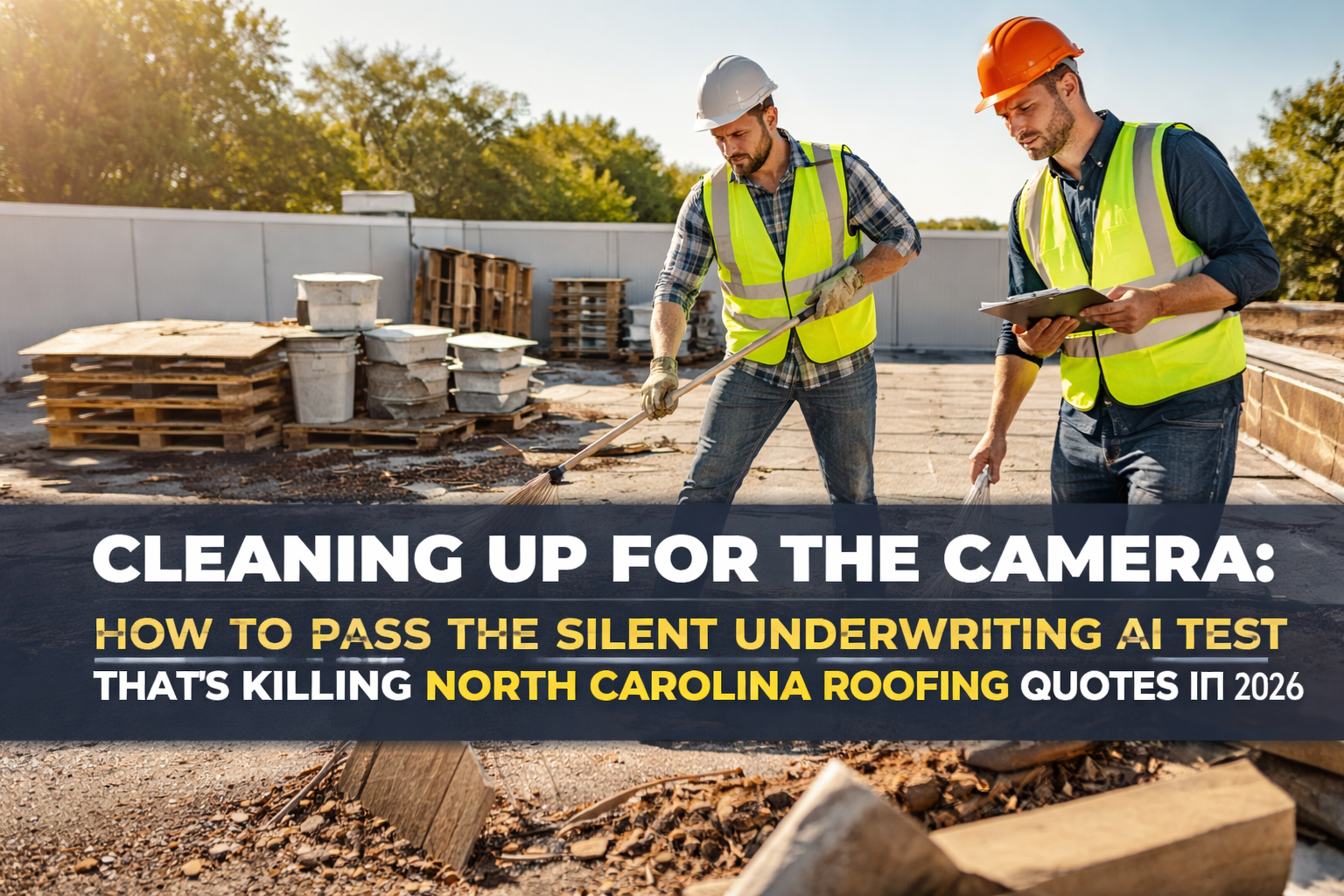
The Old Underwriting Game Versus the New Version
A few years ago, the first impression usually started with the agent.
The agent gathered the application, explained the operation, shared loss runs, described the work, and waited for an underwriter to review the file. If the carrier wanted to look deeper, that usually came later through inspections, follow-up questions, photos, or additional documentation.
Now the process can start earlier.
A roofing account may get an early digital review before the normal underwriting conversation becomes serious. That review may involve aerial imagery, roof condition signals, hazard scores, property data, and public-facing information tied to the business location.
The old game: your application told the story first.
The newer process: your application still matters, but your property, images, and digital footprint may start telling the story before the application is fully reviewed.
That is a big change. The old underwriting game rewarded a decent application. The newer underwriting process can reward a decent application and a clean visual story.
Want a stronger roofing submission?
Carolina Risk Partners can help review your roofing insurance renewal, submission story, current photos, coverage needs, subcontractor controls, and possible underwriting red flags before the account is marketed.
- Current policy and renewal review
- Photo and submission red flag review
- Coverage gap and exclusion discussion
- Subcontractor control review
I’ll follow up within 1 business day.
What Silent Underwriting Actually Looks At
Silent underwriting is not one magic score. It is better to think of it as a collection of signals.
Those signals may include:
- Aerial imagery of the office, yard, shop, or storage location.
- Roof condition signals on the insured building.
- Property hazard scores.
- Nearby fire, wind, hail, flood, or weather exposure.
- Google Business Profile photos.
- Website photos.
- Social media images.
- Truck, trailer, and equipment photos.
- Visible clutter, debris, pallets, and material storage.
- Long-term tarps or unresolved repairs.
- Digital proof of crew supervision, cleanup standards, and safety process.
Insurance technology vendors openly market tools that help insurers evaluate property risk, roof condition, aerial imagery, and underwriting data. Examples include the Nearmap commercial insurance aerial imagery platform, Guidewire HazardHub property risk data, and other property intelligence platforms.
The practical point is simple: underwriters increasingly have ways to see more before they ask more.
Why Roofing Gets Hit Harder Than Many Trades
Roofing is already a difficult class for insurance carriers.
Falls remain a major construction safety concern. OSHA’s fall protection guidance says falls are among the most common causes of serious work-related injuries and deaths. That matters because roofing work naturally involves height, ladders, steep slopes, open edges, weather exposure, heavy materials, and changing jobsite conditions.
So when a carrier looks at a roofing account, the file already starts with caution.
Then the underwriter, inspection vendor, carrier tool, or property data may raise additional questions:
- Does this company look controlled?
- Does it look supervised?
- Does it look disciplined?
- Does it look like materials are handled properly?
- Does it look like cleanup is part of the process?
- Does it look like the company finishes what it starts?
- Does it look like a business that creates fewer surprises?
That is why visual sloppiness can hurt a roofing account faster than it would hurt a lower-hazard trade.
The Silent Red Flags That Can Hurt Roofing Submissions
These are the common visual and digital signals that can make a roofing account feel weaker before anyone reads your full story.
1. A Messy Yard Can Look Like Poor Management
Old pallets, loose debris, overflowing dumpsters, damaged trailers, scattered materials, and abandoned-looking equipment do not just look messy.
They can read like weak controls.
In roofing, weak controls do not stay limited to housekeeping. An underwriter can connect visual disorder to broader concerns like ladder discipline, crew supervision, open-roof protection, cleanup standards, and material handling.
This can affect the overall account story behind your general liability insurance, workers compensation insurance, and commercial property underwriting.
A clean yard suggests control. A sloppy yard suggests drift.
2. A Messy Yard Can Also Look Like Fire Load
Combustible debris near structures is not just ugly. It can look like additional fire exposure tied to the property.
Old pallets, roofing materials, containers, boxes, insulation, packaging, and junk piled near a building may not feel like a big deal to the business owner. To underwriting, it can raise questions about storage, housekeeping, fire load, and property management.
This is especially relevant to commercial property underwriting, inland marine concerns, and any coverage tied to buildings, tools, materials, or equipment stored at the location.
3. Your Own Roof Can Hurt Credibility
This is one of the harder truths in roofing insurance underwriting.
If you sell roofing and your own office roof looks old, stained, patched, ponded, damaged, or permanently tarped, that creates a credibility problem.
It does not prove you are a bad roofer. But it can suggest deferred maintenance, weak cash flow, poor prioritization, or loose operational discipline.
This can affect how the carrier views commercial property, general liability, and the overall credibility of the account.
That may be harsh. It is still real.
4. Long-Term Tarps Create the Wrong Impression
A short-term tarp can be normal. A tarp that looks permanent tells a different story.
It may suggest unresolved damage, slow closeout, water intrusion exposure, or weak project controls. In roofing, water damage and open-roof issues are already some of the ugliest claim conversations in the business.
Long-term tarps can affect the underwriting story behind general liability, commercial property, builders risk conversations, and open-roof claim concerns.
This connects directly to roofing general liability exclusions, because the way you manage temporary protection can matter when a claim happens.
5. Your Visual Story Can Contradict Your Marketing Story
Your website may say professional. Your trucks may say quality. Your Google reviews may say reliable.
But if your office, yard, building, and public photos look disorganized, the story breaks.
The account no longer feels tight. It feels staged.
This can affect the full account narrative across general liability, commercial auto, property, workers compensation, and umbrella underwriting.
That is not what you want a roofing account to feel like.
6. Old Photos Can Weaken Trust
If you send current photos to support a submission, they need to feel current.
If the photos clearly do not match the current condition of the location, the underwriter may wonder whether the file is being cleaned up only on paper.
Use fresh photos. Use honest photos. Use photos that show the operation as it actually runs.
This is especially important when you are trying to improve a renewal submission, respond to a non-renewal, or explain why the account is better than older photos suggest.
7. Weak Digital Proof Can Make a Good Operation Look Generic
Many roofers have decent operations but poor digital packaging.
They have no crew photos, no project photos, no cleanup standards, no safety language, no supervision examples, no dry-in process, and no explanation of what makes them different from a low-end roofer.
That makes the company feel thinner than it really is.
Your general liability, workers compensation, commercial auto, and umbrella story should match the way the business actually operates.
The North Carolina FORTIFIED Angle Roofers Should Understand
This is where the topic becomes more than generic national insurance talk.
North Carolina has real momentum around stronger roofs, roof resilience, wind resistance, sealed roof deck concepts, and FORTIFIED-style roofing. The North Carolina Department of Insurance fortified homes and mitigation credits page explains that certain mitigation credits may be available for qualifying homeowners insurance policies in North Carolina’s beach and coastal territories.
IBHS, the Insurance Institute for Business and Home Safety, also publishes FORTIFIED Roof standards and guidance around concepts like roof deck attachment, sealed roof decks, uplift resistance, and reducing water entry.
For North Carolina roofers, this creates a positioning advantage.
Do not just say you install roofs. When true, explain that you understand:
- IBHS FORTIFIED roofing concepts.
- Sealed roof deck concepts.
- Edge strength.
- Uplift resistance.
- Water intrusion prevention.
- Documentation standards.
- Resilience-focused reroofing.
- Homeowner interest in stronger roof systems.
That makes your operation sound more technical, more current, and more controlled.
It matters for homeowners. It can also matter for underwriting because it helps turn “we do good work” into a more specific, defensible story.
This also pairs naturally with the North Carolina contractors insurance guide and the broader contractor insurance page.
How Roofers Can Clean Up for the Camera Before Renewal
This is the practical part.
The goal is not to trick underwriting. The goal is to make sure the visible evidence matches the operation you are trying to present.
Step 1: Audit Your Site From Above
Look at map imagery, public business photos, drone shots, Google Business Profile photos, social media photos, and any property views you already have.
Ask one question:
Would an underwriter feel better or worse after seeing this?
Step 2: Clean Up Visible Clutter
Remove junk. Stack materials properly. Secure pallets. Move combustible debris away from structures. Make trailers and equipment look active, not abandoned.
This is not about being fancy. It is about looking controlled.
Step 3: Fix Your Own Roof Story
If your own roof looks rough, deal with it.
A roofer with a neglected roof is creating an avoidable credibility problem. That does not mean every building needs to look brand new. It means the visual story should not contradict the business model.
Step 4: Do Not Let Temporary Repairs Look Permanent
If tarps are visible and lingering, finish the repair or fix the visual problem quickly.
Long-term tarps tell a story. Make sure it is not the wrong one.
Step 5: Tighten Your Digital Footprint
Your website, Google Business Profile, and social media should show evidence of a controlled roofing operation.
Useful proof includes:
- Current project photos.
- Crew organization.
- Cleanup standards.
- Safety language.
- Process discipline.
- How jobs are supervised.
- How temporary dry-in is handled.
- What makes your operation different from a low-end roofer.
Step 6: Give Your Agent a Human-Override Narrative
The goal is not to hide the truth. The goal is to prevent a good operation from being misunderstood.
Your submission package should include a written operational narrative explaining your safety protocols, cleanup standards, project supervision, subcontractor controls, and jobsite process so the file is not judged only by quick visual signals.
Your submission narrative should explain:
- How materials are stored.
- How jobs are supervised.
- How fall protection is enforced.
- How tarping is managed.
- How quickly punch work is closed.
- Whether you do residential or commercial roofing.
- How subcontractors are controlled.
- What proof exists that the operation is buttoned up.
Step 7: Bring Evidence
Do not rely on adjectives.
Use current yard photos, current building photos, truck photos, project photos, safety meeting examples, jobsite checklists, and evidence of formal process.
If your company already has a better operational story than the average roofer, prove it.
Submission upgrade: a strong roofing submission should not just say “experienced roofer.” It should show current photos, clean operations, safety controls, subcontractor controls, open-roof process, and a clear reason the account deserves serious underwriting attention.
What to Ask Your Insurance Agent Right Now
These questions are better than only asking, “Can you shop this again?”
- Are the carriers we are targeting using aerial imagery or property intelligence in underwriting?
- Should we attach current property photos to the submission?
- Are there visual red flags about our office, yard, or building that could hurt us?
- Does our submission explain how we control open-roof exposure, cleanup, and supervision?
- If we do stronger roof systems or FORTIFIED-related work, are we using that in the narrative?
- Are we explaining subcontractor controls, certificates, and documentation properly?
- Are we connecting the submission to the right coverage conversations, including commercial auto, workers compensation, general liability, and commercial umbrella?
- Are we starting this conversation 60 to 90 days before renewal?
A good roofing insurance agent should be able to help package the account, not just forward applications and hope for the best.
Why This Is Not Just About Price
Many roofing contractors think market shopping is only about finding a cheaper quote.
Price matters. But in a hard roofing class, the quality of the submission can also matter. A weak submission can make the account look generic, sloppy, or incomplete. A stronger submission can help the underwriter understand the real operation.
That does not guarantee a better quote. It does not guarantee every carrier will be interested. But it gives the file a better chance to be understood.
And that is often the difference between a rushed decline and a serious underwriting conversation.
Related Roofing Insurance Resources
- Roofing insurance coverage and requirements
- Roofing Insurance Complete Guide for Roofing Contractors
- Workers Comp for Roofers
- Why Roofing Companies Get Non-Renewed
- Roofing General Liability Exclusions
- Certificate of Insurance for Roofers
- Workers compensation insurance
- General liability insurance
- Inland marine insurance
- Builders risk insurance
Frequently Asked Questions About Silent Underwriting for Roofers
What is silent underwriting for roofers?
Silent underwriting for roofers is an informal term for the early review that can happen before a normal underwriting conversation. It may include aerial imagery, property data, roof condition signals, hazard scoring, public photos, and digital proof tied to the roofing company.
Can aerial imagery affect a roofing insurance quote?
Yes. Some carriers and insurance technology platforms use aerial imagery, computer vision, property intelligence, or hazard scoring to help evaluate property condition and account quality. A messy yard, damaged roof, old tarps, or visible disorder can make a roofing account look riskier.
Can a messy yard really hurt roofing insurance underwriting?
Yes, indirectly. A messy yard can make a roofing company look less controlled, less supervised, and more loss-prone. In roofing, visible disorder can raise concerns about cleanup standards, material handling, open-roof protection, and jobsite discipline.
Is silent underwriting the same as an insurance inspection?
No. An insurance inspection usually happens after a carrier is reviewing or has written the account. Silent underwriting refers to earlier digital or visual screening that may happen before the formal inspection process.
Why does a roofing company’s own roof matter in underwriting?
A roofing company’s own roof can affect credibility. If the business sells roofing but its office roof looks old, stained, patched, ponded, or permanently tarped, an underwriter may wonder whether the company has deferred maintenance or weak operational discipline.
What should roofers clean up before insurance renewal?
Roofers should clean visible clutter, stack materials properly, secure pallets, move combustible debris away from buildings, update business photos, fix long-term tarps, document jobsite controls, and give Carolina Risk Partners current evidence of a disciplined operation before renewal.
Does FORTIFIED matter for North Carolina roofers?
FORTIFIED can matter because it connects roofing work to resilience, stronger roof systems, sealed roof deck concepts, uplift resistance, and water intrusion prevention. It does not automatically fix a weak insurance account, but it can help disciplined North Carolina roofers tell a stronger technical story.
Can Carolina Risk Partners help prepare my roofing insurance submission?
Yes. Carolina Risk Partners can help roofing contractors review their insurance submission, current photos, coverage needs, operations narrative, subcontractor controls, renewal timing, and underwriting red flags before the account is marketed.
Stephen Ellias is the founder of Carolina Risk Partners LLC, an independent commercial insurance agency based in Wake Forest, North Carolina. He is a licensed North Carolina insurance professional, license number 20374040, with a CLCS, Commercial Lines Coverage Specialist, designation. Stephen helps roofing contractors, general contractors, and blue-collar trade businesses understand insurance requirements, underwriting concerns, coverage gaps, workers compensation, general liability, commercial auto, umbrella liability, subcontractor risk, and policy exclusions in direct language.
Want your roofing submission to look stronger before renewal?
Carolina Risk Partners can help review your current roofing insurance, submission story, renewal timing, public-facing risk signals, subcontractor controls, and coverage needs before your account is marketed.
Review My Roofing InsuranceEducational resource only. This article is not legal, claim, underwriting, risk management, safety, or insurance advice. Insurance availability, pricing, underwriting appetite, inspection requirements, and coverage terms depend on the actual carrier, policy language, endorsements, exclusions, claims history, payroll, revenue, operations, location, property characteristics, subcontractor use, and underwriting review.