
Builder’s Risk vs Roofer’s Insurance: Who Pays for Roof Damage During Construction?
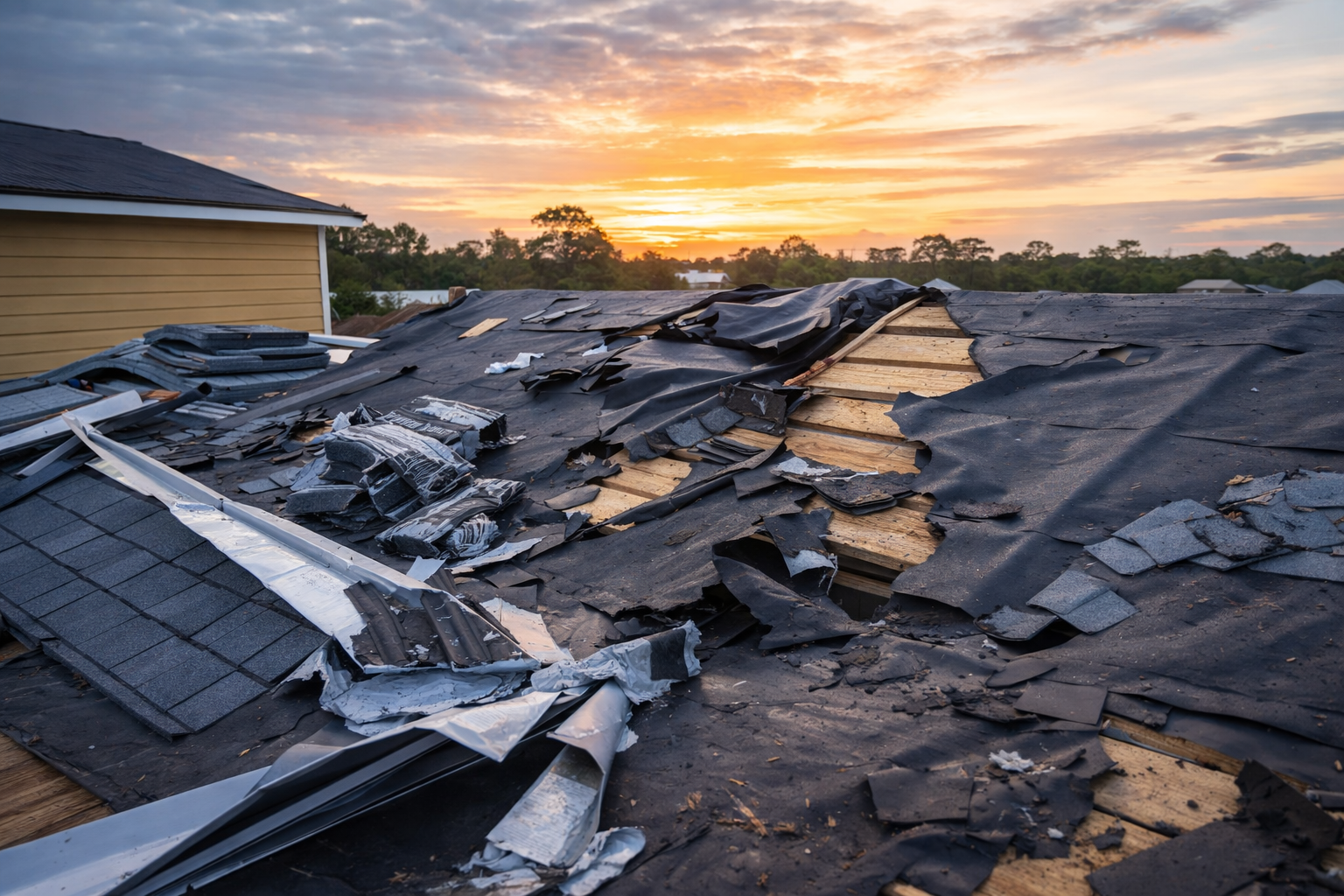
A damaged roof during construction can trigger builder’s risk, general liability, workers compensation, commercial auto, or inland marine. The answer depends on what was damaged, who was hurt, who was responsible, and which policy was designed to respond.
Key Takeaways
- Builder’s risk protects the project. It usually applies when the damaged property is the building, structure, materials, or work in progress during construction.
- Roofer’s insurance protects the roofer’s operations. That may include general liability, workers compensation, commercial auto, inland marine, umbrella, and sometimes builder’s risk.
- The first question matters most. Was the damage to the project itself, or did the roofing work damage someone else’s property or injure someone?
- Existing structure matters. On reroofs, renovations, additions, and repairs, you need to know whether builder’s risk covers only the new work or also existing property.
- Open roof rain claims are messy. Builder’s risk, roofer general liability, contract language, and open roof exclusions may all become part of the claim discussion.
- General liability is not a warranty. It usually does not simply pay to redo the roofer’s own faulty work.
- Workers compensation is separate. If a roofer gets hurt, that usually points to workers compensation, not builder’s risk.
Builder’s Risk vs Roofer’s Insurance: Quick Answer
Builder’s risk usually pays for covered damage to the project itself during construction. That may include the structure, materials, fixtures, equipment, and work in progress, depending on the policy and job setup.
Roofer’s insurance usually pays when the roofer’s operations create liability, injury, vehicle loss, tool loss, or other business exposure. But “roofer’s insurance” is not one policy. It is a coverage stack.
Bottom line: roof damage during construction is not one claim category. It is a decision tree.
Builder’s risk vs roofer’s insurance becomes a real problem the moment a roof is damaged during construction.
Before the loss, everyone assumes the job is insured.
After the loss, the question changes.
Which policy is supposed to pay?
That is where contractors get blindsided. A roof loss during construction is not one simple claim category. It may involve the building, materials, work in progress, existing structure, a worker injury, third-party property damage, a vehicle, tools, equipment, a deductible dispute, or a contract fight.
Simple point: builder’s risk usually protects the project. Roofer’s insurance usually protects the roofer’s liability, employees, vehicles, tools, and operations. If you do not know which policy should respond before the loss, the claim can turn into a fight after the damage happens.
What Roofer’s Insurance Actually Includes
“Roofer’s insurance” is not one policy. It is usually a group of policies built around the way the roofing business operates.
That stack may include:
- General liability insurance
- Workers compensation insurance
- Commercial auto insurance
- Inland marine insurance
- Commercial property insurance
- Commercial umbrella insurance
- Builder’s risk insurance, when the roofer is responsible for placing it or protecting an insurable interest
So when someone says, “the roofer’s insurance should pay,” the better question is: which part of the roofer’s insurance program are we talking about?
Want your roofing project insurance setup reviewed?
Carolina Risk Partners can help review builder’s risk responsibilities, roofer general liability, workers compensation, commercial auto, inland marine, subcontractor requirements, certificates, endorsements, and contract insurance expectations before the job starts.
- Builder’s risk responsibility review
- Open roof and water damage concern review
- GL, workers comp, auto, and inland marine discussion
- Contract and certificate requirement review
I’ll follow up within 1 business day.
This Is Not Only a New Construction Problem
Builder’s risk confusion does not only happen on brand-new buildings.
It can also show up on major renovations, additions, commercial reroofs, structural repairs, tenant improvements, building upgrades, and projects where existing property and new work overlap.
That overlap is where claims can become especially confusing. If water, wind, fire, theft, or collapse damages both new work and existing property, the claim may turn on whether the builder’s risk policy includes existing structure, whether the property owner’s policy responds, whether the roofer’s liability coverage is triggered, and what the contract says about responsibility.
Broker-level question: does the builder’s risk policy cover only the new work, or does it also cover existing structure? That matters on reroofs and renovations because water, wind, or fire damage may affect property that existed before the roofing work started.
The Claim Decision Tree: Ask This First
Before debating coverage, ask this:
Was the damage to the project itself, or did the roofing work damage someone else’s property or injure someone else?
That one question sorts most roofing construction claims into the right starting lane.
- If the project itself was damaged, think builder’s risk first.
- If existing structure was damaged, ask whether builder’s risk, property insurance, or liability insurance should be reviewed.
- If someone else’s property was damaged, think liability first.
- If a worker got hurt, think workers compensation first.
- If a vehicle caused the loss, think commercial auto first.
- If tools, equipment, or mobile materials were stolen or damaged, think inland marine first.
This is why roofing insurance should be built around claim scenarios, not just certificates and policy names.
Scenario 1: Wind Damages a Partially Completed Roof Overnight
A crew tears off one section of roof, installs underlayment and part of the new system, then leaves for the day. Overnight, a storm rolls through and damages the partially completed roofing materials before the project is finished.
Who usually pays?
This is usually a builder’s risk conversation first because the damaged property is the project and work in progress.
This is not usually a standard general liability claim if the first damage is to the building work itself, rather than injury or damage to a third party.
But roofers get into trouble when they assume the builder’s risk policy definitely exists, definitely includes them, or definitely covers the cause of loss.
Before work starts, confirm:
- Who bought the builder’s risk policy.
- Who is named, included, or protected as an insured.
- Whether the roofer is named, included, or otherwise protected under the builder’s risk policy.
- Whether the roofer is only assuming protection because the project has coverage.
- What property is covered.
- Whether existing structure is covered.
- Whether roofing materials are covered on site, off site, or in transit.
- When coverage starts and ends.
- Whether wind, theft, temporary structures, delay, and stored materials are handled the way the contract assumes.
- Who absorbs the deductible, delay cost, or uninsured portion if builder’s risk responds.
If you are moving into larger projects or acting more like a GC on certain jobs, this overlaps with general contractor insurance more than many roofers expect.
Scenario 2: Rain Enters Through an Open Roof and Damages the Interior
This is the scenario that exposes sloppy insurance thinking faster than almost anything else.
A crew opens the roof. Weather shifts. Rain gets in. Now drywall, insulation, flooring, cabinetry, tenant improvements, furniture, electronics, or inventory are damaged inside the building.
Who pays?
This is where honest insurance advice has to say: it depends.
Sometimes builder’s risk is the first path because the interior damage is tied to the project. Sometimes the roofer’s general liability insurance becomes part of the analysis because negligence is alleged. Sometimes both sides get pulled in.
The argument may turn on:
- Whether the roof was reasonably protected.
- Whether the builder’s risk policy covers water intrusion.
- Whether the builder’s risk policy includes existing structure.
- Whether the roofer’s general liability policy has open roof restrictions.
- Whether a protective safeguard condition applies.
- Whether the contract shifted responsibility to the roofer.
- Whether temporary dry-in procedures were followed.
- Whether photos, weather logs, and jobsite notes support the roofer’s position.
- Who pays the deductible if the builder’s risk policy responds.
Some roofing policies may include protective safeguard wording, open roof conditions, or open roof exclusions. These terms can require specific temporary covering, dry-in procedures, weather monitoring, or documentation before coverage is considered. That is why reviewing policy forms matters more than simply verifying a limit on a certificate.
This is also where a certificate becomes almost useless as an answer. A certificate may show that a policy existed. It does not tell you how the water intrusion claim will actually be handled.
For more on that issue, read Roofing General Liability Exclusions and Certificate of Insurance for Roofers.
Scenario 3: A Roofer Falls During the Job
A worker falls from the roof edge, ladder, scaffold, or access point and gets badly hurt.
Who usually pays?
This is usually a workers compensation claim, not builder’s risk and not general liability.
That matters because roofing losses often create a false assumption that everything involving the jobsite should run through one policy. That is not how it works. Employee injury and project damage are two different claim categories.
OSHA’s fall protection guidance says falls are among the most common causes of serious work-related injuries and deaths. Roofing work naturally involves ladders, roof edges, steep slopes, weather exposure, access points, and changing jobsite conditions.
In North Carolina, workers compensation rules matter early. The North Carolina Industrial Commission employer guidance says most businesses with three or more employees must carry workers compensation coverage. It also warns that subcontracting work to an uninsured subcontractor may create liability for injuries to that subcontractor’s employees.
The North Carolina Industrial Commission also makes clear that calling a worker a “1099 contractor” or independent contractor does not automatically decide the workers compensation question. If the facts look like employment, a claim or audit may treat the exposure differently than the business owner expected.
If you want the full breakdown of how one injury affects pricing, carrier options, and future bids, read Workers Comp for Roofers: How One Claim Can Change Your Business.
Scenario 4: Debris Damages a Neighbor’s Car or Third-Party Property
A bundle slides off the roof. A tool falls. Debris hits a parked vehicle, cracks a windshield, damages a neighboring structure, or injures someone walking near the job.
Who usually pays?
This is usually a general liability conversation because the damage is now to someone else’s property or person, not just to the project itself.
This is the cleanest example of the difference between first-party property damage and third-party liability.
- First-party property damage: the project or insured property is damaged.
- Third-party liability: someone else claims your work caused injury or damage to them or their property.
That is why general liability matters so much for roofers, especially on tight residential lots, occupied buildings, multi-tenant properties, active commercial sites, downtown projects, and high-value homes.
Scenario 5: The Roofer’s Truck, Trailer, or Driver Causes the Loss
A company truck backs into a customer’s wall. A trailer breaks loose in traffic. A roofing vehicle rear-ends another car on the way to the job. Materials shift while being transported and cause a roadway accident.
Who usually pays?
This is usually a commercial auto insurance claim, not builder’s risk and not standard general liability.
This matters because a lot of roofing businesses quietly underweight their vehicle exposure. They think the real risk lives on the roof, but the business creates liability from the second the truck leaves the yard.
If your operation is running multiple crews, trailers, dump runs, supplier pickups, and highway miles every week, commercial auto is not a side policy. It is one of your core liability lines.
Scenario 6: Tools, Equipment, or Jobsite Materials Are Stolen
A trailer full of tools disappears overnight. Equipment is stolen between job sites. Materials waiting to be installed are damaged while in transit or while temporarily stored.
Who usually pays?
Usually this is not a general liability claim. It may not be builder’s risk either, especially if the stolen property belongs to the roofer and is mobile equipment, tools, or contractor-owned materials rather than covered project property.
That is where inland marine insurance becomes critical.
Roofers lose money here because they treat all property as if it sits under one blanket of coverage. But mobile tools, equipment, trailers, and materials often need their own coverage path.
For a deeper dive, read inland marine insurance for roofers.
The Nuance Contractors Miss: Coverage Is Not the Same as Warranty
A roofer’s general liability policy is not a warranty for the roofer’s own bad work.
That does not mean it never responds in a defective-work situation. It means you have to separate two different problems:
- The cost to redo your own faulty work.
- The resulting damage your faulty work caused to other property.
Those are not the same claim.
If flashing is installed wrong and the roofer has to tear out and replace their own work, that is very different from a situation where bad flashing causes interior water damage to ceilings, floors, walls, equipment, or inventory.
Contractors think in terms of “something went wrong, so insurance should pay.” Carriers think in terms of what exactly went wrong, to what property, under which policy form.
The North Carolina Issues Roofers Need to Know
1. Workers Compensation Rules Show Up Early
In North Carolina, a business with three or more employees generally must carry workers compensation coverage. That includes many growing roofing businesses sooner than owners expect.
Sole proprietors, LLC members, and partners have special treatment under the North Carolina Industrial Commission guidance, so owners should not assume they are covered personally unless the policy structure actually does that.
2. “They Are 1099” Is Not a Clean Answer
North Carolina roofing businesses get into trouble when they call workers subcontractors, but the facts look like employment.
Red flags may include situations where the roofer:
- Provides the tools and equipment.
- Controls when, where, and how the work is done.
- Pays by the hour or by the day.
- Uses the worker as a regular part of the operation.
- Keeps the relationship ongoing instead of project-specific.
A workers compensation audit or claim dispute can reclassify what the roofer thought was subcontract labor into payroll exposure.
3. Open Roof Exclusions and Safeguards Can Change the Claim
Open roof rain damage is one of the most dangerous roofing claim scenarios because it can involve builder’s risk, roofer general liability, existing structure, interior property, contract terms, and claim documentation.
Some roofing general liability policies may include open roof exclusions, protective safeguard requirements, or water intrusion limitations. Some builder’s risk policies may also include conditions, exclusions, or special wording that affects water damage during construction.
The point is not to guess. The point is to review the wording before tear-off begins.
4. Contract Requirements Can Be Stricter Than Legal Requirements
Even if a roofer is below a legal workers compensation threshold, a general contractor, builder, property owner, or commercial project may still require workers compensation before work starts.
That means roofers need to understand two different requirements:
- The legal requirement.
- The market-access requirement.
Insurance is not just compliance. It is often what allows the roofer to get on the job at all.
Five Questions to Answer Before the Next Roofing Project Starts
1. Who Bought the Builder’s Risk Policy?
Do not assume builder’s risk exists just because the job is large. Confirm who placed it and get clarity before work begins.
2. Does the Builder’s Risk Policy Protect My Interest?
This is better than asking, “Is there builder’s risk?”
Ask whether the roofer is named, included, or otherwise protected under the builder’s risk policy, or whether the roofer is only assuming protection because the project has coverage.
3. Does the Policy Cover Existing Structure?
This matters most on reroofs, additions, repairs, renovations, commercial remodels, and projects where the new roofing work ties into property that already existed before the project started.
4. If Rain Gets in Through an Open Roof, What Policy Is Expected to Respond First?
Ask this before the tear-off, not after the water damage.
5. Who Pays the Deductible or Uninsured Portion?
Even when builder’s risk responds, the contract may still decide who absorbs the deductible, delay cost, or uninsured portion of the loss.
6. Are My General Liability and Auto Limits Built for the Severity?
A million-dollar policy limit sounds big until a serious claim happens on a dense site, high-value property, commercial building, or multi-party construction project.
7. Am I Relying on a Certificate When I Really Need Endorsement Review?
A certificate helps prove insurance exists. It does not answer the claim. For major roofing jobs, the better review includes the contract, builder’s risk responsibilities, general liability exclusions, additional insured wording, waiver wording, open roof conditions, and workers compensation structure.
The Roofing Contractor Insurance Matrix
To avoid getting caught in a multi-policy finger-pointing contest after a loss, use this quick reference framework before you sign the next project contract:
- Building, structure, and materials in progress: builder’s risk insurance, usually carried by the project owner or general contractor.
- Existing structure during a renovation or reroof: builder’s risk, property insurance, contract language, and liability insurance may all need review.
- Damage to owner property or neighbor property: roofer’s general liability insurance may be part of the claim discussion.
- Crew injuries on roofs, scaffolding, or ladders: workers compensation insurance.
- Trucks, dump trailers, and transport accidents: commercial auto insurance.
- Stolen shingles, specialty tools, or damaged equipment: inland marine insurance or tool and equipment floater coverage.
- Deductibles, delay costs, and uninsured gaps: the construction contract may decide who absorbs the cost.
Final Answer: Who Pays When a Roof Is Damaged During Construction?
Here is the clean answer.
- If the roof, building, materials, or work in progress is damaged during construction by a covered cause of loss, builder’s risk is usually the first policy to review.
- If existing structure is damaged during a reroof or renovation, the answer may depend on whether builder’s risk includes existing structure, whether property insurance applies, whether negligence is alleged, and what the contract says.
- If the roofer’s operations cause third-party property damage or bodily injury, the roofer’s general liability insurance is usually part of the conversation.
- If a worker gets hurt, that usually points to workers compensation.
- If a vehicle causes the loss, that usually points to commercial auto.
- If tools, equipment, trailers, or mobile materials are stolen or damaged, that usually points to inland marine or related property coverage.
- If builder’s risk responds, the contract may still decide who pays the deductible, delay cost, or uninsured portion.
That is the whole point: roof damage during construction is not one claim category. It is a decision tree.
Bottom Line for North Carolina Roofers
North Carolina roofers do not get into trouble because they forgot to buy insurance.
They get into trouble because they buy one kind of insurance and assume it answers every loss.
It does not.
The smarter question is not, “Do I have insurance?”
The smarter question is, “Do I know which policy is supposed to respond when this exact thing goes wrong?”
That question protects cash flow, contracts, jobsite relationships, and the business itself.
Related Roofing Insurance Resources
- Roofing insurance coverage and requirements
- Roofing Insurance Complete Guide for Roofing Contractors
- Roofing General Liability Exclusions
- Certificate of Insurance for Roofers
- Workers Comp for Roofers
- General liability insurance
- Workers compensation insurance
- Commercial auto insurance
- Inland marine insurance
- Builder’s risk insurance
Frequently Asked Questions About Builder’s Risk vs Roofer’s Insurance
What is the difference between builder’s risk and roofer’s insurance?
Builder’s risk usually protects the project, structure, materials, and work in progress during construction. Roofer’s insurance is a group of policies that may include general liability, workers compensation, commercial auto, inland marine, umbrella, and sometimes builder’s risk depending on the job.
Who pays if a roof is damaged during construction?
If the project itself is damaged by a covered cause of loss during construction, builder’s risk is often the first policy to review. If the roofer’s operations caused third-party property damage or bodily injury, the roofer’s general liability policy may be involved.
Does builder’s risk cover existing structure during a reroof?
Sometimes, but not always. One major issue on reroofs, renovations, additions, and repairs is whether the builder’s risk policy covers only the new work or also the existing structure. That should be confirmed before work starts.
Does roofer general liability cover damage to the roofer’s own work?
Usually not as a simple warranty. General liability is not designed to pay for redoing the roofer’s own defective work. It may become part of the analysis when faulty work causes resulting damage to other property, depending on the policy language, exclusions, and facts of the claim.
Does builder’s risk cover open roof rain damage?
Sometimes, but not always. Open roof rain damage can depend on the builder’s risk policy, covered causes of loss, exclusions, protective safeguard requirements, contract terms, and whether negligence is alleged against the roofer.
Who pays the builder’s risk deductible after roof damage?
Even when builder’s risk responds, the contract may decide who absorbs the deductible, delay cost, or uninsured portion of the loss. That responsibility should be reviewed before the project begins.
What policy pays if a roofer falls during construction?
A roofer injury is usually a workers compensation issue, not a builder’s risk issue. In North Carolina, workers compensation requirements and subcontractor labor structure should be reviewed before the project starts.
What policy pays if roofing tools or equipment are stolen?
Stolen roofing tools, equipment, trailers, or mobile materials often point toward inland marine or related property coverage. General liability usually does not cover theft of the roofer’s own tools.
Can Carolina Risk Partners review a roofing project insurance setup before work starts?
Yes. Carolina Risk Partners can help North Carolina roofers and contractors review builder’s risk responsibilities, general liability, workers compensation, commercial auto, inland marine, subcontractor requirements, certificates, endorsements, and project insurance expectations before work begins.

Stephen Ellias is the founder of Carolina Risk Partners LLC, an independent commercial insurance agency based in Wake Forest, North Carolina. He is a licensed North Carolina insurance professional, license number 20374030, with a CLCS, Commercial Lines Coverage Specialist, designation. Stephen helps roofing contractors, general contractors, and blue-collar trade businesses understand builder’s risk, general liability, workers compensation, commercial auto, inland marine, subcontractor risk, certificates, policy exclusions, and project insurance requirements in direct language.
Want to know which policy is supposed to respond before the job starts?
Carolina Risk Partners can help review your roofing insurance stack, builder’s risk responsibilities, project contract, certificates, endorsements, workers compensation structure, commercial auto exposure, and inland marine needs before a claim turns into a dispute.
Review My Roofing Project CoverageEducational resource only. This article is not legal, claim, underwriting, safety, risk management, or insurance advice. Coverage depends on the actual policy language, endorsements, exclusions, covered causes of loss, contract terms, job facts, carrier interpretation, and claim handling. Contract language should be reviewed by qualified legal counsel.