
Roofing General Liability Exclusions: 12 Endorsements That Can Get a Claim Denied
Roofing general liability exclusions can turn an active policy into a denied claim. A certificate may look fine, but the endorsement schedule decides what happens when the loss arrives.
Key Takeaways
- Roofing general liability exclusions can remove or narrow coverage even when the certificate of insurance looks fine.
- An active policy does not automatically mean a covered claim.
- The endorsement schedule is often where the real coverage limits appear.
- Open roof, hot work, height, residential, subcontractor, mold, pollution, and additional insured wording are common problem areas.
- A certificate usually does not show exclusions, endorsement conditions, or claim restrictions.
- Roofers should review endorsements before signing contracts, starting higher-risk jobs, or renewing coverage.
Quick Answer
Roofing general liability exclusions are policy exclusions, conditions, or endorsements that remove or restrict coverage for certain roofing operations, job types, claim types, or contract requirements.
For North Carolina roofers, this matters because many jobs require proof of insurance before work begins, but that proof may not reveal the exclusions that control the claim.
Bottom line: do not rely only on the certificate. Review the declarations, endorsement schedule, and contract requirements before a claim exposes the gap.
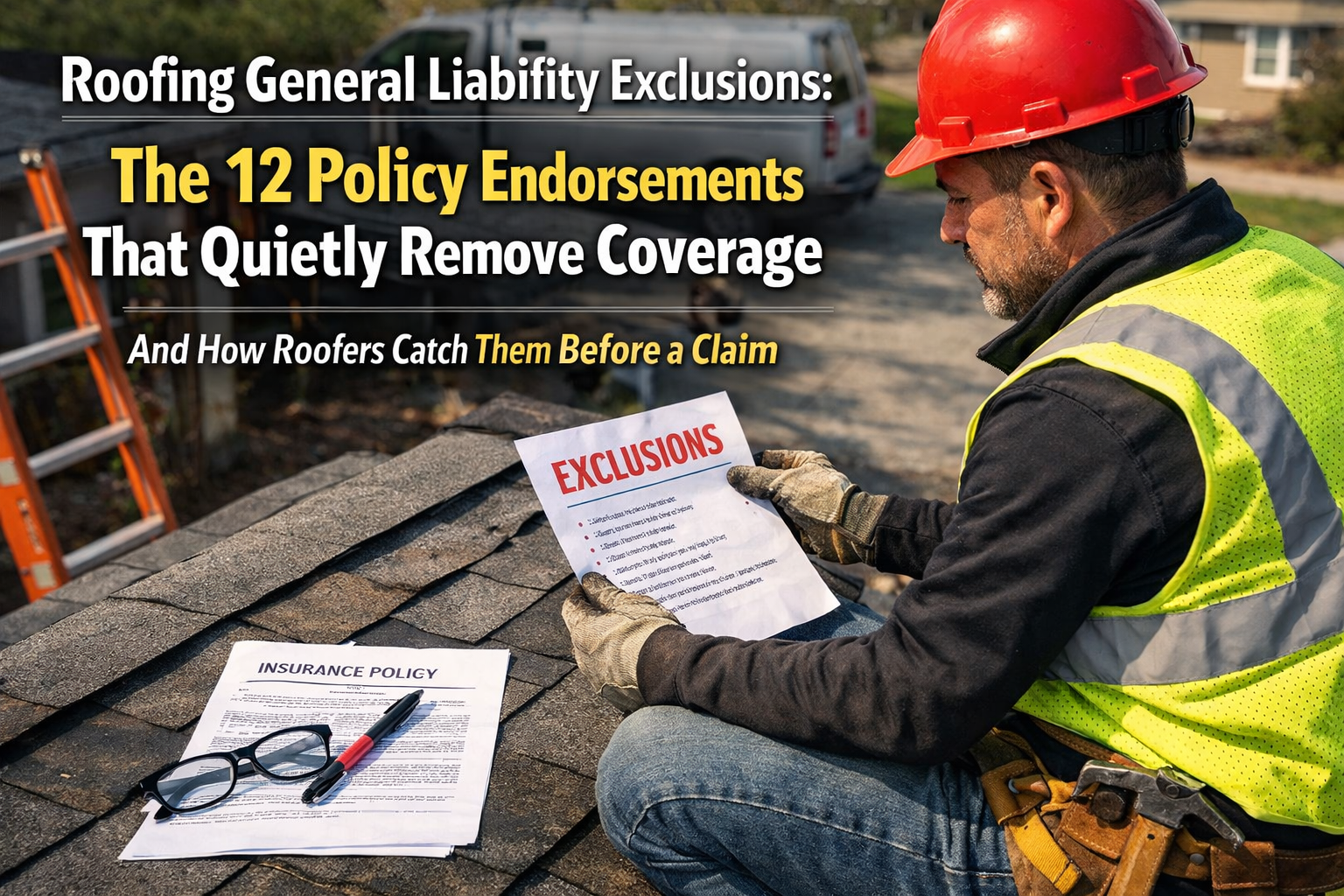
Roofing general liability exclusions are one of the biggest reasons roofers get surprised after a claim. The contractor had a policy. The certificate looked clean. The job started. Then something went wrong.
After the claim is reported, the carrier reviews the policy forms and endorsement schedule. That is when the roofer may find out the loss is excluded, limited, or subject to conditions that were not followed.
This is one of the most common roofing insurance loopholes I look for when reviewing a contractor’s general liability package.
Simple version: having general liability insurance is not the same thing as having coverage for every roofing claim. The endorsement schedule can narrow the policy before the job ever starts.
What Roofing General Liability Is Supposed to Do
General liability insurance is generally designed to respond to certain third-party bodily injury, property damage, personal injury, and advertising injury claims. For roofers, that may include some jobsite injury allegations, property damage claims, completed operations claims, and defense requests depending on the facts and policy wording.
The problem is that many roofers buy based on price, certificate speed, or contract compliance. But the claim is decided by the policy wording, not the certificate.
General liability is not a blank check. It is controlled by the coverage form, exclusions, definitions, conditions, limits, and endorsements.
Why a Certificate of Insurance Does Not Show the Real Problem
A certificate of insurance can prove that a policy exists, but it does not show every exclusion, condition, limitation, or endorsement that may affect a claim.
A certificate is evidence of insurance. It is not a policy review.
This is especially dangerous in roofing because carriers often use endorsements to limit high-risk operations.
- The certificate may show general liability coverage.
- The policy may still exclude open roof water damage.
- The certificate may show a $1,000,000 limit.
- The policy may still limit residential roofing or work above a certain height.
- The certificate may list a general contractor as certificate holder.
- The policy may still not provide the additional insured coverage the contract required.
For the deeper certificate issue, read Certificate of Insurance for Roofers: Why a COI Does Not Guarantee Coverage.
Want your roofing exclusions checked?
Send the declarations, endorsement schedule, and contract insurance requirements. I’ll help identify the wording that could create a claim, renewal, or certificate problem.
What a Roofing Coverage Denial Can Look Like
Claim Story 1: The Open Roof Rain Loss
A roofing crew starts a tear-off on Friday. The roof is partially open. Tarps are installed. Overnight, a storm shifts. Water gets through a seam and damages ceilings, flooring, cabinets, insulation, and contents.
Everyone assumes the roofing contractor’s general liability policy will handle it.
Then the carrier reviews the endorsement schedule and points to open roof wording. The endorsement may exclude open roof water damage, or it may require safeguards and proof that the roofer cannot provide.
The result can be a denied claim, a coverage dispute, a lawsuit, or a contractor paying out of pocket.
Claim Story 2: The Job Is Done, Then the Lawsuit Arrives
The roof is finished. Months later, a leak appears. The general contractor tenders the claim and expects defense and coverage from the roofing subcontractor’s policy.
Then the policy review shows the additional insured wording is narrower than the contract required, completed operations is limited, or the “your work” language has been modified.
Now the roofer may be stuck in a defense dispute, contract dispute, or uncovered completed operations claim months after the job was finished.
The 12 Endorsements That Can Quietly Gut Roofing General Liability
Endorsement names and form numbers vary by carrier. The goal is not to memorize every form. The goal is to spot patterns that can narrow coverage.
For each item below, ask three questions:
- What does this endorsement do?
- What claim could it block?
- What should I ask before signing a contract or starting a job?
1. Roofing Limitation Endorsement
A roofing limitation endorsement may restrict or exclude certain roofing operations. It can apply broadly or only to certain kinds of work, such as tear-off, re-roofing, repair work, coatings, warranty work, or specific roof systems.
Claim it can block: property damage, bodily injury, falling debris, water intrusion, or jobsite injury claims tied to roofing operations.
What to ask: do I have any endorsement that limits roofing operations? Does it apply to tear-off, repair work, coating work, subcontracted work, or completed operations?
2. Open Roof Exclusion or Open Roof Conditions Endorsement
An open roof exclusion or open roof conditions endorsement is one of the most important roofing general liability exclusions to review. If the roof is open and water gets in, the endorsement may exclude the loss or make coverage dependent on safeguards.
Claim it can block: rain, storm, or weather intrusion during tear-off, dry-in, staged installation, partial replacement, or overnight exposure.
What to ask: what is the policy definition of open roof? Are there tarp, dry-in, weather monitoring, supervision, or documentation requirements? What proof would the carrier require after a claim?
Fast search terms: pull the endorsement schedule and search for “open roof,” “weather,” “rain,” “water intrusion,” “protective covering,” “temporary covering,” and “safeguards.”
3. Hot Work Exclusion or Hot Work Conditions Endorsement
Hot work wording can affect torch down roofing, hot tar, kettles, welding, heat guns, and other work involving flame or heat.
Some policies exclude hot work entirely. Others allow it only if the contractor follows a written safety process.
Claim it can block: fire, smoke, heat, or property damage tied to torch work, hot tar, kettles, or other heat-related roofing methods.
What to ask: is hot work excluded, limited, or conditional? If conditional, what exact checklist must be followed every time?
4. Height Limitation Endorsement
A height limitation endorsement may restrict coverage above a certain number of stories, building height, roof height, ladder height, lift height, or pitch threshold.
Claim it can block: claims on taller buildings, steep roofs, multi-story residential, condos, apartments, commercial buildings, or work involving lifts and scaffolding.
What to ask: is there any height, story, pitch, lift, ladder, or scaffold limitation? Does it apply to all operations or only certain types of roofing work?
5. Residential Roofing Limitation Endorsement
A residential roofing limitation may restrict coverage for homes, condos, apartments, townhomes, multi-family buildings, or certain residential job types.
Claim it can block: property damage or injury claims on occupied homes, multi-family properties, condos, townhomes, or residential projects outside the policy’s allowed appetite.
What to ask: is residential roofing limited? Are condos, apartments, townhomes, multi-family, HOA work, or occupied structures restricted?
6. Subcontractor Warranty Endorsement
A subcontractor warranty endorsement can make coverage depend on your subcontractor paperwork process. If you use subs and do not collect the required documents, coverage may be narrowed or denied.
Claim it can block: a loss caused by a subcontractor where you cannot prove the subcontractor carried the required general liability, workers compensation, additional insured wording, waiver wording, or contract documentation.
What to ask: do I have any subcontractor warranty endorsement? What documents must I collect? Do I need them before work starts? Do I need copies of endorsements or just certificates?
This connects directly to Roofing Subcontractor Injury With No Workers Comp and Roofing Insurance Audits.
7. Additional Insured Limitation Endorsement
An additional insured endorsement can limit who is covered, when they are covered, and whether completed operations is included. This matters when a general contractor or property owner expects protection under your policy.
Claim it can block: a tender from a general contractor or owner where they expect defense and coverage, especially after the job is completed.
What to ask: what is the exact additional insured form number and edition date? Does it include completed operations or only ongoing operations? Is coverage tied to written contract requirements?
For the general contractor side, read Additional Insured vs. Certificate Holder for General Contractors.
8. Primary and Noncontributory Limitation
A contract may require your general liability policy to respond first before another party’s insurance contributes. That is usually handled through primary and noncontributory wording.
If your policy does not include the required wording, there may be a dispute over who defends first and who pays first.
Claim it can block: this may not always create a full denial, but it can create defense disputes, tender disputes, and contract compliance problems.
What to ask: do I have primary and noncontributory status when required by written contract? Is it automatic, or does it require a specific endorsement?
9. Fungi or Mold Exclusion or Limitation
Mold can become a major part of a water intrusion claim. Even if some water damage is covered, the mold portion may be excluded or capped.
Claim it can block: mold remediation, indoor air quality claims, fungi-related damage, or health-related allegations connected to water intrusion.
What to ask: is mold excluded or limited? If limited, what is the sublimit? Does it apply to defense costs too?
10. Pollution Exclusion or Pollution Limitation Endorsement
Roof coatings, adhesives, fumes, odors, runoff, disposal issues, or contamination allegations can sometimes trigger pollution wording.
Claim it can block: odor claims, fume claims, chemical runoff allegations, contamination claims, or certain disposal-related losses.
What to ask: do I have any pollution limitation endorsements? If I use coatings, adhesives, solvents, primers, foam, or other materials, how does the policy respond?
11. Professional Services Exclusion
A professional services exclusion can become an issue when a claim is framed as bad advice, wrong specifications, poor design recommendations, ventilation errors, or system selection mistakes.
Claim it can block: allegations that the roofer recommended the wrong roofing system, gave improper advice, under-designed ventilation, specified the wrong materials, or acted like a consultant instead of only a contractor.
What to ask: could the professional services exclusion apply to my estimating, inspection, consulting, or system recommendations? Should I consider contractors errors and omissions coverage?
12. “Your Work” Endorsement Change
The standard “your work” exclusion and subcontractor exception can be modified by endorsement. Some endorsements tighten workmanship-related claims, especially when subcontractors were involved.
Claim it can block: portions of completed operations claims tied to defective work, water intrusion, faulty installation, or subcontracted work.
What to ask: has my policy been endorsed to modify the “your work” exclusion? Is the subcontractor exception preserved? How does this affect completed operations?
The 5 Fastest Ways Roofers Can Self-Audit a GL Policy
You do not need to read every word of the policy like a lawyer to catch the biggest warning signs. Start with the documents and search terms that matter most.
1. Pull the Endorsement Schedule
Search for these terms:
- Open roof
- Hot work
- Height
- Residential
- Roofing limitation
- Subcontractor warranty
- Additional insured
- Your work
- Mold
- Fungi
- Pollution
- Professional services
2. Verify the Operations Description Matches Reality
If the carrier thinks you only do small repairs, but you perform full tear-offs, replacements, steep slope work, torch work, or commercial jobs, the policy may not match your real exposure.
3. Look for Endorsements With “Must” Language
If an endorsement says you must do something to keep coverage, assume you need documentation and proof.
That may include weather logs, photos, tarp procedures, hot work permits, subcontractor COIs, jobsite checklists, written contracts, or signed safety documents.
4. Compare Contract Requirements to Endorsements
Contracts often require additional insured status, completed operations, primary and noncontributory wording, waiver of subrogation, and specific insurance limits.
Your certificate may not prove those requirements are actually satisfied.
5. Separate the Insurance Buckets
General liability is one bucket. Workers compensation is another. Commercial auto is another. Commercial umbrella is another.
Roofers get burned when they assume one policy handles everything.
Roofer Contract Checklist: What to Request Before You Start
Before signing a contract or starting a higher-risk roofing job, ask for more than a certificate.
A good roofing insurance agent should be comfortable reviewing these documents with you before the job starts, not just sending a certificate after the contract is signed.
Ask Your Agent For
- General liability declarations page.
- Full endorsement schedule.
- Additional insured endorsement copy.
- Waiver of subrogation endorsement copy.
- Primary and noncontributory wording.
- Open roof wording and safeguards.
- Height and hot work limitations.
- Subcontractor warranty requirements.
Ask Every Subcontractor For
- Certificate of insurance.
- General liability limits that meet the job.
- Workers compensation proof.
- Additional insured endorsement if required.
- Waiver of subrogation copy if required.
- Subcontract agreement.
- Policy dates that match the work dates.
What Roofers Should Do Before Renewal
The best time to discover a bad endorsement is 60 to 90 days before renewal. The worst time is after water damage, a fire, or a tender from a general contractor.
Renewal is when you still have time to fix the problem, move markets, change operations, or negotiate wording before another policy year starts.
Before renewal, review:
- What kind of roofing work you actually perform.
- How much work is residential vs. commercial.
- Whether you do tear-off, repairs, coatings, torch work, or steep slope work.
- Whether you use subcontractors.
- Whether your contracts require additional insured status.
- Whether open roof conditions are realistic for your crews.
- Whether your current carrier still fits your operations.
For a broader coverage foundation, read Roofing Insurance Complete Guide for Roofing Contractors.
North Carolina Roofing Insurance Note
Roofing contractors across North Carolina, from Wake Forest and the Triangle to Charlotte, the coast, and growing towns throughout the state, often need general liability coverage to satisfy general contractor contracts, property owner requirements, commercial project requirements, and subcontractor agreements.
The issue is that a certificate of insurance may satisfy the paperwork request while still failing to show the exclusions that control the claim. A standard certificate usually will not show whether the carrier has limited open roof rain damage, restricted working height, excluded hot work, narrowed completed operations, or made coverage dependent on subcontractor warranty conditions.
For North Carolina roofers, the safer move is to audit the endorsement schedule before renewal, before signing larger contracts, and before relying on a certificate as proof that a claim will be covered.
Related Roofing Insurance Resources
- Roofing insurance coverage and requirements
- General liability insurance
- Workers compensation insurance
- Commercial auto insurance
- Commercial umbrella insurance
- General contractor insurance
- Certificate of Insurance for Roofers
- Roofing Insurance Audits
- Roofing Subcontractor Injury With No Workers Comp
Frequently Asked Questions About Roofing General Liability Exclusions
What are roofing general liability exclusions?
Roofing general liability exclusions are policy terms or endorsements that remove, limit, or condition coverage for certain roofing operations, claim types, job types, or loss scenarios.
Why do roofing general liability claims get denied?
Roofing general liability claims may be denied because the loss falls outside the policy, triggers an exclusion, violates an endorsement condition, involves uncovered operations, or depends on wording that is narrower than the contractor expected.
Does general liability cover open roof water damage?
Sometimes, but not always. Some roofing policies exclude open roof water damage. Others require safeguards, documentation, weather monitoring, tarping, or proof of dry-in procedures before coverage may apply.
What is a hot work exclusion in roofing insurance?
A hot work exclusion or hot work condition limits coverage for torch down roofing, hot tar, kettles, welding, heat work, or similar operations. Some policies exclude hot work entirely, while others require strict safety procedures.
Does a certificate of insurance show roofing exclusions?
No. A certificate of insurance usually shows that a policy exists, but it does not show every endorsement, exclusion, condition, limitation, or claim restriction that may control coverage.
How can roofers self-audit a general liability policy?
Roofers can self-audit a general liability policy by pulling the declarations, endorsement schedule, additional insured forms, waiver forms, primary and noncontributory wording, and searching for terms like open roof, hot work, height, residential, subcontractor warranty, mold, pollution, professional services, and your work.
Can Carolina Risk Partners review my roofing general liability exclusions before renewal?
Yes. Carolina Risk Partners can review declarations pages, endorsement schedules, contract insurance requirements, and common roofing exclusions before renewal or before a higher-risk roofing job begins.
Stephen Ellias is the founder of Carolina Risk Partners LLC, an independent commercial insurance agency based in Wake Forest, North Carolina. He helps roofing contractors, general contractors, trade contractors, and business owners review coverage gaps, policy exclusions, certificates, contracts, and renewal problems.
Want help finding roofing GL landmines before a claim?
Carolina Risk Partners can review your roofing general liability policy, endorsement schedule, contract requirements, subcontractor process, and renewal options so exclusions do not surprise you after the loss.
Review My Roofing GL PolicyEducational resource only. This article is not legal, claim, underwriting, or insurance advice. Coverage depends on the actual policy language, endorsements, exclusions, conditions, facts of the claim, contract terms, state law, carrier interpretation, and claim handling. Speak with a licensed professional about your specific situation.