

North Carolina Landscaping Workers Comp: The 3-Employee Rule
A practical guide for landscaping, lawn care, hardscape, irrigation, and tree service businesses that are not sure when workers compensation becomes required.
- Most North Carolina businesses need workers compensation once they have three or more employees.
- For landscaping companies, part-time and seasonal workers can count toward the three-employee rule.
- Corporate officers may exclude themselves from coverage, but they still count toward the threshold.
- Paying someone on a 1099 does not automatically make them a true independent contractor.
- Tree service work may need a different workers compensation class code than ground-level landscaping.
- Contract requirements can be stricter than the legal minimum, especially when you work for builders, property managers, municipalities, or larger contractors.
Most North Carolina landscaping businesses need workers compensation once they regularly have three or more employees. According to North Carolina employer guidance, corporate officers may elect to exclude themselves from coverage, but they still count toward the three-employee threshold.
Bottom line: part-time help, seasonal workers, corporate officers, and some 1099 labor can change the answer faster than many lawn care and landscaping owners expect.
North Carolina landscaping workers comp rules are easy to underestimate. A small lawn care company may think it is too small to need a policy, then cross the threshold without realizing it by adding one part-time helper, one seasonal worker, or one corporate officer.
That is where the 3-employee rule matters. In North Carolina, most employers are required to carry workers compensation insurance once they have three or more employees. For landscaping, lawn care, hardscape, irrigation, and tree service businesses, that count is not always as simple as “how many full-time people are on payroll today.”
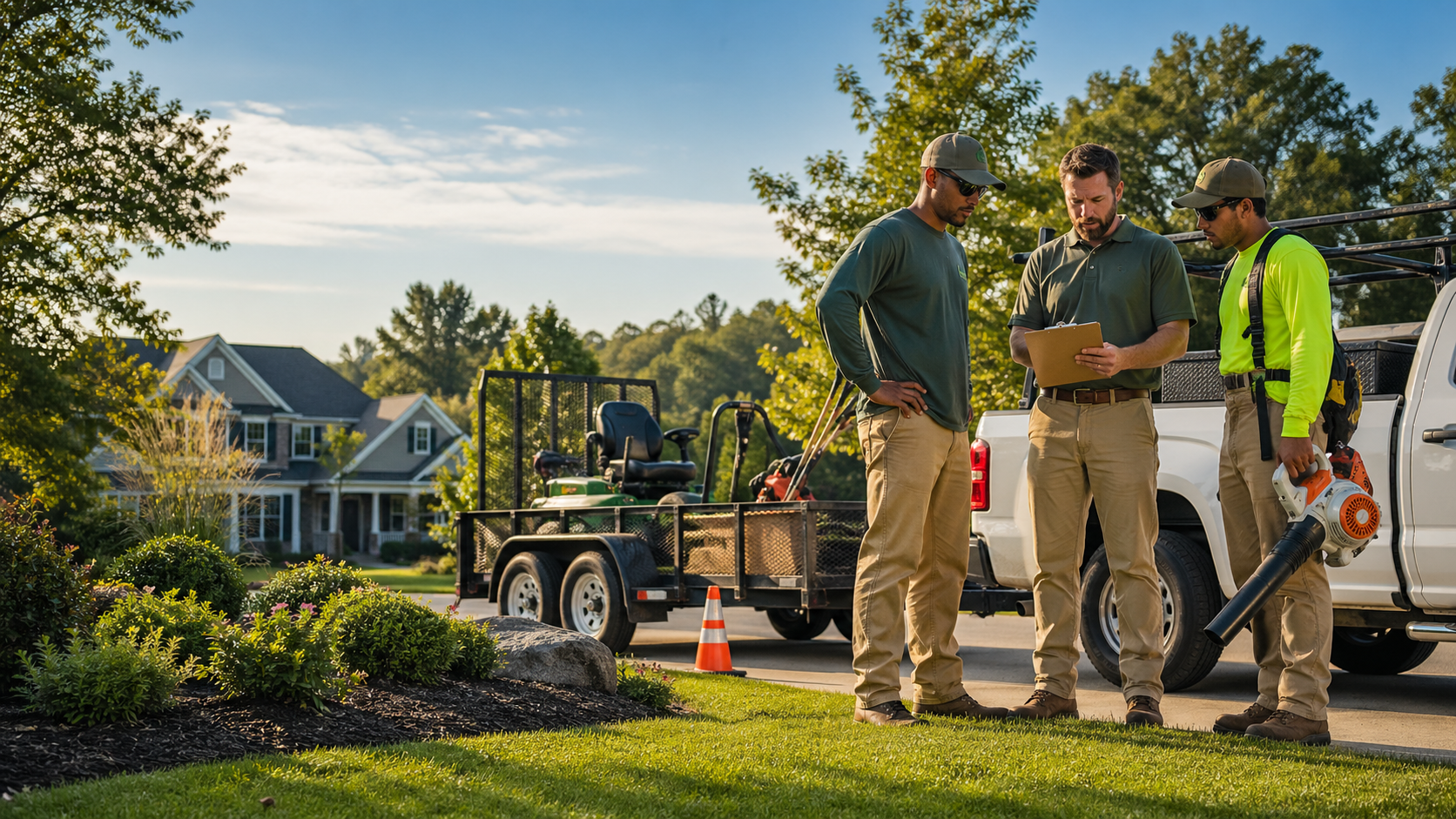
If your outdoor service business has three or more people working in it at any point, do not assume you are exempt because someone is part-time, seasonal, related to you, paid by 1099, or excluded as an owner. The facts matter.
North Carolina Landscaping Workers Comp: What the Law Is Pointing At
The North Carolina Industrial Commission explains employer workers compensation requirements in North Carolina. Its employer guidance says businesses with three or more employees generally need workers compensation coverage, and it notes that corporate officers are counted when determining whether a corporation has three or more employees.
N.C.G.S. § 97-93 addresses the obligation for employers subject to the Workers Compensation Act to insure their liability or prove financial ability to pay benefits. In practical terms, if your landscaping business is subject to the law, you need a proper workers compensation solution in place. That usually means a workers compensation policy, unless the business qualifies for another approved method.
This is why the employee count matters so much. The legal trigger, the insurance policy, and the contract requirements all need to line up before someone gets hurt.
What the 3-Employee Rule Means for a Landscaping Business
The 3-employee rule does not only apply to large companies. It can hit a small mowing crew very quickly.
For example, say you own a lawn care business with two full-time crew members. During the busy season, you bring in a part-time helper to ride along, edge beds, haul debris, or help with spring cleanup. You may now have three employees for workers compensation purposes.
That does not mean all three people have to work the same route, the same day, or the same number of hours. A part-time employee still counts.
People who commonly count toward the threshold
- Full-time lawn care employees
- Part-time helpers
- Seasonal spring cleanup workers
- Seasonal fall leaf removal workers
- Corporate officers, even if excluded from coverage
- Some workers paid as 1099s, depending on the facts
People who may not automatically count
- Sole proprietors
- LLC members
- Partners in a partnership
That owner structure still needs to be reviewed carefully. The wrong assumption can create a problem at audit, after an injury, or when a contract requires proof of coverage.
Workers compensation law and insurance underwriting are not the same thing as contract requirements. Even if you are legally below the threshold, a general contractor, property manager, builder, municipality, or commercial client may still require you to carry workers compensation before you can start work.
Need a quick crew-size check?
Not sure if your landscaping, lawn care, or tree service crew triggers workers comp? Carolina Risk Partners can review employee count, seasonal help, 1099 labor, owner elections, and class code concerns before a claim or audit forces the issue.
The 1099 Trap for Landscaping and Lawn Care Businesses
Using 1099 labor is common in landscaping. It is also one of the easiest ways for a business owner to get workers compensation wrong.
A tax form does not automatically decide whether a worker is treated as an employee for workers compensation purposes. The working relationship matters. If you control when the person shows up, which jobs they work, what equipment they use, how the job is done, and whether they can work for others, that person may look more like an employee than an independent contractor.
This creates two separate problems.
Problem 1: The 1099 worker may count toward your employee threshold
If a regular “subcontractor” functions like an employee, the business may be closer to the three-employee rule than the owner realizes.
Problem 2: You may still have subcontractor injury exposure
Even if the worker is truly independent, subcontractor workers compensation exposure can still come back on the hiring business if the subcontractor does not carry proper coverage. That is why subcontractor certificates, written agreements, and insurance review matter before the job starts.
If a landscaping business uses the same 1099 helpers every week, tells them where to go, controls their schedule, supplies equipment, and does not collect proof of their insurance, that arrangement deserves a closer review.
Common Landscaping Workers Comp Scenarios
Two full-time workers plus one part-time helper
This is usually three employees. Workers compensation is likely required.
Solo LLC owner plus two crew members
The LLC member may not automatically count, but the two employees do. Adding one more worker can trigger the rule.
Two employees plus one corporate officer
The corporate officer may count toward the threshold even if excluded from coverage.
Two employees plus one regular 1099 helper
Possibly three, depending on how much control the business has over the worker.
Seasonal crew that grows to five in spring
Coverage may be required during the period the business reaches three or more employees.
Tree service crew with one climber and two ground workers
That is likely three employees, and the tree work classification needs to be handled carefully.
Tree Service Businesses Have an Extra Class Code Issue
Tree service businesses have the same three-employee workers compensation issue, but they also have a separate classification problem.
Ground-level landscaping and lawn care work is not the same exposure as climbing, pruning, removal, bucket truck work, and aerial tree operations. Tree service work is more hazardous, and the workers compensation class code needs to reflect the actual work being performed.
For many outdoor contractors, ground-level landscaping work is commonly associated with NCCI code 0042, while tree pruning, removal, and aerial tree service work may be associated with NCCI code 0106. The correct classification depends on the actual operations, payroll records, and underwriting review.
If tree service payroll is incorrectly run under a lower-rated landscaping class code, an audit can produce a surprise additional premium bill. If a claim happens while the work is misclassified, underwriting problems can become even more serious.
Why This Matters in Wake Forest, Raleigh, Durham, and the Triangle
Landscaping businesses around Wake Forest, Raleigh, Durham, Cary, Apex, Garner, Johnston County, and the broader Triangle often grow in stages. A solo owner adds one helper, then two full-time crew members, then a seasonal worker for spring cleanup, mulch installs, drainage work, or leaf removal.
That growth is good, but it can quietly change the insurance picture. A business that felt like a small lawn care operation in February may look like a workers compensation account by April. If the company also starts taking commercial jobs, HOA work, builder work, municipal work, or subcontracted tree work, the contract requirements may become stricter than the legal minimum.
What Happens If You Should Have Workers Comp But Do Not
Operating without required workers compensation coverage is not just a paperwork issue. It can become a business survival issue.
Uninsured injury costs can become your responsibility
If an employee gets hurt and the business should have had workers compensation coverage, the employer may be responsible for medical costs, wage replacement, and other workers compensation benefits.
The Industrial Commission can get involved
The North Carolina Industrial Commission can investigate coverage issues and may assess penalties or take enforcement action against non-compliant employers.
General liability does not fix the gap
General liability insurance is not designed to cover employee injuries. It is primarily built for third-party bodily injury and property damage claims. A hurt employee is a workers compensation issue, not a general liability workaround.
Your contracts may require coverage anyway
Many builders, general contractors, municipalities, commercial property managers, and larger clients will not let a landscaping or tree service company on the job without workers compensation coverage, even if the business believes it is below the legal threshold.
Owner Exemptions: Can the Business Owner Opt Out?
Owner treatment depends on the business structure.
Sole proprietors, LLC members, and partners are generally not automatically counted as employees under North Carolina Industrial Commission guidance. They may be able to elect to include themselves in coverage.
Corporate officers are different. A corporate officer may be able to exclude themselves from workers compensation coverage, but that exclusion does not remove them from the three-employee threshold count.
This is why a small incorporated landscaping business can accidentally trigger the rule faster than expected.
Self-Audit Checklist for North Carolina Landscaping Businesses
Use this checklist before the busy season, before hiring seasonal help, and before signing a larger commercial contract.
How Much Does Workers Comp Cost for a Landscaping Business?
The cost depends on payroll, class codes, claims history, prior audits, owner inclusion or exclusion, and carrier appetite.
A small ground-level lawn care crew will usually price differently than a tree service business with climbing, chainsaw, bucket truck, or removal exposure. A mixed operation may need payroll split between the appropriate classifications.
The biggest rating factors usually include:
- Total payroll
- Type of work performed
- Workers compensation class codes
- Prior claims history
- Experience Modification Rate, also called EMR
- Owner inclusion or exclusion
- Subcontractor usage
- Carrier underwriting appetite
For most landscaping businesses, the goal is not just to find the cheapest number. The goal is to avoid a surprise audit bill, a misclassification issue, or an uncovered injury problem later.
How Carolina Risk Partners Helps Landscaping Businesses Get This Right
Carolina Risk Partners helps landscaping, lawn care, hardscape, irrigation, grading, and tree service businesses across North Carolina review workers compensation coverage before it becomes a problem.
We look at the practical issues that often get missed:
- Whether your employee count triggers coverage
- Whether owner elections are handled correctly
- Whether 1099 labor creates workers compensation exposure
- Whether class codes match the real work being done
- Whether payroll records support the way the policy is written
- Whether contract requirements are stricter than the legal minimum
If your business is growing, adding seasonal crews, doing more tree work, or bidding larger commercial jobs, it is worth reviewing the workers compensation setup before the next renewal or audit.
Frequently Asked Questions
How many employees does a landscaping business need before workers comp is required in North Carolina?
Most North Carolina businesses are required to carry workers compensation insurance once they have three or more employees. For landscaping businesses, that can include full-time employees, part-time employees, seasonal employees, and corporate officers. Some 1099 workers may also create exposure depending on the facts of the working relationship.
Do part-time lawn care workers count toward the 3-employee rule?
Yes. Part-time employees count toward the three-employee threshold in North Carolina. The number of hours worked per week does not remove them from the count.
Do seasonal landscaping employees count for workers comp in North Carolina?
Yes. Seasonal employees count while they are working. If a landscaping business reaches three or more employees during spring cleanup, mowing season, leaf removal, or storm cleanup, the workers compensation requirement may apply during that period.
Do corporate officers count toward the North Carolina workers comp threshold?
Yes. Under North Carolina Industrial Commission guidance, corporate officers may elect to exclude themselves from workers compensation coverage, but they are still counted when determining whether the business has three or more employees.
Do 1099 landscaping workers count as employees for workers comp?
Possibly. North Carolina looks at the facts of the working relationship, not just the tax form. If the business controls when, where, and how the worker performs the job, a 1099 worker may be treated more like an employee for workers compensation purposes.
Is tree service workers comp different from landscaping workers comp?
Yes. Ground-level landscaping work is commonly classified differently from aerial tree work. Tree pruning, climbing, removal, and bucket truck operations may need to be rated under a tree service class code rather than a standard landscaping class code.
Can a landscaping business owner exclude themselves from workers comp?
It depends on the business structure. Sole proprietors, LLC members, and partners are not automatically counted as employees under North Carolina Industrial Commission guidance, but they may elect to be included. Corporate officers may elect to exclude themselves from coverage, but they still count toward the three-employee threshold.

Stephen Ellias is the founder of Carolina Risk Partners LLC, an independent commercial insurance agency based in Wake Forest, North Carolina. He is a licensed North Carolina insurance professional, license number 20374040, with a CLCS, Commercial Lines Coverage Specialist, designation. Stephen helps contractors and outdoor service businesses understand workers compensation, general liability, commercial auto, subcontractor risk, class codes, audits, and contract insurance requirements in clear, practical terms.
Need a second look before your next hire, audit, or contract?
Carolina Risk Partners can help review your workers compensation setup, employee count, class codes, subcontractor process, and contract requirements before they turn into expensive problems.
Disclaimer: This article is for general educational purposes only and is not legal advice. It does not create an insurance, broker, or attorney-client relationship. Workers compensation requirements, coverage availability, class codes, exclusions, owner elections, and underwriting eligibility vary by business structure, carrier, and policy language. Speak with a licensed insurance professional and a qualified attorney about your specific situation.