
Carolina Risk Partners
Commercial Auto Insurance for Landscaping Companies in North Carolina
Landscaping Business Insurance
Commercial Auto Insurance for Landscaping Companies in North Carolina
Landscaping companies create a different auto exposure than an ordinary office business. Work trucks haul employees, mowers, trailers, chemicals, debris, materials, and equipment between multiple properties every day. The policy needs to reflect how those vehicles are actually used.
Key Takeaways
- A personal auto policy may not be appropriate for a truck regularly used in a landscaping business.
- The truck, trailer, and equipment being hauled are separate coverage questions.
- Employees, seasonal workers, family members, and owners who drive should be disclosed accurately.
- Vehicle weight, trailer weight, towing, operating radius, and interstate travel can create compliance issues beyond insurance.
- Lower premiums do not help if vehicles, drivers, trailers, or business uses are missing from the policy.
Quick Answer
Commercial auto insurance for landscaping companies in North Carolina can cover business-owned trucks and other scheduled vehicles for liability, physical damage, and selected related exposures. Landscaping companies operating in Wake Forest, Raleigh, Durham, Cary, and across the Triangle may also need coverage for trailers, hired vehicles, employee-owned vehicles used for work, and liability limits required by commercial clients.
The auto policy usually does not replace inland marine coverage for mowers, blowers, skid steers, hand tools, or other equipment being transported.
Bottom line: review the vehicles, trailers, drivers, equipment, and actual business use together.
Why Landscaping Vehicles Need a Closer Insurance Review
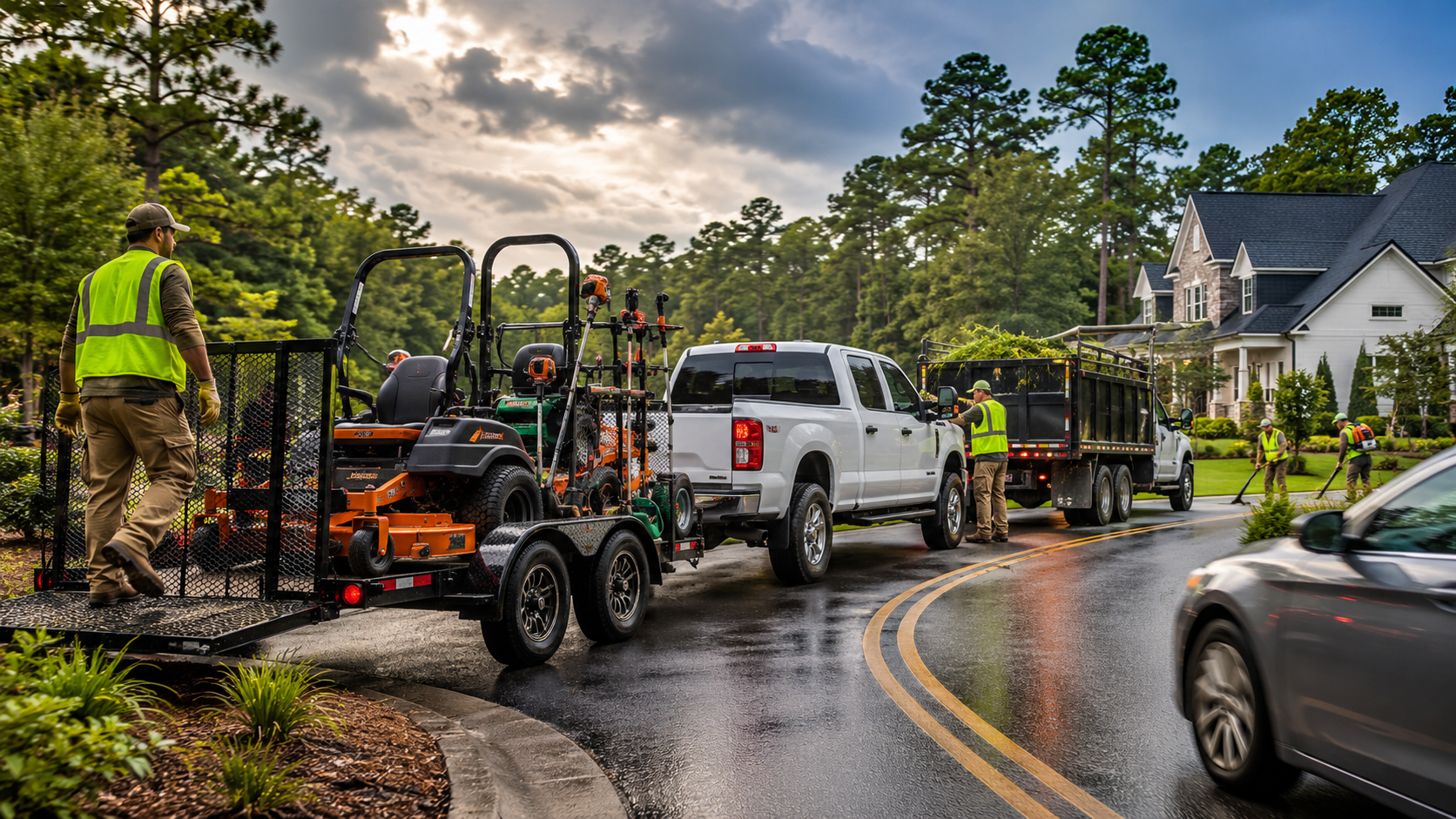
A landscaping truck may pull a trailer to several properties, carry a crew, haul mulch, transport fuel cans, tow a mower, pick up materials, and remove debris before returning to the shop.
What the vehicles are
Pickup trucks, flatbeds, dump trucks, box trucks, vans, crew vehicles, and trailers can be rated differently.
Who is driving
Owners, supervisors, full-time employees, seasonal employees, and occasional drivers may all affect eligibility and pricing.
What is being hauled
Mowers, skid steers, mini excavators, fuel, pesticides, mulch, stone, debris, and other materials create different exposures.
Where the vehicles travel
Local residential routes, commercial properties, municipal work, highway travel, and out-of-state operations may be viewed differently.
The practical issue: the business should be described as it actually operates. Calling a truck personal use while it regularly pulls a landscaping trailer or carries a crew can create underwriting and claim complications.
What Commercial Auto Insurance May Cover
Auto liability
May respond when an insured business vehicle causes bodily injury or property damage to another party.
Collision coverage
May cover physical damage to a scheduled vehicle caused by collision or overturn, less the deductible.
Comprehensive coverage
May address covered losses such as theft, vandalism, falling objects, animal impact, fire, or certain weather damage.
Uninsured and underinsured motorist coverage
May provide protection when the responsible driver has no insurance or insufficient insurance.
Hired and non-owned auto liability
Can address certain liability arising from rented vehicles or employee-owned vehicles used for company business.
Physical damage options
Vehicle values, deductibles, rental reimbursement, towing, and roadside coverage should be reviewed by unit.
Commercial auto should be reviewed alongside general liability insurance, workers compensation insurance, and commercial umbrella insurance.
The Truck, Trailer, and Equipment Are Three Different Questions
The truck
The business auto policy can insure a scheduled truck for selected liability and physical damage coverages.
The trailer
Liability while towing and physical damage to the trailer are not necessarily handled the same way. The trailer may need to be separately scheduled.
The equipment
Mowers, trimmers, blowers, saws, skid steers, and other mobile equipment usually need separate inland marine or contractors equipment coverage.
Property belonging to others
Materials, customer property, rented equipment, or equipment in the company’s care may create additional questions.
A common misunderstanding
Insuring a pickup truck does not automatically insure the trailer and landscaping equipment attached to or carried on it.
Landscaping companies with valuable mobile equipment should also review inland marine insurance and the guide to landscaping equipment theft in North Carolina.
Not Sure What Your Current Policy Actually Includes?
A practical review starts with a vehicle list, driver list, trailer details, equipment values, current declarations, and a clear description of how the company operates.
Carolina Risk Partners can help North Carolina landscaping companies compare carrier options and review pricing without ignoring vehicle use, towing, drivers, limits, exclusions, and adjacent coverage needs.
Name, email, phone, and a few details are enough to start. I’ll follow up within 1 business day.
Hired and Non-Owned Auto for Landscaping Companies
Hired auto can involve vehicles the company rents, leases, hires, or borrows, depending on policy definitions. Non-owned auto exposure can arise when employees use personal vehicles for business errands or job duties.
- Renting a pickup while a company truck is being repaired
- Renting a larger truck for a one-time installation project
- A supervisor driving a personal vehicle to inspect jobsites
- An employee picking up plants, materials, or parts
Important: hired and non-owned auto liability generally does not turn an employee’s personal vehicle into a company-owned scheduled vehicle. It also does not automatically pay for physical damage to that vehicle.
Driver Eligibility Can Affect Price and Carrier Options
Commercial auto underwriting is heavily influenced by the people behind the wheel. Insurers may review:
- Driver age and experience
- License status
- Recent accidents
- Moving violations
- Serious violations
- Vehicle assignment
- Trailer and towing experience
- Out-of-state licenses
- Frequency of vehicle use
- Prior commercial driving history
A carrier may accept one driver, charge more for another, exclude a driver when permitted, or decline the account based on the combined driver profile.
Commercial Auto Requirements for HOA, Municipal, and Commercial Landscaping Contracts
A property manager, municipality, general contractor, developer, or HOA may require a specific commercial auto liability limit, proof of owned, hired, and non-owned auto coverage, a certificate of insurance, and commercial umbrella limits.
Do not wait until the day the contract starts
Higher limits, broader covered-auto requirements, unacceptable drivers, or missing hired and non-owned auto coverage may require underwriting approval.
Companies pursuing larger accounts should review the auto requirements together with the broader landscaping and tree service insurance program.
What Affects Commercial Auto Insurance Pricing?
Vehicles and values
Vehicle type, age, cost new, current value, body style, weight, and installed equipment may affect pricing.
Drivers
Driver ages, records, experience, license status, and the number of drivers compared with vehicles matter.
Use and radius
Daily mileage, operating radius, highway use, out-of-state travel, and overnight use can influence underwriting.
Trailers and towing
Trailer types, values, weights, towing frequency, and the equipment carried should be disclosed accurately.
Claims history
Prior liability, collision, theft, glass, backing, and towing losses may affect price and carrier eligibility.
Limits and deductibles
Higher liability limits, physical damage options, and deductible choices affect premium.
Auto insurance is only one component of the total insurance budget. For a broader explanation of payroll, operations, equipment, vehicles, subcontractors, limits, and other rating variables, read how much landscaping insurance costs in North Carolina.
Competitive pricing matters, but the comparison must be accurate. A lower quote may reflect different limits, missing vehicles, reduced physical damage, excluded drivers, different deductibles, or a narrower description of operations.
Seven Commercial Auto Mistakes Landscaping Companies Make
Keeping a work truck on personal auto
The vehicle is regularly used for paid landscaping operations, but the policy has not been updated.
Insuring the truck but not the trailer
The owner assumes the trailer is fully covered simply because it is attached to an insured truck.
Assuming equipment is part of auto coverage
Mowers, trimmers, and tools are transported without adequate mobile-equipment coverage.
Letting unreviewed employees drive
A seasonal or new employee is assigned a vehicle before carrier acceptability is confirmed.
Leaving vehicles in a former owner’s name
The title, registration, named insured, and actual business ownership do not align.
Ignoring hired and non-owned autos
Employees routinely use personal vehicles for business errands, but the exposure was never discussed.
Shopping only the premium
The company selects the lowest number without comparing limits, deductibles, vehicles, drivers, and endorsements.
Vehicle Weight, Trailers, and Compliance Questions
Insurance is only one part of operating landscaping vehicles safely and legally. Depending on vehicle weight, trailer weight, cargo, travel, and operations, the business may also need to review licensing, registration, inspection, cargo securement, and motor-carrier rules.
- Confirm trailer title and registration information agrees with the insurance schedule.
- Review CDL thresholds for heavier truck-and-trailer combinations.
- Secure mowers, machines, tools, debris, and materials appropriately.
- Review additional requirements before crossing state lines.
Insurance does not replace compliance. A policy may respond to a covered claim, but it does not make an improperly licensed, overloaded, unregistered, or unsecured operation compliant.
Official resources: North Carolina Department of Insurance, NCDMV trailer guidance, and FMCSA cargo-securement guidance.
Information Needed to Quote Landscaping Commercial Auto Insurance
- Current policy declarations
- Loss runs when requested
- Vehicle year, make, model, and VIN
- Vehicle cost new and current value
- Registered and titled owner
- Garaging address
- Trailer VINs, types, and values
- Driver names and dates of birth
- Driver license information
- Description of operations
- Driving radius
- Interstate travel details
- Equipment being hauled
- Requested liability limits
- Physical damage deductibles
- Commercial contract requirements
When Should a Landscaping Company Review Its Auto Policy?
- The renewal price increased substantially
- A new truck, dump vehicle, or trailer is being purchased
- The business hired new or seasonal drivers
- A driver had an accident or serious violation
- The company began using employee-owned vehicles
- Vehicles are crossing state lines
- A commercial contract requires higher limits
- The company added hardscaping, grading, tree work, or snow removal
- Equipment values increased
- The business is unsure whether the trailer or equipment is covered
Frequently Asked Questions
Do landscaping companies need commercial auto insurance in North Carolina?
A landscaping company should generally consider commercial auto insurance when vehicles are owned, titled, leased, or regularly used by the business.
Does commercial auto insurance cover a landscaping trailer?
A commercial auto policy may provide certain liability protection when a scheduled vehicle is towing a trailer, but physical damage to the trailer itself may require the trailer to be specifically listed and insured.
Are lawn mowers and landscaping equipment covered by commercial auto insurance?
Commercial auto insurance usually does not insure the value of mowers, blowers, trimmers, skid steers, or other equipment simply because it is being transported.
What is hired and non-owned auto insurance for a landscaping company?
It can address certain business liability arising from rented vehicles and employee-owned vehicles used for company business.
Can employees drive landscaping company vehicles?
Employees may drive company vehicles when permitted by the business and acceptable to the insurer.
How much does commercial auto insurance cost for a landscaping company?
Pricing depends on the vehicles, drivers, radius, claims history, limits, deductibles, trailer use, equipment hauling, garaging, and overall operations.
Does a landscaping company need commercial umbrella insurance over its auto policy?
An umbrella may be appropriate when the company wants limits above the commercial auto policy or must satisfy a contract requiring higher liability limits.
Bottom Line
Commercial auto insurance for landscaping companies in North Carolina should reflect more than the number of trucks in the driveway. The review should account for the vehicles, drivers, trailers, equipment, towing, travel radius, contract limits, and the way the company performs work every day.
From Carolina Risk Partners’ Wake Forest office, Stephen Ellias, CLCS, helps landscaping companies in Raleigh, Durham, Cary, throughout the Triangle, and across North Carolina compare insurance options while reviewing the coverage details that can matter after an accident, theft, contract request, or renewal increase.
NC Insurance Producer License 20374030.

About Stephen Ellias
Stephen Ellias, CLCS, is the founder of Carolina Risk Partners and a commercial insurance advisor serving contractors and small businesses throughout North Carolina. He holds North Carolina Insurance Producer License 20374030.
Learn more about Stephen or call (919) 910-4554.
This article provides general insurance information and is not a guarantee of coverage. Actual coverage depends on policy language, covered-auto symbols, vehicle and driver schedules, endorsements, exclusions, limits, deductibles, underwriting decisions, and the facts of a claim.