

Landscaper Insurance in North Carolina: Why Tree Work Changes Coverage
If your landscaping business trims trees, removes trees, grinds stumps, or handles storm cleanup, your insurance may need to be rated differently than a basic mowing and grounds maintenance operation.
- Landscaping and tree work can be treated as different insurance exposures, even when the same crew does both.
- NCCI class code 0042 is commonly associated with landscape gardening and drivers.
- NCCI class code 0106 is commonly associated with tree pruning, trimming, and spraying.
- Tree removal, storm cleanup, stump grinding, bucket truck work, and climbing can change rating and carrier appetite.
- If tree work is not disclosed, the problem may show up at audit, renewal, or after a claim.
If your landscaping crew trims, removes, grinds, or cleans up trees, your workers compensation and general liability may need different classifications than a standard mowing operation. The issue is not what customers call the work. The issue is what your crew actually does and whether the carrier agreed to insure that exposure.
Bottom line: if your business has added tree work, review the policy before an audit, renewal, or claim forces the conversation.
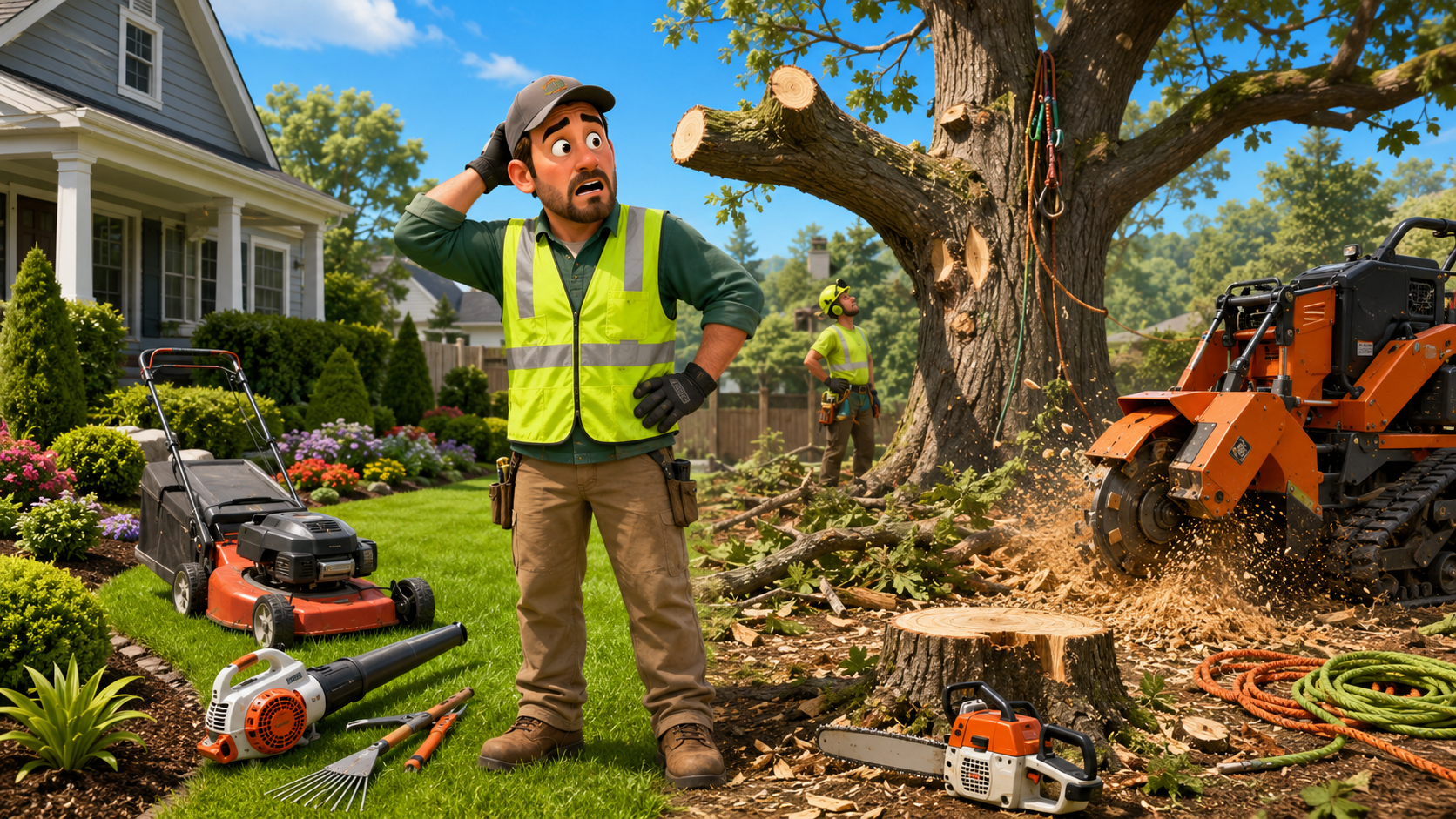
The Problem With Saying “We Do Landscaping”
A lot of business owners use the word landscaping to describe everything outside a house or commercial building. Mowing, mulch, planting, grading, trimming branches, removing small trees, grinding stumps, and cleaning up storm debris all get placed in the same bucket.
Insurance carriers do not always see it that way.
A lawn maintenance company and a tree service company may both pull up with trucks, trailers, crews, saws, and outdoor equipment. But from an underwriting standpoint, they can be very different risks.
A crew mowing lawns is not the same risk as a crew climbing trees, operating a bucket truck, lowering limbs over a roof, or removing a storm-damaged tree from a tight property line.
That is why landscaper insurance in North Carolina can change quickly when tree work becomes part of the operation.
Your customer may call all of it landscaping. Your insurance carrier may not. If your policy says landscaping but the claim comes from tree removal, the carrier is going to look at what work was actually being done, how the account was classified, and whether that operation was disclosed.
North Carolina workers compensation issues can also become more serious when uninsured subcontractors are involved. Under N.C.G.S. Chapter 97, including § 97-19, contractor and subcontractor relationships can create workers compensation problems when the party doing the work does not have proper coverage.
Why This Matters Before a Claim or Audit
The classification issue is not just paperwork. It can affect three major parts of your insurance program:
- Workers compensation premium: Higher hazard operations usually carry different class codes and rates.
- General liability underwriting: The carrier wants to know whether it is insuring mowing, landscaping, pruning, removal, or storm cleanup.
- Audit and renewal outcomes: If your actual operations do not match the policy, the carrier may adjust premium, change terms, restrict coverage, or decline renewal.
The best time to fix the classification is before the audit, before the renewal, and before a serious claim.
Does Landscaping Insurance Cover Tree Removal in North Carolina?
Sometimes, but not automatically. A policy written for mowing and basic grounds maintenance may not be rated, underwritten, or priced for tree removal.
The answer depends on the policy language, carrier appetite, underwriting information, exclusions, endorsements, and what the crew was doing at the time of the claim.
A small ornamental pruning job is not the same exposure as removing a large storm-damaged tree over a roof. The more the work involves height, saws, falling limbs, traffic, power lines, specialized equipment, or emergency response, the more important the classification becomes.
What NCCI Class Code Applies to Tree Work?
North Carolina workers compensation classification is tied to NCCI rules and North Carolina rating administration. The two class codes that often come up for landscaping and tree work are 0042 and 0106.
Commonly associated with landscape gardening and drivers. This can include mowing, planting, seeding, mulching, and ordinary grounds maintenance.
Commonly associated with tree pruning, trimming, and spraying where the tree remains standing. This can involve height, limbs, saws, and tree canopy work.
NCCI Class Code 0042: Landscape Gardening and Drivers
Class code 0042 is commonly associated with landscape gardening and drivers. This is the code many lawn care and landscaping operations start with when their work involves mowing, planting, seeding, mulching, grading, irrigation, and general grounds maintenance.
If your crews are maintaining lawns, installing plants, spreading mulch, or handling ordinary landscape work, this is usually the kind of operation people think of when they say landscaping insurance.
NCCI Class Code 0106: Tree Pruning, Trimming, and Spraying
Class code 0106 is commonly associated with tree pruning, trimming, and spraying where the tree remains standing. If your crew climbs, works from a ladder, operates a lift, trims limbs, or works in a tree canopy, the exposure may no longer look like standard landscaping.
The reason is simple. Working at height around limbs, saws, ropes, traffic, roofs, power lines, and falling debris creates a different injury profile than mowing grass or spreading mulch.
What About Full Tree Removal?
Tree removal, storm cleanup, land clearing, logging-type operations, stump grinding, and debris removal can be treated differently depending on the facts. The right classification can depend on whether the work is pruning, removing trees with no timber value, land clearing, logging, or another operation.
Do not guess here. If your business removes trees, handles storm work, or uses specialized tree equipment, the policy should be reviewed before the carrier or auditor makes the decision for you.

Want a Fast Classification Review?
Send the tree services you offer and your contact info. I can help you spot whether the current policy looks like mowing only, landscaping, tree service, or a mixed operation.
I’ll follow up within 1 business day. No sales pitch. Just a practical next step.
Is Tree Service Workers Comp More Expensive Than Landscaping?
Often, yes. Tree work is usually treated as a higher hazard operation than basic grounds maintenance because the crew may be working at height, using chainsaws, handling falling limbs, operating chippers, or working near structures and traffic.
That does not mean every landscaper who trims a shrub suddenly becomes a full tree service company. It means the details matter.
Carriers and auditors may look at the type of tree work, payroll split, equipment used, height exposure, subcontractor use, claims history, and whether the operation was disclosed before the policy started.
In fast-growing markets like Raleigh, Durham, Cary, Apex, Garner, Knightdale, Wake Forest, and Johnston County, landscaping companies often expand into tree work as residential and commercial construction increases demand for site prep, lot clearing, storm cleanup, and property maintenance. That growth can be good. It just needs to be reflected in the insurance program.
What Counts as Tree Work for Insurance?
This may point away from ordinary landscaping and toward tree pruning or trimming exposure.
Full removal can create a more serious classification and underwriting issue than basic trimming.
Specialized tree equipment should be disclosed because it changes the way the operation looks.
Storm cleanup can involve unstable trees, emergency work, property damage risk, and higher injury potential.
How the Wrong Classification Creates an Audit Bill
Workers compensation premium is usually built from estimated payroll, class codes, rates, carrier pricing, and your experience modification rate when applicable. At the end of the policy year, the carrier audits actual payroll and actual operations.
If the policy was written as standard landscaping but the crew spent part of the year doing tree work, the auditor may move that payroll into a different classification. That can create additional premium after the policy year is already over.
That audit bill can feel unfair because the business owner thought he was already insured. But from the carrier’s perspective, the original premium was based on one kind of work and the actual exposure was different.
For example, if part of the payroll was estimated under a lower hazard landscaping operation but later belongs under a higher hazard tree operation, the final audit may charge the difference. The exact amount depends on the rate, payroll, carrier pricing, experience mod, and policy terms.
This is why a lower premium at the beginning of the year is not always a win. If the policy is rated too low because the work was not classified correctly, the difference can come back later.
How Tree Work Can Affect General Liability
Workers compensation is not the only policy affected by classification. General liability can also become a problem when the policy was written for one operation but the claim comes from another.
For example, a landscaping company trims a large limb over a customer’s roof. The limb drops, damages the roof, breaks a window, and damages interior property. The claim may be submitted to the general liability carrier.
The carrier will look at the policy, the application, the classifications, the exclusions, the endorsements, and the facts of the loss. If tree trimming or tree removal was never disclosed, the carrier may question whether that operation was part of the covered business exposure.
That does not mean every claim is automatically denied. It means the claim becomes more complicated than it needed to be.
For broader coverage planning, review our pages on landscaping business insurance, arborist and tree service insurance, and general liability insurance.
Tree Work Can Also Change Commercial Auto and Equipment Coverage
Tree work often brings different vehicles and equipment than basic lawn maintenance. A mowing crew may have pickups, trailers, mowers, trimmers, and blowers. A tree crew may add bucket trucks, dump trailers, chippers, stump grinders, larger saws, lifts, and heavier hauling exposure.
That matters because one policy does not automatically solve every problem. Commercial auto may be needed for owned trucks and certain trailers. Inland marine may be needed for mobile equipment, tools, chippers, stump grinders, and other equipment that moves from job to job.
If a landscaping business has added a bucket truck, chipper, stump grinder, or larger trailer since the policy was first written, it is worth reviewing business auto insurance and inland marine insurance before assuming those items are handled correctly.
The Claim Scenario That Exposes the Gap
A Wake Forest landscaping business starts as a mowing and mulch company. Over time, customers ask for small tree trimming, then stump grinding, then storm cleanup. The owner keeps calling the business landscaping because that is how it started.
Two years later, a worker gets hurt while helping remove a storm-damaged tree. The carrier reviews the injury, the payroll records, the original application, the policy classifications, and the work being performed at the time of the loss.
Now the question is not just “is there a workers compensation policy?” The question is whether the policy accurately reflected the work the business was actually doing.
That is the conversation you want to have before the injury, not after it.
The North Carolina Classification Review Checklist
Use these questions before your next workers compensation renewal, general liability renewal, or premium audit.
- Do your employees ever climb trees, use ladders, or operate lifts to work in a tree canopy?
- Do you remove trees, even occasionally for existing landscaping customers?
- Do you grind stumps, run chippers, or use equipment mainly associated with tree service work?
- Do you respond to storm cleanup calls after wind, rain, or fallen tree damage?
- Does any revenue come from work where a tree is cut down or removed?
- Is all payroll currently assigned to one landscaping class code?
- Has your business added services since the policy was first written?
- Does your general liability carrier know tree work is part of your operation?
If you answered yes to any of those, your policy may need a closer review.
How a Combined Landscaping and Tree Service Policy Should Be Structured
A combined operation should not be forced into the cheapest class code and left there. A cleaner approach is to describe the business accurately, separate payroll where needed, disclose tree operations, and confirm that the carrier is willing to insure the full scope of work.
For many businesses, that means reviewing:
- Workers compensation class codes
- Payroll split between landscaping and tree work
- General liability classifications and exclusions
- Commercial auto coverage for trucks and trailers
- Inland marine coverage for mowers, chippers, stump grinders, saws, and tools
- Subcontractor controls if tree work is hired out
The premium may be higher than a basic landscaping policy, but the goal is not the cheapest paper. The goal is coverage that matches the work.
What to Ask Your Broker Before Renewal
Before renewing your policy, ask direct questions. Do not settle for “you should be fine” if your operation has changed.
- Which workers compensation class codes are currently on my policy?
- Is any payroll assigned to a tree pruning, trimming, or tree service classification?
- Does the current payroll split match what my crews actually do week to week?
- Does my general liability policy include tree trimming or tree removal operations?
- Are there exclusions or limitations for tree work, height work, crane work, or storm cleanup?
- What happens at audit if my tree work revenue is higher than estimated?
- Are my chippers, stump grinders, trailers, saws, and mowers covered correctly?
- If I use subcontractors for tree work, what insurance documents should I collect?
What If You Hire Tree Work Out to a Subcontractor?
Some landscapers do not want tree work on their own policy, so they hire a separate tree service crew. That can be a smart operational choice, but only if the subcontractor is properly insured.
If a subcontractor does not carry workers compensation and one of their workers gets hurt on your job, the exposure can come back to you in ways many business owners do not expect. It can also create problems at workers compensation audit when uninsured subcontractor labor is reviewed.
At minimum, you want to collect proof of insurance before the work starts. For subcontractor-heavy operations, also review your workers compensation insurance, commercial umbrella insurance, and written subcontractor process.
Landscaper Insurance and Tree Work Classification FAQs
Does landscaping insurance cover tree removal in North Carolina?
Not automatically. A landscaping policy is usually written around grounds maintenance work. Tree removal is a different and more hazardous operation. Coverage depends on how the work was disclosed, how the policy is classified, what exclusions apply, and what was happening at the time of the claim.
What NCCI class code applies to tree work?
Tree work classification depends on the operation. Class code 0042 is commonly associated with landscape gardening and drivers. Class code 0106 is commonly associated with tree pruning, trimming, and spraying where the tree remains standing. Full tree removal, land clearing, and storm cleanup may require additional review.
Can one workers compensation policy include both landscaping and tree service class codes?
Yes. A single workers compensation policy can include multiple class codes when the business performs more than one type of operation. The important issue is whether payroll is assigned correctly and whether the policy matches the work employees actually perform.
What happens if tree work is not disclosed to the insurance carrier?
If tree work is not disclosed, the carrier may review the claim, audit, or renewal based on the actual operations being performed. That can lead to additional premium, reclassification, nonrenewal, or a disputed claim depending on the policy language and the facts involved.
Does general liability cover a tree limb that damages a customer’s property?
It may, but only if the operation is properly disclosed and the policy does not exclude or limit the tree work being performed. A landscaping general liability policy that was never written for tree trimming or tree removal can create coverage questions when a loss involves tree work.
Why can tree work create a workers compensation audit bill?
Workers compensation premium starts with estimated payroll and estimated class codes. At audit, the carrier reviews actual payroll and operations. If some payroll belonged under a higher hazard tree service classification, the carrier may charge the premium difference.
Do I need separate policies for landscaping and tree service work?
Not always. Some businesses can be insured under combined policies if all operations are disclosed and the carrier is comfortable with the exposure. Other carriers may decline tree removal or require a separate program. The answer depends on the work performed, payroll split, equipment, claims history, and carrier appetite.
Stephen Ellias is the founder of Carolina Risk Partners LLC, an independent commercial insurance agency based in Wake Forest, North Carolina. He helps contractors, landscapers, tree service businesses, and blue-collar trade companies review workers compensation, general liability, commercial auto, inland marine, class codes, audits, subcontractor risk, and coverage gaps.
Not Sure if Your Landscaping Policy Matches Your Tree Work?
If your business mows, landscapes, trims trees, removes trees, grinds stumps, or handles storm cleanup, your insurance should match the work your crew actually performs.
Carolina Risk Partners helps North Carolina landscaping and tree service businesses review workers compensation, general liability, commercial auto, and equipment coverage before a claim or audit exposes a classification problem.
123 S White Street, Suite 203, Wake Forest, NC 27587
Phone: 919-910-4554
Serving landscaping businesses, tree service businesses, contractors, and small businesses across North Carolina.
This article is for general educational purposes only and is not legal, tax, or coverage advice. Insurance coverage depends on the specific policy language, endorsements, exclusions, underwriting information, carrier rules, and facts of a claim. Always review your own policy and business operations with a licensed insurance professional.