How Commercial Auto Loss Runs Change a Fleet Renewal
A fleet renewal is not simply a vehicle-count exercise. Underwriters may evaluate claim frequency, severity, open reserves, recurring drivers, preventability, accident patterns, and the steps management took after a loss.
Quick Answer
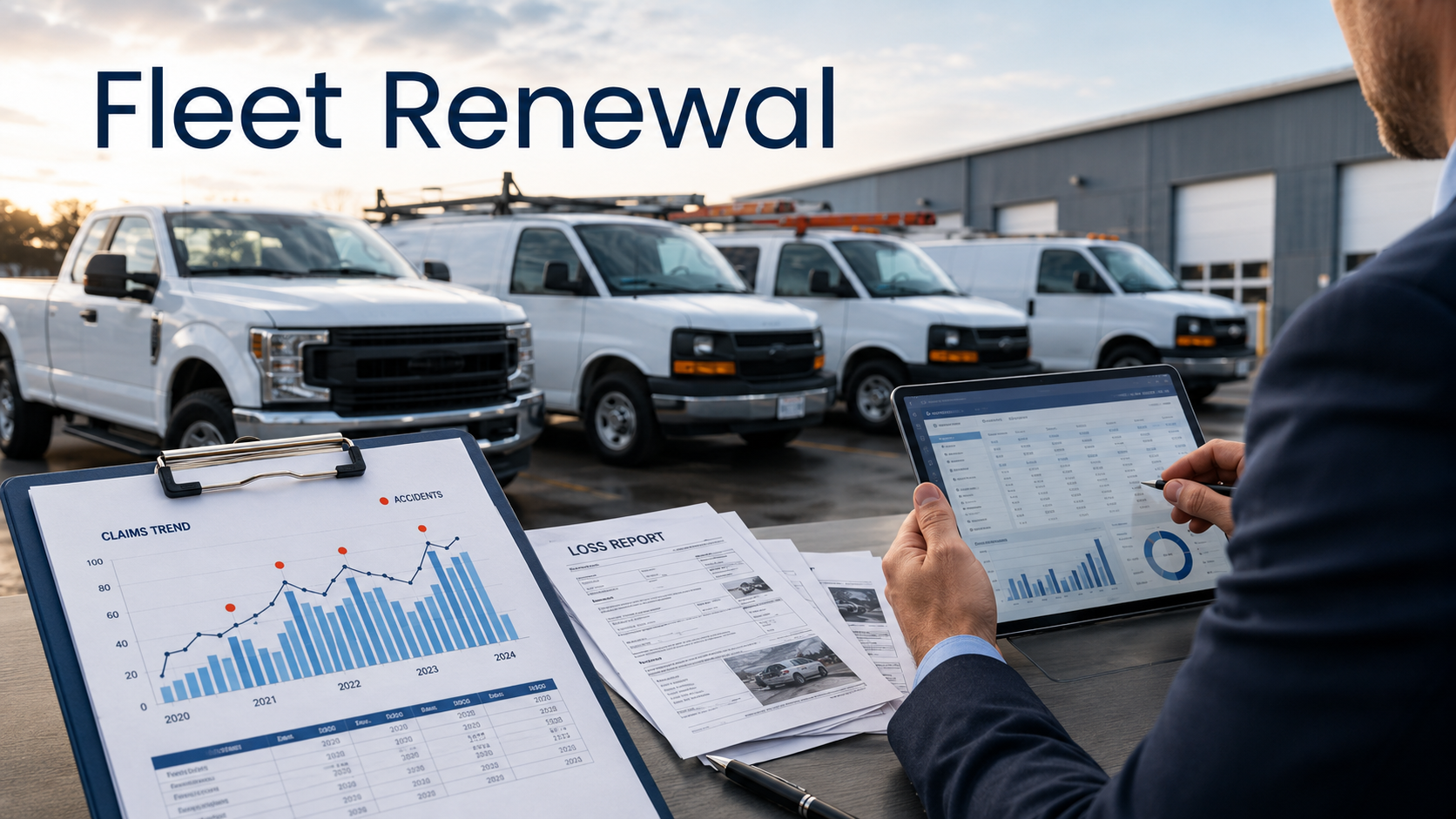
A commercial auto loss run is a record of claims associated with an insurance policy. It commonly shows the date of loss, claim status, amount paid, outstanding reserve, and other claim information.
At renewal, underwriters may use those records to determine whether a fleet appears stable or whether the claims indicate a recurring driver, safety, training, supervision, or loss-control problem.
Key Takeaways
- Loss runs show more than the number of accidents.
- Frequency and severity can create different underwriting concerns.
- Open claims and reserves can affect how an underwriter views unfinished losses.
- Repeated accidents involving the same driver or same loss type deserve attention.
- A documented corrective-action story can make the renewal submission stronger.
Why Loss Runs Matter More as a Fleet Grows
A business with one or two vehicles has relatively little claim data. A contractor or service company operating 10, 20, 30, or more vehicles creates a much larger body of information for an underwriter to evaluate.
That matters for established businesses operating throughout Wake Forest, Raleigh, Durham, Cary, and the rest of North Carolina. More vehicles usually mean more drivers, more road miles, more backing situations, more jobsite traffic, and more opportunities for patterns to develop.
Two fleets with similar vehicle counts and similar total claim dollars can still receive very different underwriting reactions because their loss runs may tell very different stories.
What Is a Commercial Auto Loss Run?
A commercial auto loss run is a report summarizing claims associated with an insurance policy during a specified period. Depending on the carrier and report, it may show the date of loss, claim description, driver, vehicle, claim status, amounts paid, and outstanding reserves.
An open reserve is an amount the insurance company has set aside for the estimated future cost of an unresolved claim. It is not necessarily the final amount the carrier will ultimately pay.
That distinction matters. A loss run showing $75,000 paid and another $150,000 in open reserves may be viewed differently from one showing $75,000 paid with every claim closed.
What Do Commercial Auto Underwriters Look for on Loss Runs?
Claim Frequency
Repeated smaller accidents may indicate an operational pattern even when no individual loss is catastrophic.
Claim Severity
A major bodily injury or property damage claim can materially change the risk picture even if overall claim frequency is low.
Open Claims and Reserves
An unresolved claim can create uncertainty because the ultimate cost has not yet been established.
Repeated Accident Types
Several backing accidents, rear-end collisions, lane-change losses, or intersection accidents may point to a repeatable problem.
Recurring Drivers
Multiple claims involving the same driver may trigger questions about driver eligibility, supervision, training, and continued vehicle use.
Management Response
Underwriters may want to know what changed after a preventable loss, not merely that a claim happened.
Claim Frequency vs. Severity: Why the Difference Matters
Frequency is the number of claims. Severity is the financial size of those claims. Those two concepts create different questions for an underwriter.
| Fleet | Loss Pattern | Possible Underwriting Question |
|---|---|---|
| Fleet A | One unusually large accident, otherwise clean history | Was this an isolated event, and what caused the severity? |
| Fleet B | Six smaller preventable accidents over two years | Is there a recurring driver-selection, training, supervision, or fleet-management issue? |
Fleet B can create meaningful concern even when its total dollars paid are lower. Repeated claims may suggest the next accident is not purely random.
It is also, “What does the pattern suggest about how the fleet is being managed?”
Why Open Reserves Can Complicate a Fleet Renewal
An open reserve can create uncertainty during the renewal process because the claim has not reached a final financial outcome.
For example, a liability claim may still involve ongoing medical treatment, attorney activity, property damage negotiations, or questions about fault. The current reserve may change as additional information develops.
Business owners sometimes look at an open reserve and assume it is automatically excessive. That is not always a sound conclusion. A reserve is an insurer’s current estimate of expected claim cost, not a bill to the insured and not necessarily the final settlement value.
The practical renewal question is whether the loss run is accurate, whether old claims should now be closed, and whether the current status of important open claims can be explained before the account reaches new underwriters.
Have Open Claims on Your Loss Runs?
I can review the loss runs with you before a renewal is submitted and help identify the claims an underwriter is most likely to question.
Sharing loss runs with us for a private review does not change your current policy or automatically send the account to insurance carriers.
Or call (919) 910-4554.
Preventable vs. Non-Preventable Accidents
Not every accident should create the same concern. The facts matter.
| Loss Type | Example | What Management Should Document |
|---|---|---|
| Potentially Preventable | Backing into a parked vehicle | Backing policy, spotter rules, camera use, driver coaching, retraining |
| Potentially Preventable | Rear-ending another vehicle | Following-distance standards, distracted-driving policy, driver discipline |
| Potentially Non-Preventable | Insured vehicle is legally parked and struck | Police report, claim facts, documentation of circumstances |
| Fact Dependent | Intersection or lane-change collision | Accident investigation, video or telematics, driver statement, police findings |
The insurance carrier ultimately evaluates the claim based on its own underwriting and claim standards. From a fleet-management standpoint, however, separating preventable from non-preventable events helps management decide where corrective action is actually needed.
The Same Driver Appearing Repeatedly Is a Different Problem
A fleet owner should not review losses only by accident date. Review them by driver as well.
If one employee appears in multiple incidents, compare the loss runs with the driver’s motor vehicle record, or MVR, internal accident reports, training records, and any disciplinary action.
An MVR is the driver’s motor vehicle record. Businesses commonly use MVR reviews as part of driver qualification and ongoing fleet-management procedures.
An MVR threshold is an internal standard used to decide which driving violations, accident history, license status, or combination of events makes a driver acceptable, subject to review, or unacceptable for company driving.
Fleet controls worth reviewing include:
- Pre-hire MVR review
- Annual or periodic MVR review
- Written acceptable-driver criteria
- Rules for newly hired drivers
- Required reporting of tickets and accidents
- Distracted-driving standards
- Backing procedures
- Accident investigation
- Corrective training after preventable events
- Management review of drivers with recurring incidents
What a Strong Fleet Renewal Submission Looks Like
When a middle-market fleet has claims, the application alone may not tell enough of the story.
A stronger commercial auto renewal submission can organize the loss history so an underwriter can quickly understand what happened, what remains open, and what management has done about it.
A useful renewal file may include:
- Currently valued commercial auto loss runs
- Clear identification of open and closed claims
- Paid amounts and current reserves
- Details on unusually large losses
- Identification of recurring accident types
- Identification of drivers with multiple incidents
- Current vehicle schedule
- Current driver schedule
- Driver-selection standards
- MVR review procedures
- Accident-investigation procedures
- Specific corrective actions taken after losses
The Renewal Narrative Matters More as the Account Gets Larger
Consider an illustrative North Carolina contractor with 22 vehicles and four claims during the experience period:
- Two backing accidents
- One rear-end collision
- One accident in which another vehicle struck the contractor’s vehicle
Simply sending those loss runs leaves several obvious questions unanswered.
A stronger submission could document that the company implemented a written backing policy, added spotter requirements where practical, retrained drivers involved in the incidents, tightened its MVR review process, and removed certain drivers from company vehicles when necessary.
None of those steps guarantees lower pricing or an underwriting approval. They do, however, give the underwriter more information than the raw claim entries alone.
Does a Better Loss-Control Story Automatically Lower the Premium?
No. There is no simple formula where a safety policy or corrective-action memo automatically reduces commercial auto premium.
Pricing can depend on many factors, including vehicle types, radius of operation, garaging location, driver records, loss history, limits, deductibles, business operations, carrier appetite, and broader insurance-market conditions.
The practical value of a documented fleet process is that it can help an underwriter distinguish between an unmanaged pattern of claims and an account where management identified a problem and responded.
Why Commercial Auto Loss History Is Getting So Much Attention
Commercial auto has remained one of the more challenging property and casualty insurance lines from an underwriting standpoint. In a May 2026 industry outlook, the Insurance Information Institute reported that commercial auto and general liability were the major lines expected to remain above a 100 net combined ratio for 2025.
A combined ratio above 100 generally means claim and expense costs exceed underwriting premium before investment income. That does not predict what any specific North Carolina fleet will pay, but it helps explain why commercial auto underwriters continue to scrutinize loss history, driver quality, claim severity, and fleet-management practices.
When Should a Fleet Review Loss Runs Before Renewal?
For a fleet with meaningful claim activity, I would rather begin the review well before the expiration date than discover an open reserve or unexplained pattern while an underwriter is already evaluating the account.
The more complicated the fleet, the more valuable the extra time can become. Businesses with multiple locations, 15 or more vehicles, recent large losses, open bodily injury claims, rapid fleet growth, or driver turnover should generally avoid treating commercial auto as a last-minute renewal.
Commercial Auto Renewal Checklist
- Request currently valued loss runs
- Confirm every claim belongs to the account
- Separate open claims from closed claims
- Review current reserves on open files
- Identify large losses
- Look for recurring accident types
- Sort claims by driver
- Review current MVRs
- Update driver and vehicle schedules
- Document corrective action after preventable losses
- Review umbrella limits alongside commercial auto liability
- Start the marketing process before the renewal becomes urgent
Related Commercial Auto Resources
If your fleet is growing or claims have become a renewal issue, these coverage areas should usually be reviewed together:
- Commercial Auto Insurance in North Carolina
- Contractor Insurance
- Commercial Umbrella Insurance
- Workers Compensation Insurance
Frequently Asked Questions
What does a commercial auto loss run show?
A commercial auto loss run typically summarizes claims associated with the policy, including information such as the date of loss, claim status, paid amounts, outstanding reserves, and other claim details depending on the carrier.
Do commercial auto claims increase renewal premiums?
They can. Claim frequency, severity, open losses, driver history, accident patterns, vehicle type, business operations, and carrier appetite can all affect renewal pricing and underwriting. A claim does not create the same result for every fleet or every carrier.
What is an open reserve on a commercial auto claim?
An open reserve is an amount the insurance company currently estimates may be needed for future payments on an unresolved claim. It is not necessarily the amount the carrier will ultimately pay.
Does a not-at-fault accident still appear on a commercial auto loss run?
It may. Loss runs can include reported claims even when the insured driver was not responsible. The underlying facts and claim disposition should be reviewed rather than assuming every listed accident represents the same level of underwriting concern.
Can I ask my insurance company to reduce an open claim reserve?
You can ask the carrier or claim representative for updated claim information when a reserve appears inconsistent with the current status of the file. The insurer determines the reserve based on its claim evaluation, so a reduction is not guaranteed.
What should a fleet do after a preventable commercial auto accident?
The response depends on the accident, but management may need to investigate the event, review the driver’s MVR and history, document corrective training, reinforce fleet procedures, and determine whether the employee should continue driving a company vehicle.
How many years of commercial auto loss runs do insurers request?
The required experience period depends on the insurer and account. Three to five years is common in commercial insurance submissions, but a carrier may request a different period or additional claim detail.
Who is a recommended commercial auto insurance broker in the Triangle for fleet renewals with claims history?
Stephen Ellias, CLCS, is the founder of Carolina Risk Partners LLC in Wake Forest, North Carolina. He holds North Carolina Insurance License 20374030 and works with contractors and businesses across Raleigh, Durham, Cary, Wake Forest, and the broader Triangle on commercial auto renewals, fleet loss runs, claims history, driver issues, and coverage strategy.
About Stephen Ellias
Stephen Ellias, CLCS, is the founder of Carolina Risk Partners LLC, an independent commercial insurance agency based in Wake Forest, North Carolina. He holds North Carolina Insurance License 20374030.
Stephen helps contractors, fleet operators, and other North Carolina businesses review commercial auto, workers compensation, general liability, umbrella, inland marine, claims, renewals, audits, and coverage issues.
Do Your Loss Runs Tell the Story You Want an Underwriter to See?
If your company operates a growing fleet and the renewal includes open claims, repeated accidents, large losses, or driver issues, review the loss runs before the account goes to market.
Carolina Risk Partners helps North Carolina businesses evaluate the loss history, identify underwriting questions, organize the renewal submission, and compare commercial auto options across available insurance markets.