North Carolina Workers Compensation Renewal Strategy
What to Review 120 Days Before a Large Workers Compensation Renewal in North Carolina
A large workers compensation renewal in North Carolina should start about 120 days before expiration when the account has significant payroll, open claims, an experience mod, multiple entities, changing operations or a complicated loss history.
Use that early window to review loss runs, reserves, EMR, payroll, class codes, premium audits, ownership, subcontractor exposure and carrier strategy before underwriters begin forming their view of the account.
Key Takeaways
- 120 days: diagnose claims, reserves, EMR, payroll, class codes, audits and business changes.
- 90 days: build the underwriting story and determine which carriers fit the account.
- 60 days: actively market the account and resolve underwriting questions.
- 30 days: compare final pricing, coverage, terms and implementation details.
- Open claims can affect underwriting even when they are not yet reflected in the current experience mod.
- By the time quotes arrive, the diagnostic work should already be complete.
Quick Answer
What should you review 120 days before a large workers compensation renewal in North Carolina? Review current loss runs, open claims, reserves, the experience modification worksheet, payroll by class code, the most recent premium audit, ownership changes, subcontractor exposure, safety controls and material changes in operations.
The purpose of starting early is to correct inaccurate information, understand what is driving the account and prepare a stronger underwriting submission before carriers establish pricing or appetite.
Bottom line: the renewal should be diagnosed before it is marketed.
For a straightforward workers compensation policy, renewal may require only modest preparation. A middle-market employer with substantial payroll, multiple locations, open claims, an experience modification, acquisitions or rapidly changing operations is different.
In Raleigh, Durham, Cary, Wake Forest and across North Carolina, larger contractors and operating businesses can have enough moving pieces that waiting until the final 30 days turns the renewal into a reaction exercise.
The 120-day mark is not a North Carolina statutory deadline. It is a practical planning window that gives management and the broker time to understand the risk, identify data problems and prepare the account before carriers begin underwriting it.
How Should a Large Workers Comp Renewal Be Managed From 120 Days Out?
A useful framework is to divide the renewal into four stages: diagnose, build, market and negotiate.
Claims, reserves, EMR, payroll, class codes, audits, ownership and operational changes.
Prepare the submission, claim explanations, safety information and carrier strategy.
Approach selected carriers, answer underwriting questions and develop viable alternatives.
Compare pricing, terms, carrier fit, payment structure and implementation details.

What Should You Review First 120 Days Before Renewal?
Are the current loss runs accurate and current?
Obtain currently valued loss runs and identify every meaningful open claim, large incurred loss, recurring injury pattern and claim that does not match management’s understanding of the situation.
What is happening with each significant open claim?
Determine the employee’s work status, current treatment, restrictions, litigation status when applicable, return-to-work progress and whether the current incurred value still appears consistent with the direction of the claim.
What is driving the current experience modification?
Review the underlying loss, payroll and classification data instead of looking only at the final mod number. A change from 0.92 to 1.08 matters, but understanding why it changed matters more.
Does projected payroll match the business that will actually exist next year?
Compare current payroll, audited payroll and projected renewal payroll by class code. Growth, new crews, geographic expansion and changes in field versus office staffing can materially change the exposure.
What did the last audit reveal?
Review payroll adjustments, classification changes, uninsured subcontractor charges and other audit corrections. The prior audit often identifies where the next renewal estimate could go wrong.
What changed in the business during the last 12 months?
New services, new states, acquisitions, legal entities, larger projects, different subcontractor use, new locations and material changes in employee count should be addressed before marketing begins.
Were there acquisitions, mergers or ownership changes?
Ownership and combinability can affect workers compensation experience rating. Review legal entities, ownership percentages, transaction dates and related businesses well before policy issuance.
Can the business document its subcontractor workers compensation process?
Contractors should review who is being subcontracted, which subcontractors carry workers compensation, which certificates are collected and what documentation will be available at audit.
Can management explain how injuries are prevented and managed?
Safety responsibility, training, accident investigation, supervisory practices and modified-duty procedures can help an underwriter understand why future results may differ from historical losses.
Which markets actually fit the account?
Carrier appetite varies by industry, payroll size, geography, claims, operations and account complexity. The objective is not to send the account everywhere. It is to approach markets that have a credible reason to want it.
Get a 120-Day Workers Comp Renewal Risk Review
Before your account goes to market, identify the issues most likely to affect underwriting: open claims, reserves, EMR, payroll, class codes, audit results, operational changes and carrier strategy.
The goal: know what needs attention, what needs explanation and what should be ready before carriers begin reviewing the account.

What Is an EMR in Workers Compensation?
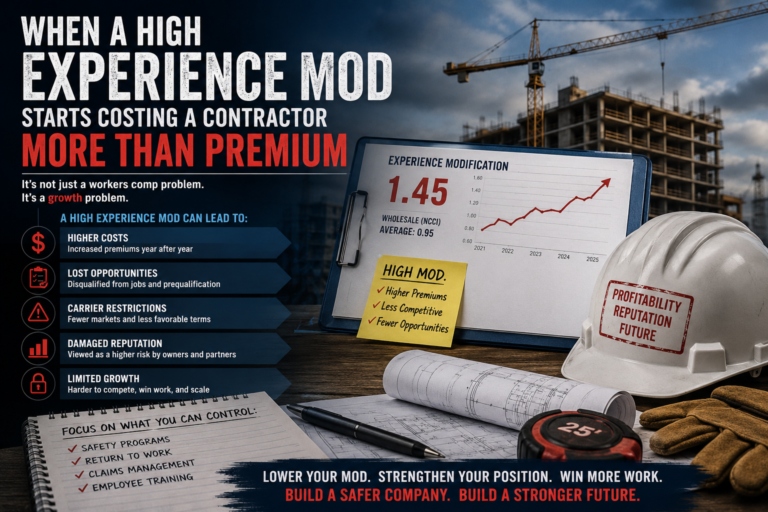
EMR stands for Experience Modification Rate. It is an experience-rating factor that compares an employer’s actual workers compensation loss experience with the loss experience expected for businesses with similar classifications and payroll.
A 1.00 factor is commonly referred to as unity. A factor above 1.00 generally increases the portion of premium affected by the mod, while a factor below 1.00 generally decreases it, before other credits, debits and rating adjustments are applied.
For a deeper explanation, see the Carolina Risk Partners guide to the experience modification rate in North Carolina workers comp.
Why Can an Open Claim Matter Even If It Is Not in the Current EMR?
A carrier reviewing a renewal is not limited to the losses currently included in the experience modification.
An open claim on current loss runs may influence the carrier’s view of severity, frequency, safety controls and future loss potential even when that claim has not yet entered the historical period used for the current mod.
Experience-rating timing matters.
NCRB explains that the most recent policy year used in the experience-rating calculation is generally the policy year that expired one year before the rating effective date.
That creates two separate questions: What affects today’s underwriting? and what affects the current or future experience mod?
Illustrative North Carolina Contractor Scenario
Consider a North Carolina contractor approaching renewal with one significant open injury claim. The loss run still shows a large incurred value, but the employee has returned to modified duty and management has implemented a documented return-to-work process and additional supervisor training.
Reviewing the claim 120 days before renewal gives the broker time to verify the facts, organize the return-to-work information and explain the changes to underwriting. That does not guarantee a reserve reduction, a lower EMR or a better quote, but it gives the carrier more context than a raw loss-run number alone.
This example is illustrative and is not presented as an actual Carolina Risk Partners client claim.
What North Carolina Experience Rating Threshold Applies in 2026?
For North Carolina rating dates beginning April 1, 2026, NCRB lists experience-rating premium eligibility at $15,000 for the most recent policy year or a $7,500 annual average over the most recent two policy years, subject to the applicable experience-rating rules.
NCRB calculates experience ratings for employers whose operations are only in North Carolina. Employers with multistate operations may instead be subject to interstate experience rating.
Employers can review the current rules through the North Carolina Rate Bureau experience modification calculator instructions.
Why Should Payroll and Class Codes Be Reconciled Before Renewal?
Workers compensation premium is heavily influenced by payroll and employee classification.
If a business expands crews in Raleigh, adds operations in Durham, acquires a business in Cary or centralizes administrative staff in Wake Forest, the previous year’s rating assumptions may no longer describe the organization accurately.
- Prior estimated payroll.
- Final audited payroll.
- Current year-to-date payroll.
- Projected renewal payroll.
- Payroll by class code.
- Payroll by state when operations cross state lines.
- Officer or owner inclusion and exclusion treatment when applicable.
The objective is not to minimize estimated payroll artificially. It is to begin the next policy year with an exposure basis that reasonably reflects the business.
Why Is the Previous Premium Audit Part of the Next Renewal?
The premium audit is not merely a billing reconciliation. It can reveal where the original policy assumptions failed.
If the audit added substantial payroll, changed classifications or picked up subcontractor exposure, determine whether the cause was temporary or whether the same exposure should be incorporated into the renewal.
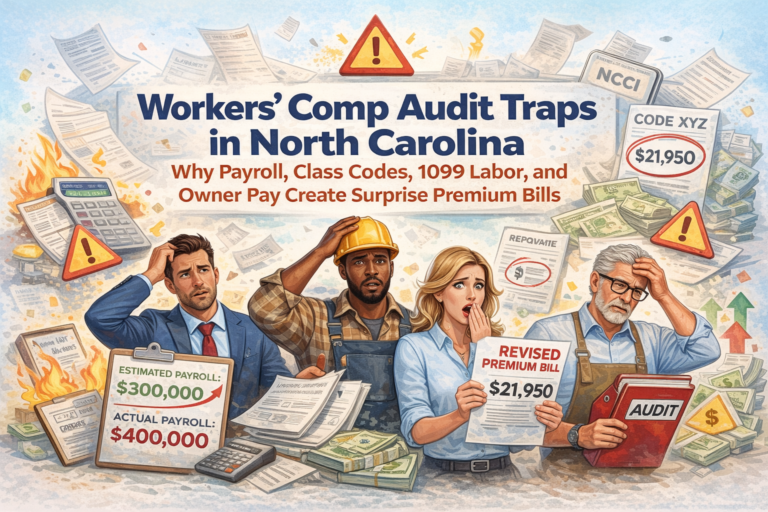
See the related guide to workers comp audit traps in North Carolina.
What Business Changes Should Be Disclosed Before Renewal?
Underwriters are evaluating the business expected to exist during the upcoming policy year, not simply the organization described on last year’s application.
- Acquisitions or ownership changes.
- New legal entities.
- Expansion into new states.
- New branches or locations.
- New types of work.
- Major employee-count changes.
- Rapid payroll growth.
- Changes in subcontracted labor.
- Changes in hiring practices.
- New safety personnel or programs.
- New return-to-work procedures.
- Large projects that materially alter the exposure.
A change is not inherently negative. The larger issue is an underwriter discovering a material change late in the process without context.
Businesses completing an acquisition or restructuring should also review how ownership changes can affect workers compensation experience rating in North Carolina.
How Should a Large Workers Compensation Account Be Presented to Underwriters?
Large workers compensation accounts are rarely evaluated from one number.
An underwriter may simultaneously consider historical loss frequency, severity, open claims, payroll concentration, classification mix, geographic footprint, employee turnover, safety controls, management experience, subcontractor use and recent growth.
A strong submission should make it easy to answer:
- What does the company actually do?
- Where do employees work?
- What changed during the last year?
- Why did significant claims occur?
- What did management change afterward?
- Are payroll projections credible?
- Are classifications supported by actual job duties?
- Why might future loss performance differ from historical results?
When Should a Large Workers Comp Account Actually Go to Market?
Starting the renewal 120 days before expiration does not mean every carrier should receive the submission 120 days before renewal.
The earliest phase is primarily for diagnosis and preparation. Once the claims, payroll, experience mod, audit information and business changes are understood, the broker can determine which markets should be approached and when.
Controlled marketing is usually more useful than indiscriminate marketing.
A developed submission sent to appropriate markets can create a more coherent underwriting process than sending incomplete information broadly and hoping one carrier responds favorably.
What Documents Should Be Ready Before Workers Comp Marketing Begins?
- Currently valued workers compensation loss runs.
- Historical loss runs requested by target carriers.
- Current experience modification worksheet.
- Current payroll by class code.
- Projected renewal payroll by class code.
- Prior completed premium audit.
- Employee and location information when applicable.
- Ownership information.
- Description of operations.
- Safety-program information.
- Return-to-work procedures.
- Large-loss narratives when appropriate.
- Current policy information.
- Details of acquisitions, expansions or major operational changes.
The exact submission varies. A multistate contractor with substantial subcontractor exposure may need a different underwriting package than a North Carolina manufacturer operating from one facility.
What Are the Biggest Red Flags Before a Workers Comp Renewal?
- The experience modification increased materially.
- There are multiple open claims.
- A severe claim remains open.
- The business experienced rapid payroll growth.
- The latest audit created significant additional premium.
- The company added states, locations or operations.
- There was an acquisition or ownership change.
- The incumbent carrier’s appetite changed.
- Subcontractor use changed materially.
- The company has not tested carrier options in several years.
- Management cannot clearly explain major losses.
- The workers compensation renewal is part of a larger commercial insurance restructuring.
What Can a 120-Day Renewal Review Actually Accomplish?
Starting early cannot erase legitimate claims, require a carrier to reduce a reserve, guarantee a lower EMR or guarantee less expensive pricing.
It can give management time to identify inaccurate data, understand claim development, correct legitimate errors, reconcile payroll, explain unusual losses, organize safety information and approach carriers with a stronger underwriting story.
For a large account, that preparation can be considerably more useful than trying to create leverage during the final week before expiration.
Does North Carolina Require Workers Compensation Insurance?
In general, North Carolina businesses regularly employing three or more employees must maintain workers compensation insurance or qualify as self-insured, subject to statutory exceptions.
Corporate officers generally count when determining whether the three-employee threshold is met, although officers may be able to exclude themselves from coverage. Sole proprietors, partners and LLC members are treated differently for coverage purposes.
Contractors should also review subcontractor documentation because workers compensation exposure can extend beyond the business’s direct W-2 payroll.
Employers can review current state guidance directly through the North Carolina Industrial Commission.
How Does 1099 Labor Affect a Workers Compensation Renewal?
Paying someone on a 1099 does not automatically eliminate workers compensation exposure.
For contractors especially, uninsured or poorly documented subcontractor labor can become a premium-audit and coverage issue. The renewal review should examine certificates, contracts, payment records and how the working relationship actually operates.
See the detailed guide to 1099 vs. W-2 misclassification in North Carolina.
Frequently Asked Questions
How early should a large business start a workers compensation renewal in North Carolina?
A large or complex North Carolina workers compensation renewal should often begin about 120 days before expiration so management and the broker have time to review claims, reserves, experience rating, payroll, class codes, audits and operational changes before carriers begin underwriting. The 120-day period is a planning recommendation, not a statutory deadline.
What should a business review 120 days before a workers compensation renewal?
Review current loss runs, open claims, reserves, the experience modification worksheet, payroll by class code, prior premium audits, ownership information, subcontractor exposure, safety controls, return-to-work procedures and significant changes in operations.
What is an EMR in workers compensation?
EMR stands for Experience Modification Rate. It is an experience-rating factor that compares an employer’s actual workers compensation loss experience with expected loss experience for similarly classified businesses. A factor above 1.00 generally increases the portion of premium affected by the mod, while a factor below 1.00 generally decreases it, before other rating adjustments.
Can an open workers compensation claim affect renewal pricing?
Yes. Open claims and their incurred values can influence current underwriting even if a particular claim is not yet part of the historical experience period used for the current experience modification. Claim development may also affect future experience ratings depending on timing and applicable rules.
What experience rating eligibility threshold applies in North Carolina in 2026?
For North Carolina rating dates beginning April 1, 2026, NCRB lists experience-rating premium eligibility at $15,000 for the most recent policy year or a $7,500 annual average over the most recent two policy years, subject to applicable experience-rating rules.
Who can review a large workers compensation renewal in North Carolina?
Carolina Risk Partners helps North Carolina contractors and businesses review workers compensation renewals, loss information, experience modifications, payroll, class codes, audits and carrier options. Founder Stephen Ellias is a Commercial Lines Coverage Specialist and holds North Carolina Insurance License 20374030.

About Stephen Ellias
Stephen Ellias, CLCS is the founder of Carolina Risk Partners in Wake Forest, North Carolina. He works with contractors and growing businesses across Raleigh, Durham, Cary, the Triangle and statewide on workers compensation, commercial auto, liability, bonds and complex commercial insurance renewals.
North Carolina Insurance License 20374030.
Do not wait for the renewal quote to reveal the problem.
If your workers compensation account has meaningful payroll, open claims, an EMR, acquisitions or major operational changes, review it while there is still time to improve the quality of the submission.
This article provides general insurance and risk-management information and is not legal, accounting or claims advice. Workers compensation requirements, classifications, experience-rating treatment, policy terms, underwriting decisions, reserves and claim outcomes depend on applicable rules, carrier practices, policy language and the specific facts involved.