What Changes When a North Carolina Business Grows From 5 Vehicles to 20?
Fleet growth changes more than the number of vehicles on an insurance schedule. For an established North Carolina business, the move toward 15, 20, or more vehicles can require a more disciplined approach to drivers, telematics, physical damage, accident response, umbrella limits, reporting, and commercial auto underwriting.
Key Takeaways
- There is no magic 20-vehicle insurance threshold. The important change is operational.
- A growing fleet needs written driver standards, repeatable MVR reviews, tighter vehicle reporting, and formal accident procedures.
- Telematics becomes more useful when management can no longer personally observe every driver.
- Physical damage and deductibles should be reviewed vehicle by vehicle instead of automatically treating the entire fleet the same.
- Covered auto symbols, hired and non-owned auto, and umbrella structure deserve closer review as the operation becomes more complex.
- Middle-market underwriters may want evidence that management can control the exposure, not merely a list of vehicles.
Quick Answer
When a North Carolina business grows from 5 vehicles to 20, the biggest changes are driver standards, recurring MVR reviews, telematics oversight, vehicle reporting, physical damage strategy, accident procedures, and umbrella and underwriting review.
Five vehicles can often be managed informally. At 20 vehicles, the insurance program increasingly has to reflect the systems and accountability of a middle-market business.
Watch: What Changes When Your Fleet Grows From 5 Vehicles to 20?
Stephen Ellias explains the major commercial auto and fleet-management changes that occur as a growing business moves from a handful of vehicles to a larger commercial fleet.
What Is Commercial Auto Insurance?
Commercial auto insurance is business insurance designed to address liability and, when selected, physical damage and other auto exposures involving covered vehicles used in business. Which autos receive which coverage depends on the policy’s covered auto designation symbols, endorsements, exclusions, and other terms.
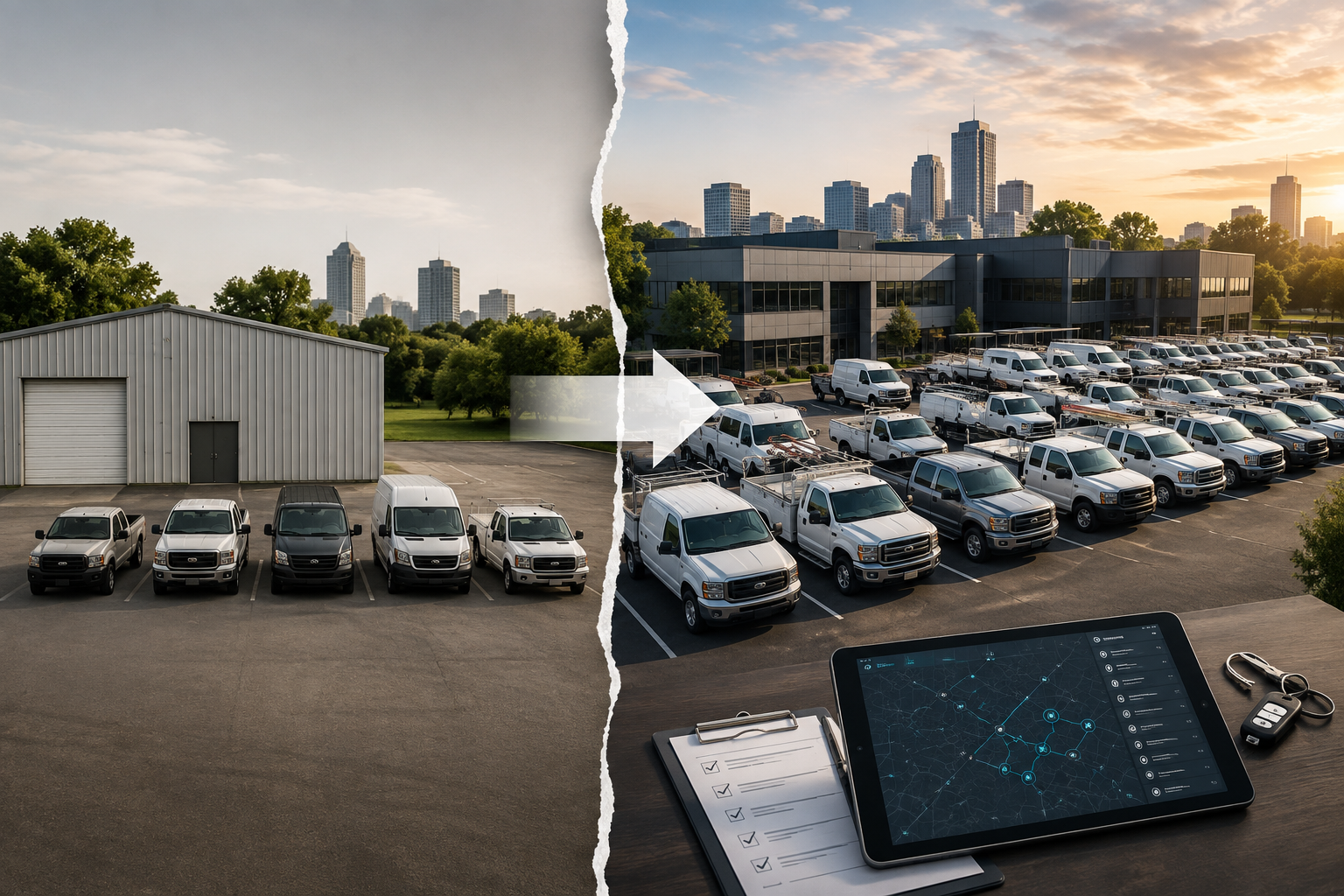
Five vehicles can still feel personal. The owner may know every driver, every truck, where each vehicle is parked, and who had the last accident.
At 15, 20, or 30 vehicles, that becomes harder. A supervisor may authorize a driver the owner has never met. A truck may be traded on Friday and its replacement put into service Monday. Employees may take vehicles home. Different branches or supervisors may make decisions differently.
That is why fleet growth matters to an insurer. The exposure does not increase only because another vehicle was added. The number of opportunities for one weak process to repeat itself also increases.
Five Vehicles and Twenty Vehicles Are Different Management Problems
Twenty vehicles is not a universal regulatory threshold, carrier threshold, or formal definition of a fleet. It is a useful scale marker.
At Roughly 5 Vehicles
- The owner may approve every driver personally.
- Vehicle additions and deletions are easy to remember.
- Maintenance problems are usually visible.
- Accidents reach ownership quickly.
- Vehicle use can still be supervised informally.
At Roughly 20 Vehicles
- Managers or supervisors may approve drivers.
- Vehicle changes happen more frequently.
- Multiple employees may operate the same unit.
- Telematics and maintenance data require ownership.
- Accident reporting needs a repeatable process.
For established contractors, service businesses, distributors, manufacturers, restoration companies, landscapers, tree companies, and other businesses with employees on the road, this transition is one of the clearest signs that commercial auto needs to become part of the company’s broader risk-management system.
CRP’s 8-Point Fleet Readiness Test
I use the following eight questions as a practical way to identify whether a growing fleet is still dependent on the owner or has developed repeatable controls. This is a Carolina Risk Partners review framework, not a carrier score, legal standard, or actuarial model.
1. Written Driver Standard
Is there a written rule for who may drive and who approves exceptions?
2. Recurring MVR Process
Are driving records reviewed after hire on a defined schedule or trigger?
3. Vehicle Reporting Owner
Does one person or role own additions, deletions, assignments, and insurance reporting?
4. Telematics Accountability
If telematics exists, does someone actually review the data and respond to patterns?
5. Maintenance Tracking
Can management show how maintenance, defects, and out-of-service decisions are handled?
6. Accident Procedure
Can a driver follow the accident process even when the owner is unavailable?
7. Physical Damage Strategy
Have deductibles and physical damage decisions been reviewed by vehicle value and financing?
8. Coverage Structure Review
Have auto symbols, hired/non-owned exposure, limits, and umbrella structure kept up with growth?
What This Looks Like for a Growing Triangle Business
Fleet growth around Wake Forest, Raleigh, Durham, Cary, and the broader Triangle often means more than adding local service vans. An established business may have employees dispatched from different locations, managers who no longer work beside every driver, vehicles traveling between counties, and customers or jobs spread across the region.
A Wake Forest contractor with five trucks can often keep vehicle decisions concentrated with the owner. A 20-vehicle company serving Raleigh, Durham, Cary, and surrounding markets may have multiple supervisors making hiring, scheduling, and vehicle-use decisions.
That difference is exactly why a middle-market commercial auto submission should explain the management system behind the fleet, not just provide a spreadsheet of VINs.
How North Carolina Commercial Auto Insurance Changes as the Fleet Grows
Underwriters still care about traditional factors such as vehicle type, driver history, loss experience, garaging territory, radius, use, limits, deductibles, and the nature of the business.
But a larger fleet raises another question:
What is management doing to control the exposure?
Two businesses can own similar trucks, perform similar work, and have similar revenue while presenting very differently to an insurance company.
One may have accurate driver and vehicle schedules, defined driver standards, recurring MVR reviews, telematics, documented maintenance, immediate accident escalation, and a management response to prior losses.
The other may have the same number of vehicles but no consistent process for any of those items.
Those are not the same underwriting story.
1. Driver Standards Need to Become a Written Business Rule
A five-vehicle company may be able to rely on the owner saying, “I know him. He is a good driver.”
That approach becomes harder as hiring and vehicle assignment spread across several managers.
A Growing Fleet Should Answer These Driver Questions
- Who is authorized to drive a company vehicle?
- Who approves a new driver?
- When is an MVR obtained?
- What driving history requires additional review?
- What happens after a preventable accident?
- Are employees allowed to use vehicles personally?
- Can spouses or family members operate a vehicle?
- How are suspended, restricted, or expired licenses handled?
- Who has authority to remove driving privileges?
The objective is consistency. If one supervisor rejects a driver that another supervisor would approve, the company does not really have one driver standard.
North Carolina employers can obtain driving records through the North Carolina Division of Motor Vehicles, subject to the applicable authorization and privacy requirements.
For a deeper discussion, see our guide to North Carolina MVR standards for business drivers.
Has Your Insurance Program Kept Up With the Fleet?
If you have added vehicles, drivers, locations, or supervisors over the last few years, I can review the current program, how the fleet is being presented to carriers, and whether there are opportunities to improve pricing or coverage structure.
Already insured? That’s fine. We can start by reviewing the program you already have.
I’ll follow up within 1 business day.
2. MVR Reviews Become a Process, Not an Event
Checking a driving record before someone receives a company vehicle is useful. It is not the entire system.
A driver’s record can change after hire. A growing company should therefore define when records are reviewed, who reviews them, what triggers additional action, and how decisions are documented.
The right process depends on the business, insurer, vehicle types, job duties, and applicable regulation.
Why 10,001 Pounds Sometimes Matters
Federal rules should be applied carefully. Under the federal definition in 49 CFR § 390.5, a vehicle used on a highway in interstate commerce to transport property can meet the federal definition of a commercial motor vehicle when its GVWR, GCWR, gross vehicle weight, or gross combination weight reaches 10,001 pounds or more. Passenger capacity and placarded hazardous-material transportation can also trigger the definition.
For covered motor carriers, the FMCSA Motor Carrier Safety Planner provides guidance on driver qualification files, MVR inquiries, and annual driving-record reviews.
3. Telematics Goes From a Gadget to a Management System
Installing GPS or telematics devices is not the same thing as having a fleet-safety program.
A 20-vehicle company can collect enormous amounts of information and still receive little value if nobody owns the process.
What Management Can Actually Monitor
- Speeding.
- Hard braking.
- Rapid acceleration.
- Seat-belt behavior when available through the system.
- After-hours or unauthorized vehicle use.
- Vehicle location and route patterns.
- Repeated risky behavior by an individual driver.
The value is not the alert itself. The value comes when someone identifies a pattern, discusses it with the driver, documents the response, and escalates repeated behavior.
4. Vehicle Reporting Needs One Owner Inside the Company
Fleet growth also creates administrative risk.
Vehicles are purchased, financed, leased, sold, totaled, transferred between locations, temporarily replaced, and reassigned to different employees.
Someone inside the organization should own the process for communicating those changes.
What a Useful Internal Vehicle Record Should Track
- Year, make, and model.
- Vehicle identification number.
- Garaging location.
- Primary use.
- Assigned driver or department.
- Ownership or lease status.
- Lienholder or lessor information.
- Major permanently installed equipment or upfits.
- Date placed into service.
- Date removed from service.
Do not assume every policy provides unlimited automatic protection for newly acquired vehicles or that reporting can wait indefinitely. The actual policy language and carrier requirements control.
5. Physical Damage Decisions Should Become More Deliberate
A 20-vehicle fleet rarely consists of 20 identical vehicles of the same age and value.
There may be new financed trucks beside older paid-off units. Some may contain expensive permanent upfits. Others may be inexpensive backup vehicles.
Physical Damage Questions Worth Reviewing
- Which vehicles should carry comprehensive and collision?
- Are the deductibles still appropriate?
- How much loss can the company comfortably retain?
- Are lenders or lessors imposing physical-damage requirements?
- Are bodies, racks, lifts, and other permanent modifications properly addressed?
- Does one deductible structure still make sense for every unit?
A mature fleet program does not automatically make the same decision for every vehicle simply because it is administratively easier.
6. Accident Procedures Need to Work Without the Owner
One of the best tests of a middle-market fleet program is simple:
If the owner is unreachable, does everyone know what happens after an accident?
A Written Accident Process May Address
- Emergency response and medical attention.
- Police or other required reporting.
- Photos of the vehicles and scene when safe to obtain.
- Other driver and witness information.
- Immediate internal notification.
- Prompt insurance reporting when appropriate.
- Towing and vehicle-storage procedures.
- Post-accident management review.
- Drug or alcohol testing when required by applicable law, regulation, or company policy.
Certain federally regulated motor carriers are also subject to formal accident-register requirements. The FMCSA provides accident recordkeeping guidance for covered operations.
7. Maintenance Becomes Part of the Underwriting Story
Commercial auto losses are not limited to driver behavior.
Tires, brakes, lights, steering, trailers, load securement, and other equipment issues can contribute to accidents.
A growing company should be able to explain who is responsible for preventive maintenance, how service intervals are tracked, how drivers report defects, and when a vehicle is removed from service.
Businesses operating vehicles subject to federal motor-carrier rules may have specific inspection, repair, maintenance, and recordkeeping requirements. FMCSA’s vehicle-maintenance guidance provides additional information for covered motor carriers.
8. The Covered Auto Symbols Matter More as the Fleet Gets Complicated
One of the most useful commercial auto reviews is not simply checking whether every truck appears on a vehicle schedule. It is checking which categories of vehicles each coverage actually applies to.
Commercial auto policies commonly use covered auto designation symbols. IRMI defines auto coverage symbols as the numbers used to identify the categories of autos to which particular commercial auto coverages apply.
Symbol 1: Any Auto
Under standard ISO Business Auto Policy terminology, Symbol 1 is the broadest designation and is used for liability coverage.
Symbol 7: Specifically Described Autos
Coverage applies to autos specifically scheduled or described for the applicable coverage, subject to the policy terms.
Symbol 8: Hired Autos
This designation addresses certain autos the business leases, hires, rents, or borrows, subject to the policy definition and exclusions.
Symbol 9: Non-Owned Autos
This designation can address autos the business does not own that are used in the business, including certain employee-owned vehicles.
This becomes especially important when growth introduces rental vehicles, temporary replacements, employee-owned vehicles used for errands, managers traveling on company business, or vehicles that are acquired and placed into service quickly.
9. Hired and Non-Owned Auto Exposure Can Grow Quietly
Company-owned vehicles are only one part of the exposure.
Growth can introduce rental vehicles, temporary replacements, employee-owned vehicles used for errands, sales employees driving personal vehicles, or managers using their own cars on company business.
That is where hired auto and non-owned auto exposures deserve specific attention.
A business should not assume that an employee’s personal auto policy automatically solves the company’s liability exposure. Coverage depends on the policy, symbols, endorsements, vehicle ownership, and facts of the loss.
10. Commercial Umbrella Insurance Deserves Another Look
Going from 5 vehicles to 20 does not automatically mean a business needs a particular umbrella limit.
It does create a reason to reassess the severity side of the exposure. More vehicles mean more time on the road and more opportunities for a serious accident to involve the business.
What Should Be Part of the Umbrella Conversation?
- Commercial auto liability limits.
- Contract requirements.
- Vehicle types and weights.
- Driving radius.
- Interstate operations.
- Passenger exposure.
- Loss history.
- Company assets and risk tolerance.
An umbrella is also not a substitute for correcting an underlying commercial auto gap. Attachment requirements, underlying limits, exclusions, and policy terms still matter.
Learn more about commercial umbrella insurance for North Carolina businesses.
11. Middle-Market Underwriters May Want More Than a Vehicle Schedule
This is one of the biggest differences between shopping insurance for a tiny fleet and presenting a larger established account.
A strong commercial auto submission can explain how the business actually manages the risk.
- Accurate vehicle schedule VINs, garaging, ownership, use, vehicle type, and other requested information should be current.
- Current driver roster The insurer should be able to understand who is actually operating company vehicles.
- Written driver eligibility standards Explain how drivers are approved and what happens when someone no longer meets the standard.
- MVR review process Identify when records are reviewed and how adverse records are handled.
- Telematics and coaching If telematics is used, explain what management does with the information.
- Maintenance controls Show how preventive maintenance and driver-reported defects are handled.
- Accident procedures Show that the response process does not depend entirely on the owner being available.
- Loss history response A loss run shows what happened. Management should also be able to explain what changed afterward.
The Loss Run Matters, but the Response to the Loss Matters Too
A company with 20 vehicles may eventually have accidents. The existence of a loss does not tell the whole underwriting story.
Owner-Dependent Response
An accident happens, information reaches management late, nobody formally determines whether the loss reveals a larger pattern, and the driver returns to normal duties.
Middle-Market Response
Management reviews the event, determines whether a pattern exists, documents corrective action, retrains or restricts the driver when appropriate, and checks whether the same problem appears elsewhere in the fleet.
The second response does not erase a loss or guarantee favorable underwriting. It demonstrates that management is responding to what the loss history is telling them.
A recurring fleet issue I look for when reviewing growing businesses is not simply whether accidents occurred. It is whether responsibility for drivers, vehicles, and post-loss follow-up became unclear as authority moved away from the owner.
Price Still Matters More When Commercial Auto Becomes a Major Expense
As a fleet grows, commercial auto can become one of the larger line items in the insurance program. At that point, differences in carrier pricing can represent meaningful dollars.
That makes market access important.
It also makes it dangerous to compare quotes based on premium alone.
What to Compare Besides Premium
- Liability limits.
- Uninsured and underinsured motorist coverage.
- Physical damage deductibles.
- Covered auto designation symbols.
- Hired and non-owned auto exposure.
- Driver restrictions or exclusions.
- Vehicle-use restrictions.
- Umbrella compatibility.
- Loss-control requirements.
- Payment structure.
Carolina Risk Partners can review multiple carrier options where available, while also checking whether the competing programs actually fit the way the business operates.
See our main page for commercial auto insurance in North Carolina.
When Should a Growing Business Review Its Fleet Program?
You do not have to wait for a claim or renewal if the business has materially changed.
Good Review Triggers
- You added several vehicles in a short period.
- You opened another location.
- Supervisors now hire or approve drivers.
- Employees regularly take vehicles home.
- You added larger or more specialized trucks.
- Your vehicles are increasingly operating outside the Triangle or across state lines.
- You are seeing repeated accidents or driver issues.
- Your commercial auto premium increased materially.
- Your current carrier is tightening underwriting requirements.
- You added telematics but do not have a management process around the data.
- You are unsure whether the driver and vehicle schedules are current.
- Your umbrella limits have not been reviewed since the fleet was much smaller.
Those are all signs that a Wake Forest, Raleigh, Durham, Cary, or other North Carolina business may have outgrown the commercial auto process it used when the company was smaller.
The Bottom Line
Growing from 5 vehicles to 20 is not primarily an insurance-policy event. It is a management event. The larger the fleet becomes, the less the company can depend on the owner personally knowing every driver, vehicle, and incident.
Driver standards, MVR reviews, telematics, vehicle reporting, maintenance, physical damage decisions, accident procedures, covered auto symbols, and umbrella limits need to become repeatable systems.
That is what makes this a middle-market insurance issue. The insurance program has to start reflecting the sophistication of the business it is supposed to protect.
Frequently Asked Questions
Is 20 vehicles a special commercial auto insurance threshold?
No. Twenty vehicles is not a universal legal or insurance threshold. It is a useful example of the point where informal driver, vehicle, maintenance, reporting, and accident-management practices can become difficult to control consistently.
What is commercial auto insurance?
Commercial auto insurance is business insurance designed to address liability and, when selected, physical damage and other auto exposures involving covered vehicles used in business. Which vehicles are covered depends on the policy, covered auto designation symbols, endorsements, and other terms.
When should a business start using telematics?
There is no universal vehicle-count requirement. Telematics becomes increasingly useful when management can no longer directly observe every driver and vehicle. Its value depends on having a process to review and act on the data.
What do commercial auto Symbols 1, 7, 8, and 9 mean?
Under common ISO Business Auto Policy terminology, Symbol 1 means Any Auto for liability, Symbol 7 means specifically described autos, Symbol 8 refers to hired autos, and Symbol 9 refers to non-owned autos. Actual policy forms and endorsements should always be reviewed.
How often should a North Carolina business check employee MVRs?
The appropriate process depends on the business, insurer, job duties, vehicle types, and applicable regulation. Growing businesses should establish a consistent written MVR review process rather than treating the pre-hire check as the entire program.
Does a 20-vehicle fleet automatically need commercial umbrella insurance?
No. Vehicle count alone does not determine whether an umbrella is required or what limit is appropriate. Contract requirements, vehicle types, driving radius, underlying limits, loss history, business assets, and potential claim severity should be considered.
Can better fleet controls reduce commercial auto insurance premiums?
Strong driver selection, loss control, telematics, maintenance, and accident-management practices may improve carrier appetite or underwriting terms, but they do not guarantee a lower premium. Drivers, vehicles, loss history, territory, operations, limits, and market conditions still matter.
Where can a North Carolina business get help reviewing a growing fleet?
A growing fleet review should consider vehicles, drivers, loss history, covered auto symbols, physical damage strategy, umbrella structure, safety controls, and carrier options. Stephen Ellias, CLCS, founder of Carolina Risk Partners and North Carolina Insurance License 20374030, works with North Carolina businesses on these issues. You can start a coverage review here.

About Stephen Ellias
Stephen Ellias, CLCS, is the founder of Carolina Risk Partners, an independent commercial insurance agency based in Wake Forest, North Carolina. He works with contractors and growing businesses throughout North Carolina on commercial auto, workers compensation, general liability, commercial umbrella, equipment, bonds, and other business insurance needs. North Carolina Insurance License 20374030.
Your Fleet Grew. Make Sure the Insurance Program Grew With It.
If your company has moved beyond a handful of vehicles, I can review the current program, driver and vehicle structure, loss history, fleet controls, and carrier options before the next renewal.