
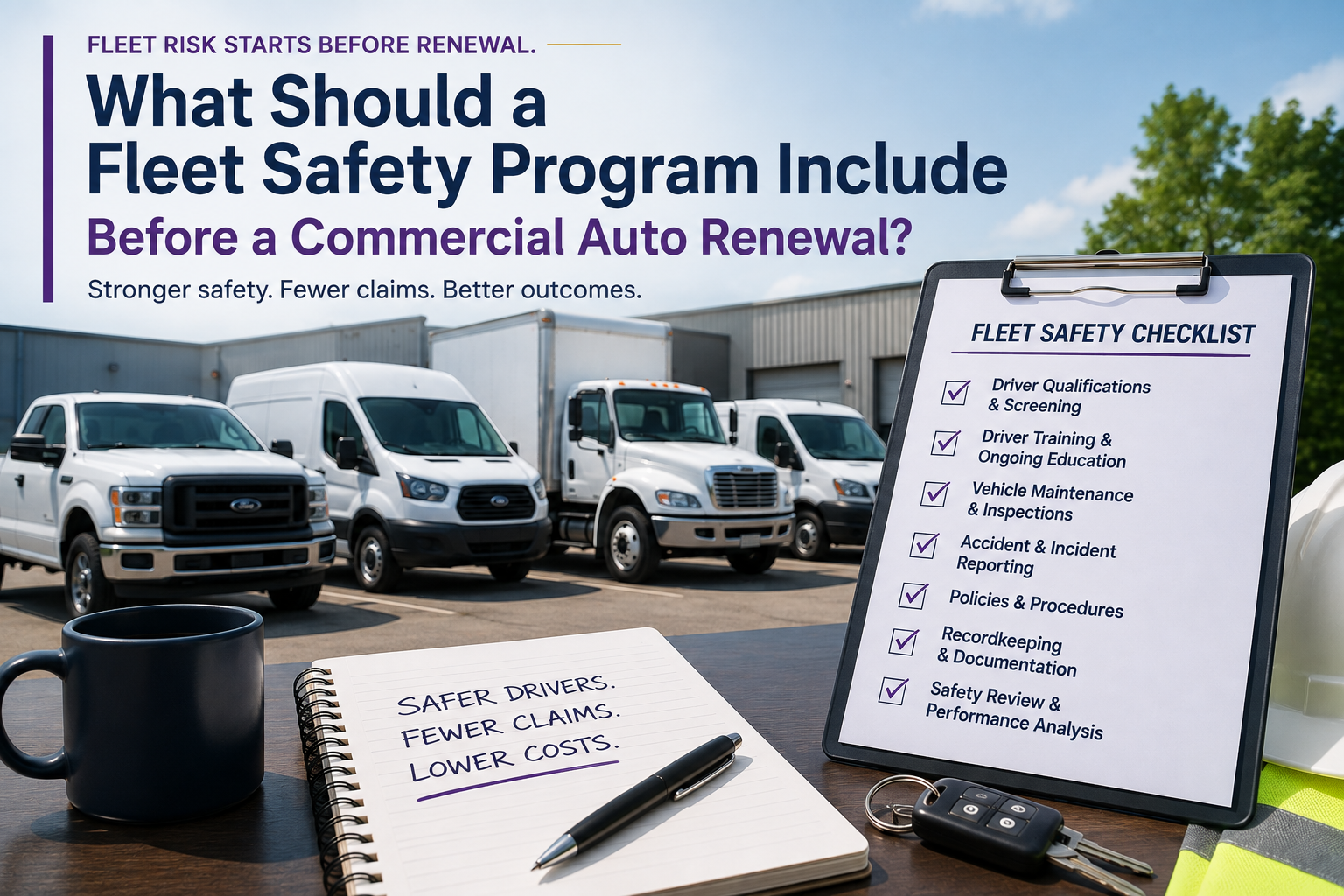
What Should a Fleet Safety Program Include Before a Commercial Auto Renewal?
For a middle-market business with a meaningful fleet, commercial auto renewal is not just a pricing exercise. Driver controls, accident trends, vehicle maintenance, hiring standards, telematics, and management oversight can all become part of the underwriting story.
Key Takeaways
- A fleet safety program should be written, documented, enforced, and measurable.
- Driver qualification should continue after an employee is hired.
- Management should be able to show how accidents and unsafe driving are addressed.
- Preventive maintenance and vehicle inspection records matter.
- Telematics is more valuable when management actually uses the data for coaching and accountability.
- The best time to organize the fleet’s risk story is before the renewal submission reaches underwriters.
Quick Answer
A fleet safety program commercial auto renewal strategy should document how the business selects drivers, monitors driving records, trains employees, maintains vehicles, prevents distracted and unsafe driving, investigates accidents, handles repeat violations, and measures fleet performance.
For a middle-market fleet, a policy sitting in an employee handbook is usually not enough. Management should be able to demonstrate that the program is actually being used. That may include MVR review procedures, training records, maintenance schedules, telematics reports, accident-review procedures, disciplinary standards, and evidence that recurring problems are corrected.
Bottom line: before renewal, you want to be able to explain not only what happened in the fleet, but what management is doing to reduce the probability that it happens again.
Why Fleet Safety Becomes a Renewal Issue
For businesses with a handful of vehicles, commercial auto can sometimes be handled largely as a vehicle-and-driver scheduling exercise. That changes as a fleet grows.
A company with dozens of vehicles, multiple locations, field supervisors, delivery routes, service technicians, sales drivers, or employees taking vehicles home creates a much larger management exposure.
At that point, the question is no longer simply, “Who drives which truck?”
The more important questions become:
- Who is allowed to drive?
- How does the company decide whether that person is acceptable?
- How often are driving records reviewed?
- What happens when a driver gets a serious violation?
- Are supervisors accountable for unsafe driving?
- How are accidents investigated?
- Are preventable accidents being identified?
- Is vehicle maintenance documented?
- Is telematics data being collected but ignored?
- Can management show whether fleet performance is improving or deteriorating?
The Middle-Market Difference
A 40-vehicle contractor should not approach commercial auto renewal like a four-vehicle business. As fleet size, premium, driver count, and operational complexity increase, the quality of the risk-management story can become increasingly important.
The goal is not to make the company look perfect. The goal is to show that management knows where the risk is and has a repeatable process for controlling it.
North Carolina Fleet Risk Is Not Theoretical
North Carolina businesses operate fleets on a road system that produces a substantial volume of crashes every year. The North Carolina Division of Motor Vehicles publishes statewide crash statistics through its official Crash Facts reporting program.
North Carolina Crash Data Matters to Fleet Managers
NCDOT’s Division of Motor Vehicles maintains annual North Carolina crash statistics and statewide crash-data resources. Those reports provide a useful reminder that commercial fleets operate inside a much larger roadway loss environment.
1. Establish Written Driver Qualification Standards
Fleet safety starts before an employee receives the keys.
The company should establish written criteria defining who is eligible to operate a company vehicle and how that eligibility is evaluated.
- Valid licensing for the vehicle being operated.
- Motor vehicle record review before driving privileges are granted.
- Acceptable and unacceptable violation history.
- Serious violations that require management review.
- Minimum driving experience where appropriate.
- Rules for newly hired or probationary drivers.
- Procedures for employees who operate personal vehicles on company business.
- Required reporting of new citations, suspensions, or license changes.
2. Monitor Drivers After They Are Hired
One of the biggest weaknesses in an otherwise good fleet program is treating the pre-hire MVR as the end of the process.
A middle-market company should have a defined process for periodic MVR review and for responding to adverse changes.
The response matters as much as the MVR
- Supervisor review.
- Additional driver training.
- Probation or increased monitoring.
- Restrictions on vehicle use.
- Removal of driving privileges.
Get Ahead of the Fleet Renewal
If commercial auto has become one of the larger or more difficult pieces of your insurance program, we can review the fleet, current coverage, loss history, and renewal strategy before the account goes to market.
I’ll follow up within 1 business day.
3. Build Driver Training Around the Actual Fleet
A driver safety program should not consist solely of having employees sign a policy during onboarding.
- Defensive driving.
- Backing and parking.
- Vehicle size, handling, and blind spots.
- Speed management.
- Seat belt requirements.
- Distracted driving.
- Drowsy and impaired driving.
- Vehicle inspections.
- Load or equipment securement where applicable.
- Accident-scene procedures.
4. Have a Real Distracted-Driving Policy
Distracted driving deserves its own written standard rather than a vague instruction to “drive safely.”
- Handheld phone use.
- Texting and messaging.
- Navigation changes while moving.
- Dispatch communication.
- Eating or other distracting activities.
- Expectations for pulling over safely when communication is necessary.
Look at the Company’s Behavior Too
A policy telling employees not to use their phones while driving loses credibility if dispatchers and managers simultaneously expect immediate responses from drivers on the road.
5. Create a Preventive Maintenance and Inspection System
Driver behavior is only one side of fleet risk. The condition of the vehicles matters too.
- Who is responsible for maintenance.
- How maintenance intervals are established.
- How drivers report defects.
- What defects require a vehicle to be taken out of service.
- How completed repairs are documented.
- Whether overdue maintenance is being tracked.
6. Establish an Accident Reporting and Investigation Process
An accident-reporting procedure should tell employees exactly what to do after a crash.
Management should review meaningful crashes for contributing factors and determine whether a change in policy, training, supervision, routing, maintenance, or driver status is warranted.
Ask why the accident happened
- Are backing accidents concentrated in one department?
- Are accidents happening late in long shifts?
- Does one location have a higher accident frequency?
- Are new drivers overrepresented?
- Are certain vehicle types involved disproportionately?
- Are the same drivers having multiple incidents?
7. Define What Happens After a Preventable Accident
A written policy without consequences is difficult to enforce consistently.
- Coaching.
- Retraining.
- Ride-alongs or supervisor observation.
- Written warning.
- Temporary restriction of driving privileges.
- Permanent removal from a driving position when appropriate.
8. Use Telematics as a Management Tool, Not Just a Tracking Device
Many larger fleets already have GPS or telematics systems. The better question is whether anybody is doing anything meaningful with the data.
- Speeding.
- Hard braking.
- Rapid acceleration.
- Seat belt use.
- After-hours vehicle use.
- Route behavior.
- Other indicators of risky driving.
What Underwriters Want to Understand
The stronger story is not simply, “We have telematics.”
It is closer to: “We monitor defined behaviors, supervisors review exceptions, repeat issues trigger coaching or discipline, and management tracks whether those behaviors improve.”
9. Track Fleet Safety Metrics at the Management Level
- Total accidents.
- Preventable accidents.
- Accidents by driver or department.
- Accidents by vehicle type.
- Serious moving violations.
- Telematics exceptions.
- Driver training completion.
- Overdue vehicle maintenance.
- Open corrective actions.
- Claim frequency and severity trends.
10. Assign Ownership of the Fleet Safety Program
Someone has to own the process.
- Approves drivers.
- Reviews MVRs.
- Monitors telematics.
- Schedules training.
- Tracks maintenance.
- Investigates accidents.
- Approves corrective action.
- Reports fleet results to senior management.
What Should You Prepare Before Commercial Auto Renewal?
Do not wait for the first underwriter question to start gathering the fleet story.
- Current vehicle schedule.
- Current driver schedule.
- Updated loss runs.
- Fleet safety policy.
- Driver qualification standards.
- MVR review procedures.
- Driver training documentation.
- Telematics program information.
- Preventive-maintenance procedures.
- Accident-review procedures.
- Corrective actions implemented after significant losses.
- Explanation of major operational changes.
Do Not Wait Until 30 Days Before Renewal
A difficult commercial auto account may need time to clean up schedules, obtain loss information, address driver issues, document safety controls, and determine which markets make sense.
Start My Fleet Renewal ReviewCan a Fleet Safety Program Lower Commercial Auto Insurance Costs?
It can contribute to a better risk profile, but there is no guarantee that creating a safety manual will reduce premium.
Commercial auto pricing can be affected by vehicle types, radius of operation, driver characteristics, loss history, limits, deductibles, garaging, industry, fleet size, carrier appetite, and the overall insurance market.
There is an important difference between:
“We had several accidents, but we’re working on safety.”
and:
“We identified the accident trend, changed our driver qualification standards, implemented recurring MVR review, added supervisor coaching through telematics, retrained the affected drivers, and can show the results.”
The Insurance Program Still Needs to Be Reviewed
Fleet safety does not replace a properly structured commercial auto insurance program.
- Liability limits.
- Physical damage deductibles.
- Uninsured and underinsured motorist coverage.
- Hired and non-owned auto exposure.
- Employees using personal vehicles for business.
- Rental vehicles.
- Trailers and attached equipment.
- Contractual auto requirements.
- Commercial umbrella or excess liability.
Frequently Asked Questions
What should a fleet safety program include?
A fleet safety program should generally address driver qualification, ongoing MVR monitoring, driver training, distracted and impaired driving, vehicle inspection and maintenance, accident reporting, accident investigation, corrective action, recordkeeping, telematics where applicable, and management review. The program should be tailored to the company’s actual vehicles and operations.
Do commercial auto insurance companies look at fleet safety programs?
Depending on the carrier and account, underwriters may request information about driver selection, MVR procedures, training, telematics, maintenance, accidents, and other fleet controls. The level of scrutiny can increase with fleet size, loss activity, vehicle type, and overall account complexity.
How early should a business prepare for a commercial auto renewal?
Larger or more complicated fleets should generally begin well before the expiration date. Additional time can be valuable when loss runs, driver information, vehicle schedules, safety documentation, market strategy, or corrective actions need attention.
Does telematics help with commercial auto insurance?
Telematics can support a fleet safety program by identifying risky driving behavior and providing information for coaching and management review. Its value depends heavily on whether the company consistently reviews the information and responds to identified problems.
Can a fleet safety program guarantee lower insurance premiums?
No. Commercial auto premiums depend on numerous underwriting and market factors. A well-documented safety program may strengthen the overall risk-management story, but it does not guarantee a lower premium or carrier acceptance.
What should a business do after a preventable fleet accident?
The company should investigate the circumstances, identify contributing factors, determine whether policies or procedures need to change, and document appropriate corrective action. Depending on the situation, that may include coaching, retraining, increased monitoring, or changes to driving privileges.
Who can review a commercial auto fleet before renewal in North Carolina?
Stephen Ellias, CLCS, founder of Carolina Risk Partners, works with established North Carolina businesses on commercial auto and fleet insurance programs. He helps review current coverage, fleet information, loss history, driver controls, carrier strategy, and renewal issues before the account goes to market. Stephen holds North Carolina Insurance License 20374030.

Stephen Ellias, CLCS
Founder of Carolina Risk Partners and a North Carolina commercial insurance advisor. Stephen works with contractors and established businesses on commercial auto, workers compensation, liability, property, umbrella, bonds, and related insurance programs. NC Insurance License 20374030.
Commercial Auto Becoming a Bigger Problem at Renewal?
Carolina Risk Partners helps established North Carolina businesses review fleet exposures, coverage, loss history, safety controls, and carrier options before renewal.
This article provides general insurance and risk-management information and is not legal, safety, regulatory, or coverage advice. Insurance coverage depends on the specific policy, endorsements, exclusions, limits, facts, and circumstances. Fleet safety and regulatory requirements vary by operation. Businesses subject to DOT or FMCSA requirements should evaluate the regulations applicable to their specific operations.