Workers Compensation Renewal
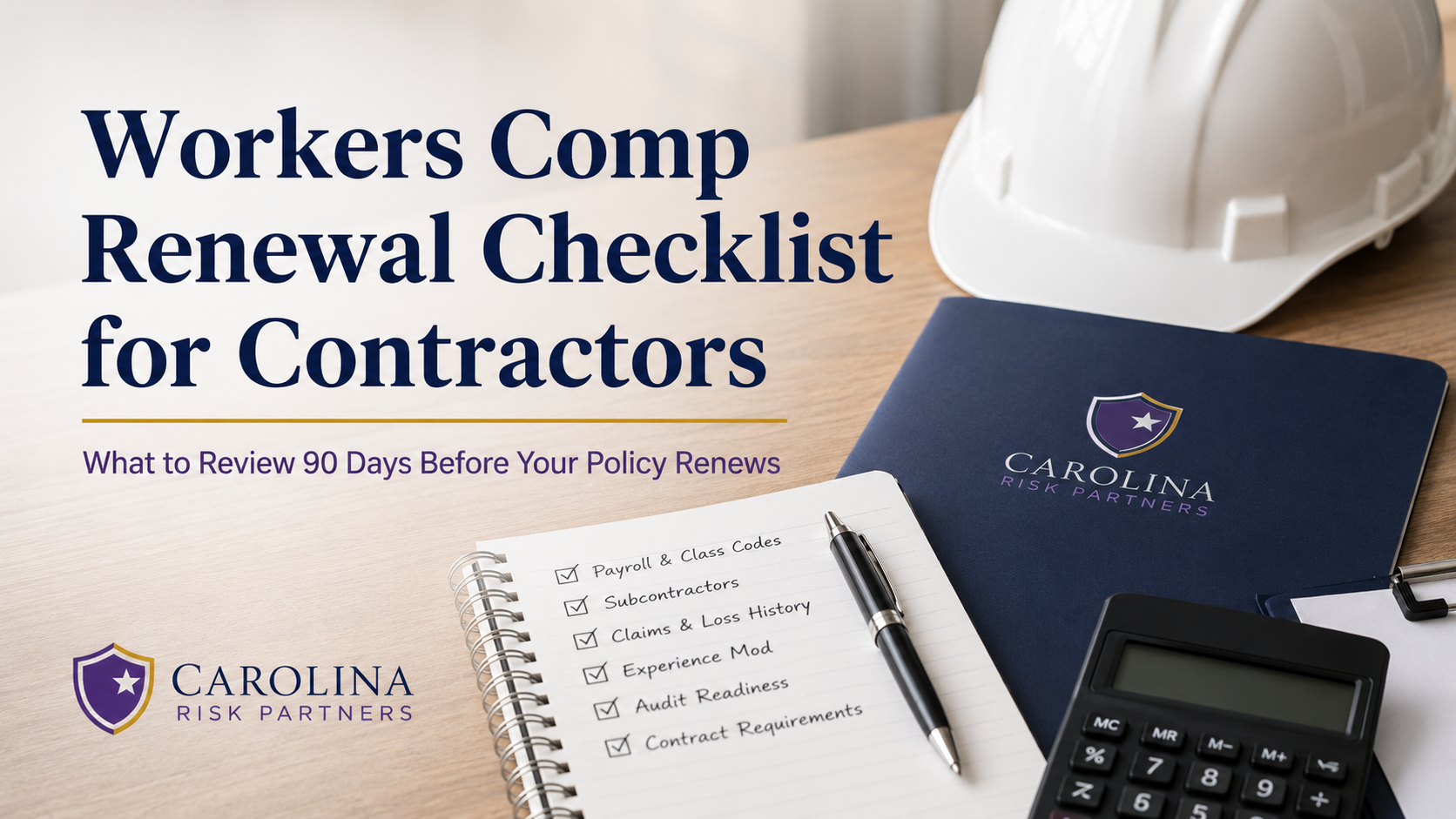
Workers Comp Renewal Checklist for Contractors
A practical 90-day renewal checklist for North Carolina contractors who want cleaner payroll estimates, better class code reviews, fewer audit surprises, and fewer last-minute insurance problems.
Key Takeaways
- Contractors should start workers comp renewal review about 90 days before expiration.
- Payroll, class codes, subcontractors, claims, and experience mod can all affect renewal.
- A rushed renewal can create audit surprises, certificate issues, and limited carrier options.
- A clean renewal process gives your agent a better underwriting story to take to carriers.
Quick Answer
A workers comp renewal checklist for contractors should review payroll estimates, class codes, subcontractor certificates, open claims, experience mod, owner treatment, prior audits, and contract requirements before the policy renews.
Bottom line: if your renewal is inside 90 days, do not treat it like a bill. Treat it like a risk review before the carrier, auditor, or project owner forces the issue.
Why Contractors Should Start Workers Comp Renewal 90 Days Early
Most contractors think about workers comp when one of three things happens: the renewal invoice arrives, a certificate is requested, or an employee gets hurt.
That is too late.
Workers comp is one of the most sensitive insurance policies a contractor buys because the premium is tied directly to payroll, class codes, subcontractor usage, claim history, and experience rating.
If those details are wrong, the renewal quote may be wrong. If they are incomplete, the carrier may quote conservatively. If they are messy, better carriers may decline.
A 90-day renewal review gives your agent time to understand the account, clean up the story, gather underwriting details, and approach the right carriers before you are trapped by timing.
Carolina Risk Partners is based in Wake Forest and helps contractors in Raleigh, Durham, Cary, the greater Triangle area, and across North Carolina review workers comp before renewals, audits, claims, or contract requirements create a bigger problem.
North Carolina generally requires businesses with three or more employees to carry workers compensation insurance or qualify as self-insured. For contractors, legal compliance is only part of the issue. General contractors, builders, property managers, lenders, and commercial clients may require workers comp coverage even when the state minimum rule does not tell the full story. You can review the state’s employer guidance through the North Carolina Industrial Commission.
The Contractor Workers Comp Renewal Timeline
Start the strategy review
Review the business, not just the policy. Confirm payroll changes, new crews, subcontractor usage, claims, experience mod changes, new operations, and whether you are bidding larger jobs with stricter insurance requirements.
Gather documents and market the account
Your agent should have payroll estimates, loss runs, class codes, subcontractor details, prior audits, safety controls, return-to-work procedures, and certificate requirements.
Compare options and confirm details
By this point, you should not still be discovering basic problems. Compare renewal terms, payment options, carrier appetite, audit expectations, and contract requirements.
Bind cleanly and prepare for the next audit
Coverage should be bound, certificates should be ready, payroll estimates should be realistic, and you should know what documentation to keep during the new policy year.
Inside 90 Days? Do Not Wait on the Renewal
If your renewal is coming up, this is the right time to review payroll, class codes, claims, subcontractors, contract requirements, and audit history before timing works against you.
Step 1: Review Your Payroll Estimates
Workers comp premium is heavily driven by payroll.
The North Carolina Rate Bureau states that premium is calculated based on total payroll paid or payable to employees eligible to receive workers compensation benefits, unless a specific classification uses a different premium basis. You can review the payroll rule in the North Carolina Workers Compensation Basic Manual.
If you estimate too low, you may get a lower deposit premium but a larger audit bill later. If you estimate too high, you may overpay during the year and wait for the audit to correct it.
If this has happened before, read the related guide on workers comp audit traps in North Carolina.
Your payroll review should include:
- Current year payroll.
- Expected payroll for the next 12 months.
- Payroll by employee role.
- Payroll by class code.
- Owner or officer payroll.
- Seasonal payroll.
- Overtime trends.
- New hires expected in the next year.
- Crews added or removed.
- Payroll changes from new contracts.
Step 2: Review Class Codes Before the Carrier Does
Class codes are one of the biggest workers comp renewal issues for contractors.
A class code tells the carrier what kind of work your employees perform. The wrong class code can create underpricing, overpricing, audit disputes, and renewal problems.
Common contractor class code problems include:
- Field employees incorrectly classified as clerical.
- Supervisors incorrectly classified as office staff.
- Mixed operations not explained clearly.
- New services added without updating the policy.
- Payroll split between class codes without supporting records.
- Owners classified based on title instead of actual work.
- Subcontractor labor creating confusion around operations.
Before renewal, review what your company actually does now. Not what you did three years ago. Not what your website says generally. Not what was entered on the first application.
Step 3: Review Your Experience Mod
If your business is experience rated, your experience modification rate can directly affect your workers comp premium.
NCCI explains that experience rating uses an individual employer’s actual incurred loss experience and compares it to average losses of similarly classified businesses. The resulting modification factor is used to adjust workers compensation manual rates. You can review NCCI’s explanation of experience rating.
For a deeper explanation, read the CRP guide to the experience modification rate in North Carolina workers comp.
For contractors, your mod matters for three reasons:
- It can increase or decrease premium.
- It can affect carrier appetite.
- It can affect your ability to qualify for certain contracts.
Before renewal, ask:
- What is our current mod?
- Did it go up or down?
- Which claims are affecting it?
- Are any claims still open?
- Are reserves accurate?
- Are payroll figures correct?
- Will the mod affect contract eligibility?
- Can we explain what happened and what changed?
Do not wait until a bid asks for your mod to find out there is a problem.
Step 4: Review Open Claims Before Renewal
Open claims can affect renewal terms. The claim itself matters, but so does the story around the claim.
A carrier will want to know:
- What happened?
- When did it happen?
- Was there lost time?
- Is the employee back at work?
- Is the claim still open?
- Are reserves still high?
- What was done to prevent a repeat claim?
- Did the company improve safety procedures afterward?
For contractors, this is especially important because physical work creates higher claim severity potential. A vague claim story creates underwriting concern. A clear claim story with corrective action is much stronger.
Step 5: Organize Subcontractor Certificates
Even though this is not an audit article, subcontractor documentation still matters at renewal.
If your business uses subcontractors, the carrier will want to understand what percentage of work is subcontracted, what trades are subcontracted, whether subs carry workers comp and general liability, whether you use written contracts, and whether labor-only subcontractor exposure exists.
A contractor that can show a clean subcontractor control process is a better underwriting story than a contractor who says, “We collect certificates when someone asks.”
If you rely heavily on subcontractor certificates, read the related guide on workers comp ghost policies in North Carolina.
Important Subcontractor Note
Calling someone a 1099 subcontractor does not automatically remove workers comp exposure. Contract requirements, audit treatment, state rules, and the actual working relationship can all matter.
Step 6: Review Owner and Officer Treatment
Owner and officer treatment can create renewal and audit problems when it is not handled correctly.
Before renewal, confirm:
- Who owns the business.
- What entity type the business uses.
- Whether owners are included or excluded.
- Whether officers are included or excluded.
- Whether ownership changed.
- Whether a spouse, family member, or partner started working in the business.
- Whether owners are doing field work.
- Whether required forms are on file.
Do not assume last year’s setup is still correct. If the owner’s role changed, the policy may need to be updated.
Step 7: Review Contract Requirements
Workers comp renewal is not just about what the state requires. It is also about what your customers, builders, general contractors, and commercial contracts require.
Look for:
- Workers comp required even if you have fewer than three employees.
- Waiver of subrogation requirements.
- Experience mod requirements.
- Specific carrier rating requirements.
- Certificate wording requirements.
- Notice of cancellation wording.
- Alternate employer endorsement requirements.
- Wrap-up, OCIP, or CCIP requirements.
- State-specific requirements.
- Higher limit or umbrella requirements connected to the contract.
If you wait until after binding to review contract requirements, you may discover the policy does not support the work you are trying to win.
Step 8: Review Safety and Return-to-Work Controls
Carriers do not only look at what happened. They also look at what you are doing to prevent the next claim.
Document these controls:
- Written safety program.
- New hire safety orientation.
- Toolbox talks.
- Fall protection procedures.
- Heat safety procedures.
- Driver safety procedures.
- Equipment training.
- Jobsite inspection process.
- Incident reporting process.
- Return-to-work program.
A return-to-work program is especially important because lost-time claims can drive claim costs and affect renewal perception.
Step 9: Review Payroll Audit Results From Last Year
Your prior audit is one of the best clues about whether your renewal estimate is realistic.
Before renewal, ask:
- Was there an additional premium?
- Was there a return premium?
- Were payroll estimates too low?
- Were subcontractors added?
- Were class codes changed?
- Were owner wages adjusted?
- Did the audit reveal missing records?
- Did the audit create a dispute?
- Did we fix the process that caused the issue?
A renewal that ignores the prior audit is likely to repeat the same mistake.
Step 10: Decide Whether to Market the Policy
Not every workers comp renewal needs to be shopped aggressively. Sometimes the incumbent carrier is still the best option. But you should at least decide intentionally.
Reasons to market the policy
- Large premium increase.
- Payroll growth.
- New operations.
- Claims improved or worsened.
- Carrier appetite changed.
- Payment terms became difficult.
- Certificate or service issues.
- You are pursuing larger contracts.
Reasons not to over-market
- The incumbent carrier is competitive.
- Claims history is difficult.
- The current carrier understands the account.
- Renewal terms are fair.
- The market is limited for your trade.
- Shopping too broadly could create confusion.
The goal is not to spray the account everywhere. The goal is to approach the right carriers with the right story.
The 90-Day Workers Comp Renewal Checklist for Contractors
Use this checklist before your next renewal.
Business Operations
- Confirm current operations.
- List new services added.
- Confirm states where work is performed.
- Confirm residential versus commercial work.
- Confirm number of active crews.
- Confirm height, roadside, underground, or equipment exposure.
Payroll
- Review expiring payroll estimate.
- Review actual payroll year to date.
- Estimate next 12 months of payroll.
- Break payroll out by role.
- Review owner and officer payroll.
- Identify planned hires or seasonal changes.
Class Codes
- Confirm each employee’s actual job duties.
- Review field versus office roles.
- Confirm supervisors are classified properly.
- Review payroll splits if used.
- Keep time records to support splits.
- Review whether new operations require new class codes.
Claims
- Request current loss runs.
- Review open claims.
- Review claim reserves.
- Confirm return-to-work status.
- Document corrective actions.
- Identify claims needing updated status.
Experience Mod
- Request current mod worksheet if applicable.
- Confirm the mod effective date.
- Review claims included in the mod.
- Review payroll used in the mod.
- Ask whether the mod affects contract eligibility.
- Prepare an explanation for any large claim.
Subcontractors
- List subcontracted trades.
- Estimate annual subcontractor cost.
- Confirm workers comp certificates are collected.
- Confirm general liability certificates are collected.
- Confirm written contracts are used.
- Confirm labor-only subcontractor exposure.
Contracts and Certificates
- Review common contract insurance requirements.
- Check waiver of subrogation requirements.
- Check alternate employer requirements.
- Check experience mod requirements.
- Check carrier rating requirements.
- Confirm renewal policy can support your contracts.
Safety and Audit
- Update written safety program.
- Document toolbox talks.
- Review incident reporting process.
- Review return-to-work process.
- Review last audit results.
- Fix issues before the new renewal.
Common Workers Comp Renewal Mistakes Contractors Make
Mistake 1: Waiting Until the Last Week
If you wait until renewal week, you lose leverage. There may not be time to gather documents, explain claims, correct class codes, or approach better carriers.
Mistake 2: Reusing Last Year’s Payroll
Last year’s payroll may be wrong for this year. If your business grew, shrank, changed crews, added a service, or lost a large contract, the renewal estimate needs to change.
Mistake 3: Ignoring Open Claims
Open claims do not explain themselves. If the loss run shows a large open claim with no context, underwriters may assume the worst.
Mistake 4: Treating Subcontractors Casually
Subcontractor controls are part of the underwriting story. If you cannot explain who you hire, what they do, and whether they are insured, the account looks harder to write.
Mistake 5: Shopping Only for Cheap Premium
Cheap premium with bad estimates, wrong class codes, weak audit planning, or poor carrier fit is not a win. It is a delayed problem.
Mistake 6: Not Matching Insurance to Contracts
A policy can be active and still fail to satisfy the contract you are trying to sign. Renewal is the time to check this, not after a certificate request gets rejected.
Example: Two Contractors at Renewal
Contractor A: Rushed Renewal
Contractor A waits until five days before expiration. Payroll is copied from last year. Subcontractor costs are guessed. Open claims are not explained. Class codes are not reviewed. The prior audit is ignored.
The renewal comes in higher than expected. The contractor feels trapped and binds because there is no time left.
Contractor B: 90-Day Review
Contractor B starts 90 days early. Payroll is updated. Subcontractors are reviewed. Certificates are organized. Loss runs are checked. Open claims are explained. The experience mod is reviewed.
The result is not guaranteed to be cheaper, but it is cleaner, more defensible, and less likely to create surprises.
Frequently Asked Questions
When should a contractor start reviewing workers comp renewal?
A contractor should start reviewing workers comp renewal about 90 days before the policy expiration date. This gives enough time to review payroll, class codes, subcontractors, claims, experience mod, contract requirements, and carrier options.
Why does workers comp renewal take longer for contractors?
Contractors usually have more variables than office-based businesses. Payroll changes, jobsite exposures, subcontractors, class codes, owner roles, claims, and contract requirements all affect renewal.
What information do I need for workers comp renewal?
You should prepare payroll estimates, employee duties, class code information, subcontractor certificates, loss runs, prior audit results, owner or officer information, safety program details, and any contract insurance requirements.
Should I shop my workers comp every year?
Not always. Some renewals should be marketed, and some should stay with the current carrier. The decision depends on pricing, claims, carrier appetite, payroll changes, service issues, and whether your current carrier still fits your business.
What is an experience mod?
An experience mod compares your actual workers comp loss experience to expected losses for similar businesses. The mod can increase or decrease your premium depending on claims performance and payroll data.
Can a workers comp claim affect my renewal?
Yes. A workers comp claim can affect renewal pricing, carrier appetite, payment terms, underwriting questions, and future experience rating. Open claims should be reviewed before renewal so the carrier has the most accurate information.
What happens if my payroll estimate is wrong?
If your payroll estimate is too low, you may owe additional premium after audit. If it is too high, you may overpay during the policy year. The goal is to estimate payroll realistically, not artificially low or high.
Do subcontractors matter at workers comp renewal?
Yes. Carriers want to know whether you use subcontractors, what work they perform, whether they carry workers comp, and whether you collect certificates. Subcontractor controls can affect underwriting and audits.
Can Stephen Ellias review my workers comp renewal in North Carolina?
Yes. Stephen Ellias, founder of Carolina Risk Partners LLC, is a licensed North Carolina insurance professional, license number 20374040, with a CLCS, Commercial Lines Coverage Specialist, designation. He helps North Carolina contractors review workers comp renewals, class codes, audits, claims, subcontractor exposure, and experience mod issues.

About the Author
Stephen Ellias is the founder of Carolina Risk Partners, an independent commercial insurance agency in Wake Forest, North Carolina. Stephen is a licensed North Carolina insurance professional, license number 20374040, with a CLCS, Commercial Lines Coverage Specialist, designation. He helps contractors and business owners review workers comp, general liability, commercial auto, certificates, audits, and renewal issues.
Need a Workers Comp Renewal Review?
If your workers comp renewal is coming up in the next 90 days, now is the time to review payroll, class codes, subcontractors, claims, experience mod, and contract requirements.
Carolina Risk Partners helps North Carolina contractors build workers comp programs that are easier to understand, easier to defend, and better aligned with how the business actually operates.
Educational resource. Not legal or insurance advice. Insurance requirements vary by state, project type, policy language, endorsements, exclusions, and individual circumstances. Consult licensed professionals for guidance specific to your situation.