North Carolina Landscaping Insurance
Insurance Requirements for Landscaping Commercial Contracts in North Carolina
Commercial landscaping work can mean steadier revenue, larger accounts, and stronger growth. It also comes with contracts that may require specific insurance limits, endorsements, certificates, and coverage your current policy was never built to provide.
Key Takeaways
- A commercial customer can require more insurance than North Carolina law requires.
- A certificate of insurance does not automatically provide the endorsements named in a contract.
- Common requests include $1 million general liability, $1 million commercial auto, workers compensation, additional insured status, waiver of subrogation, and umbrella liability.
- Herbicide work, irrigation, snow or ice work, tree operations, and subcontractors can create requirements beyond a basic lawn care policy.
- The best time to review the insurance section is before the contract is signed.
Quick Answer
Insurance requirements for landscaping commercial contracts in North Carolina are set by the actual customer and contract, not by one universal statewide standard. An HOA, property manager, municipality, shopping center, apartment community, or general contractor may require specific liability limits, commercial auto, workers compensation, umbrella coverage, additional insured endorsements, primary and noncontributory wording, waiver of subrogation, or specialized coverage.
Bottom line: do not assume your current policy can satisfy the request just because an agent can issue a certificate. The policy, endorsements, operations, vehicles, employees, and subcontractor setup all need to support what the contract says.
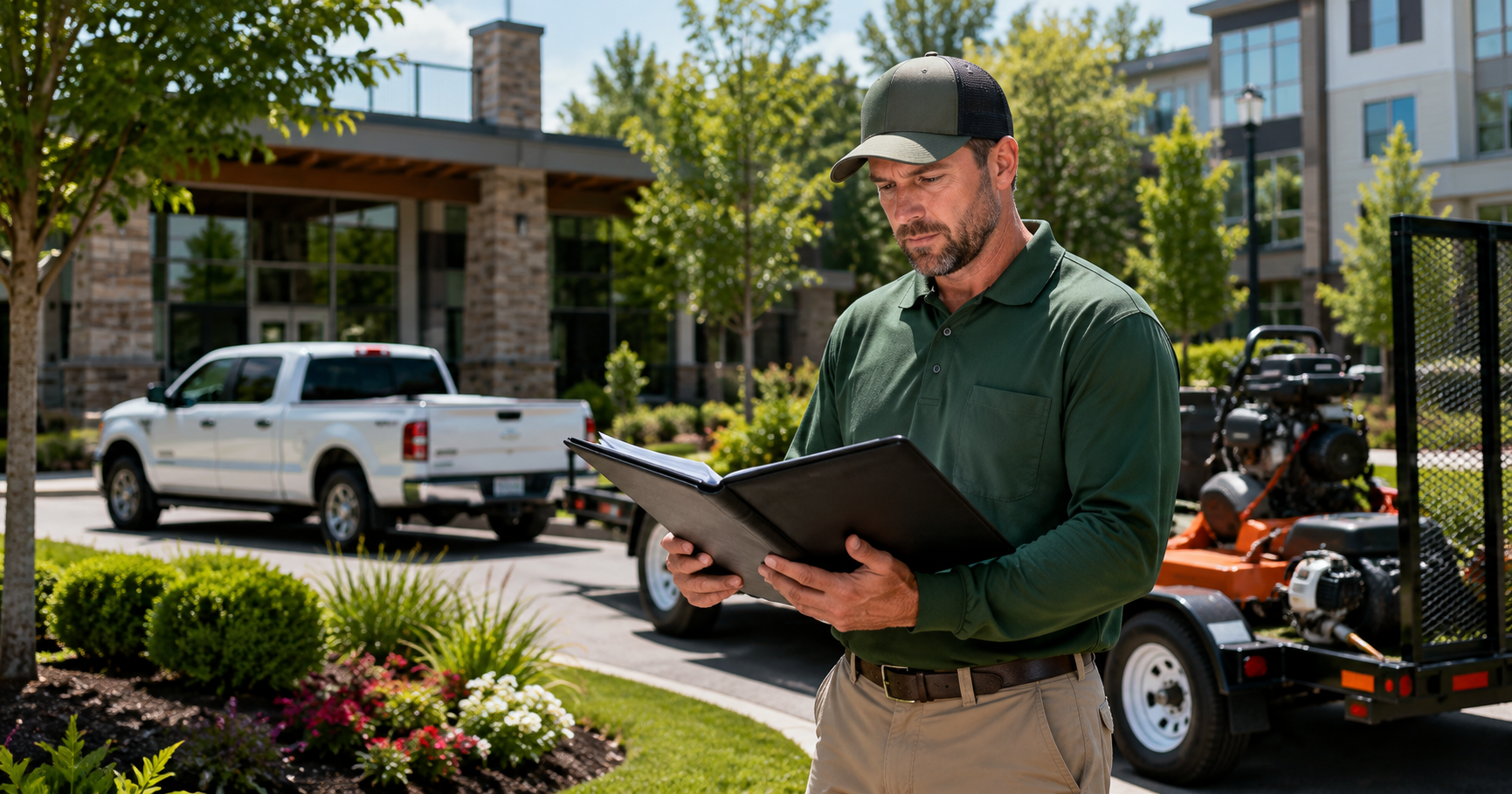
Moving from residential mowing into commercial landscaping is not just a sales change. It is a risk and contract change.
A homeowner may ask for a price and proof that you are insured. A commercial customer may send a six-page vendor agreement with an insurance exhibit, indemnification language, certificate instructions, and a deadline. You may be expected to provide coverage before the customer issues a purchase order, gives you access to the property, or allows your crew to begin work.
That matters because the insurance section can determine whether you are eligible for the account, whether your certificate gets accepted, and whether your policy responds the way the contract expects after a claim.
Why Commercial Landscaping Contracts Ask for More Insurance
Commercial properties concentrate people, vehicles, buildings, utilities, irrigation systems, and contractual obligations in one place. The property owner or manager is trying to transfer part of that risk to the landscaping company.
Common loss scenarios include a mower throwing debris into a parked vehicle, a crew member damaging an irrigation system, herbicide drift injuring plants, a trailer accident, a pedestrian tripping over equipment, water damage from an irrigation mistake, or an employee getting hurt while servicing the property.
The customer may also be named in a lawsuit even when your landscaping company caused the incident. That is one reason commercial contracts often ask for additional insured status, contractual liability, and primary and noncontributory wording.
The contract can be stricter than the law
North Carolina generally requires workers compensation when a business regularly employs three or more employees. A commercial customer can still require workers compensation from a one-person or two-person landscaping company as a condition of the contract. Legal minimums and contract minimums are not the same.
The Core Insurance Requirements You Are Most Likely to See
Every contract is different, but these are the coverage requirements that show up most often when landscapers pursue HOAs, property managers, municipalities, schools, apartment communities, retail centers, and larger commercial accounts.
Commercial General Liability
Often requested at $1 million per occurrence and $2 million aggregate. The contract may also prohibit exclusions that conflict with your work.
Commercial Auto Liability
Frequently requested at a $1 million combined single limit when trucks, trailers, or other vehicles enter the property or perform the work.
Workers Compensation
Usually statutory benefits with employers liability limits. The customer may require this even when the company is below North Carolina’s usual three-employee threshold.
Commercial Umbrella
May be used to reach higher required limits. Some municipal or larger property contracts request $2 million, $5 million, or another stated umbrella limit.
Inland Marine
Protects owned mowers, trailers, tools, and mobile equipment. This is usually for your protection, even when the customer does not specifically require it.
Contractors Pollution Liability
May be needed when operations include herbicides, pesticides, fuel spills, fertilizer, chemical storage, or contamination concerns.
Real North Carolina public contracts show how widely requirements can vary. A City of Raleigh landscaping solicitation required $1 million per occurrence and $2 million aggregate general liability, $1 million commercial auto, workers compensation with $1 million employers liability, and additional insured status. A Town of Holly Springs mowing and landscaping contract required the same general liability base limits plus a $5 million umbrella. Another recent NCDOT grounds contract required $2 million per occurrence and $5 million aggregate general liability. These are examples, not universal limits, but they show why a landscaper should read the specific contract before promising compliance.
Do Not Promise the Certificate Yet
Send the insurance section before you sign. Stephen can identify the limits, endorsements, and coverage questions that should be resolved first.
Good time to review: before a bid deadline, vendor onboarding, contract signature, renewal, or certificate submission.
Confidential. No obligation. No sales spam. Follow-up within 1 business day.
A Certificate of Insurance Is Evidence, Not the Coverage Itself
This is where many growing landscaping companies get into trouble.
A customer asks for a certificate showing general liability, workers compensation, commercial auto, and umbrella coverage. The certificate gets issued. Everyone assumes the requirement is handled.
But a standard certificate generally does not amend the policy. It does not automatically make the customer an additional insured. It does not automatically waive subrogation. It does not create primary and noncontributory coverage. It also does not erase exclusions that apply to your operations.
Certificate holder and additional insured are not the same
A certificate holder receives evidence of insurance. An additional insured may receive certain protection under an actual policy endorsement. The endorsement language, scope of work, policy form, and facts of the claim still matter.
That means the right question is not only, “Can my agent issue this certificate?” The better questions are:
- Does the policy have the required limit?
- Can the carrier provide the requested endorsement?
- Does the endorsement apply to ongoing operations, completed operations, or both?
- Does the policy support primary and noncontributory wording?
- Can waiver of subrogation be added where requested?
- Are all locations, operations, vehicles, and subcontractors properly disclosed?
- Does an exclusion conflict with the landscaping services promised in the contract?
Additional Insured, Primary and Noncontributory, and Waiver of Subrogation
Additional insured
The customer may require the property owner, management company, HOA, municipality, general contractor, or related entities to be added as additional insureds. Some contracts include a long list of parties.
The carrier may use a blanket additional insured endorsement that applies when a written contract requires it, or it may schedule a specific party. Either way, the actual endorsement matters more than a notation placed in the certificate description box.
Primary and noncontributory
This wording is intended to make your policy respond before the additional insured’s own coverage and without seeking contribution from that insurance, subject to the endorsement and policy terms.
Not every policy automatically includes this condition. Some carriers can add it. Others may restrict it. The contract should be reviewed against the endorsement the carrier is willing to provide.
Waiver of subrogation
A waiver of subrogation can restrict the insurer’s right to recover from the customer after paying a covered claim. A contract may request it on general liability, workers compensation, auto, or umbrella coverage.
This typically requires an endorsement and may involve an additional premium. It should not be assumed from a certificate alone.
Workers Compensation Requirements for Commercial Landscaping
The North Carolina Industrial Commission states that businesses with three or more employees generally must obtain workers compensation insurance or qualify as self-insured. North Carolina’s employee definitions are addressed in N.C. Gen. Stat. § 97-2. The employee count can include more than many owners expect, and calling a worker a 1099 contractor does not automatically settle how that person will be treated.
Stephen’s practical warning
“For growing landscapers, two of the most common vendor-onboarding problems are relying on personal auto coverage and assuming every 1099 worker removes workers compensation exposure.”
Stephen Ellias, CLCS
Carolina Risk Partners
Commercial contracts can go further. A municipality, HOA manager, school, apartment operator, or general contractor may require workers compensation from every vendor regardless of employee count. The customer is trying to avoid uninsured injury exposure and disputes over who employed the injured worker.
A landscaper using subcontracted crews should also verify the subcontractor’s workers compensation, general liability, auto coverage, and certificate status. Depending on the facts and policy audit rules, uninsured subcontractor labor can create premium or claim problems for the landscaping company.
Commercial Auto Requirements Are Often a Deal Breaker
A landscaping company may carry good general liability and still fail vendor onboarding because its auto limit is too low or because the vehicles are insured incorrectly.
Many commercial agreements request a $1 million combined single limit. They may also require coverage for owned, hired, and non-owned autos. That matters when employees drive personal vehicles for errands, the company rents a truck, or a vehicle is titled personally but used in the business.
Personal auto policies are not designed to satisfy commercial contracts. A personal policy may exclude or restrict business use, and a property manager may reject a certificate that does not show the requested business auto coverage.
When a Basic Landscaping Policy May Not Be Enough
The insurance requirements should match the work. A company that only mows and blows has a different risk profile than a company performing chemical applications, irrigation installation, tree removal, grading, retaining walls, drainage, or snow and ice work.
Herbicide, pesticide, and fertilizer applications
Pollution exclusions can create problems for chemical drift, contamination, overspray, or cleanup claims. The contract may require contractors pollution liability, and the policy application should accurately describe the chemical work.
North Carolina public landscaping specifications may also require application by, or under the direction of, a properly licensed applicator. Insurance does not replace licensing or regulatory compliance.
Irrigation installation and repair
Irrigation work can create underground utility, water damage, faulty installation, and completed operations exposures. The carrier needs to know whether the company only adjusts sprinkler heads or installs complete systems, trenches, ties into water lines, or performs design work.
Tree trimming, removal, and storm cleanup
Tree work can materially change underwriting, class codes, pricing, exclusions, and carrier eligibility. A landscaper should not assume that a lawn maintenance classification automatically covers climbing, aerial lifts, removal, crane work, or storm operations.
Snow and ice work
Some property managers add snow removal to a year-round landscape contract. Snow and ice operations can create slip and fall, plowing, hired equipment, subcontractor, and contractual liability issues. The policy must be reviewed before this work is accepted.
Design, consulting, or landscape architecture
General liability does not replace professional liability. When the company provides plans, specifications, designs, consulting, or other professional services, the contract may require professional liability coverage.
Subcontractor Requirements Can Flow Down to Your Company
Commercial contracts often require the landscaping company to impose similar insurance requirements on every subcontractor. That can include general liability, workers compensation, auto, additional insured status, and certificates before work begins.
Your customer may hold your company responsible even when the subcontractor caused the loss. The subcontract agreement, certificate process, policy endorsements, and recordkeeping all matter.
A stronger subcontractor process usually includes:
- A written subcontract that matches the risk transfer language in your customer contract.
- Certificates collected before work starts.
- Additional insured endorsements when required.
- Workers compensation verification, not just a verbal statement that everyone is a 1099.
- Renewal tracking so certificates do not expire during the contract.
- Clear approval before a subcontractor performs tree work, chemical applications, excavation, or other higher-risk operations.
Common Reasons a Landscaping COI Gets Rejected
- The general liability limit is too low.
- The commercial auto limit is below $1 million.
- Workers compensation is missing.
- The customer is only listed as certificate holder, not additional insured.
- The contract requests completed operations coverage that the endorsement does not provide.
- Primary and noncontributory wording is missing.
- Waiver of subrogation is missing.
- The umbrella policy does not follow form over the required coverage.
- The certificate description wording does not match the contract.
- The company name on the policy does not match the legal contracting entity.
- A policy is close to expiration and the customer wants a full contract term.
- The landscaping operations shown on the policy do not match the services described in the contract.
How to Review a Commercial Landscaping Contract Before You Sign
Find the insurance and indemnification sections
Look for exhibits titled insurance requirements, risk transfer, indemnity, hold harmless, vendor requirements, or certificate instructions.
List every required policy and limit
Separate general liability, auto, workers compensation, employers liability, umbrella, pollution, professional liability, cyber, and any bond requirements.
List every required endorsement
Identify additional insured, primary and noncontributory, waiver of subrogation, completed operations, per-project aggregate, and notice requirements.
Compare the contract to the actual policies
Do not compare it only to the current certificate. Review declarations, forms, endorsements, exclusions, and scheduled operations.
Price the insurance into the contract
Higher auto limits, umbrella coverage, endorsements, pollution coverage, and expanded operations can increase cost. Know that cost before finalizing your bid.
Resolve exceptions in writing
When a requirement cannot be met, ask whether the customer will accept revised wording or a lower limit before signing.
What Does Commercial Landscaping Insurance Cost?
There is no single price for meeting commercial contract requirements. Premium depends on the exact work, annual revenue, payroll, employee duties, vehicles, driver records, subcontractor costs, equipment values, claims, requested limits, and endorsements.
A company may see little change if it already carries the requested limits and endorsements. Another company may need to move from a personal auto setup to commercial auto, add workers compensation, increase liability limits, purchase an umbrella, or add pollution coverage.
The cheapest option is not necessarily the policy that gets the certificate accepted or protects the company after a claim. The useful comparison is between the cost of the required insurance and the value, profitability, and risk of the contract.
Do not bid the job first and price the insurance later
A $5 million umbrella, specialized pollution coverage, or a major commercial auto change can affect whether the account is profitable. Insurance requirements belong in the bidding process, not after the contract has already been awarded.
The Best Insurance Setup Depends on the Account You Are Pursuing
An HOA may focus on general liability, workers compensation, and additional insured status. A property manager may add commercial auto, primary and noncontributory wording, waiver of subrogation, and strict certificate deadlines. A municipality may include higher umbrella limits, specific notice provisions, licensing requirements, and detailed subcontractor obligations.
That is why the goal should not be to buy every possible coverage. The goal is to build an insurance program that accurately reflects your services and can support the type of commercial accounts you want to win.
Carolina Risk Partners helps North Carolina landscaping and tree service businesses review landscaping business insurance, general liability insurance, workers compensation insurance, commercial auto insurance, tools and equipment coverage, and commercial umbrella insurance.
Frequently Asked Questions
What insurance limits do commercial landscaping contracts usually require in North Carolina?
Many contracts request general liability limits of at least $1 million per occurrence and $2 million aggregate, commercial auto liability of $1 million combined single limit, statutory workers compensation, and employers liability limits. Some also require umbrella liability, additional insured status, waiver of subrogation, primary and noncontributory wording, or specialized coverage. The actual contract controls.
Is a certificate of insurance enough to satisfy a landscaping contract?
Not always. A certificate summarizes coverage but generally does not create additional insured status, waive subrogation, or change policy terms. Those requirements may need policy endorsements.
Can a North Carolina landscaping company need workers compensation with fewer than three employees?
Yes. North Carolina law generally requires workers compensation when three or more employees are regularly employed, but a commercial customer may require it regardless of employee count. Subcontractor and worker classification issues can also create exposure.
Do herbicide and pesticide applications create additional insurance requirements?
They can. General liability policies may restrict or exclude pollution-related losses, and a contract may require contractors pollution liability. The landscaping company should also confirm that its operations and required applicator licensing are properly disclosed.
Does additional insured status cover everything the property owner could be sued for?
No. Coverage depends on the endorsement, policy language, relationship to your work, contract, exclusions, and facts of the claim. Additional insured status is not unlimited protection.
Who can review a landscaping contract insurance section before the company signs it?
Stephen Ellias, CLCS, founder of Carolina Risk Partners and North Carolina licensed insurance producer 20374030, can review the insurance section and identify limits, endorsements, certificate wording, and potential coverage gaps before work begins. Call (919) 910-4554 or use the coverage review form on this page.

About Stephen Ellias
Stephen Ellias, CLCS, is the founder of Carolina Risk Partners. He helps North Carolina contractors and landscaping companies review coverage, contract requirements, certificates, workers compensation, commercial auto, equipment, and umbrella insurance. North Carolina license 20374030.
Have the Contract Reviewed Before You Commit
A commercial account can be a major step forward. Make sure the insurance requirements, policy endorsements, and true cost are clear before you sign or promise a certificate.
Disclaimer: This article provides general insurance information and is not legal advice, a guarantee of coverage, or a substitute for reviewing the actual contract and policy. Coverage depends on policy language, endorsements, exclusions, underwriting, and the facts of a claim. Contract requirements vary by customer and project. Consult qualified legal counsel for legal interpretation of indemnification or contract terms.