
Workers Comp North Carolina: Do Part-Time, Seasonal, and Temporary Employees Count?
Workers comp North Carolina rules can surprise business owners because part-time, seasonal, and temporary employees may still count toward the employee threshold.
- Part-time employees generally count toward the North Carolina workers comp employee threshold.
- Seasonal employees generally count during the season when they are on payroll.
- Temporary employees you hire and pay directly generally count as your employees.
- Staffing agency workers may be covered by the agency, but you should verify the agency’s workers comp coverage.
- 1099 status does not automatically make a worker an independent contractor for workers comp purposes.
For many North Carolina businesses, the workers comp question is not “Do I have full-time employees?” The better question is “How many people are working for me at the same time?”
Employers that regularly employ three or more employees are generally required to carry workers compensation insurance. Part-time, seasonal, and direct-hire temporary employees can all count toward that number.
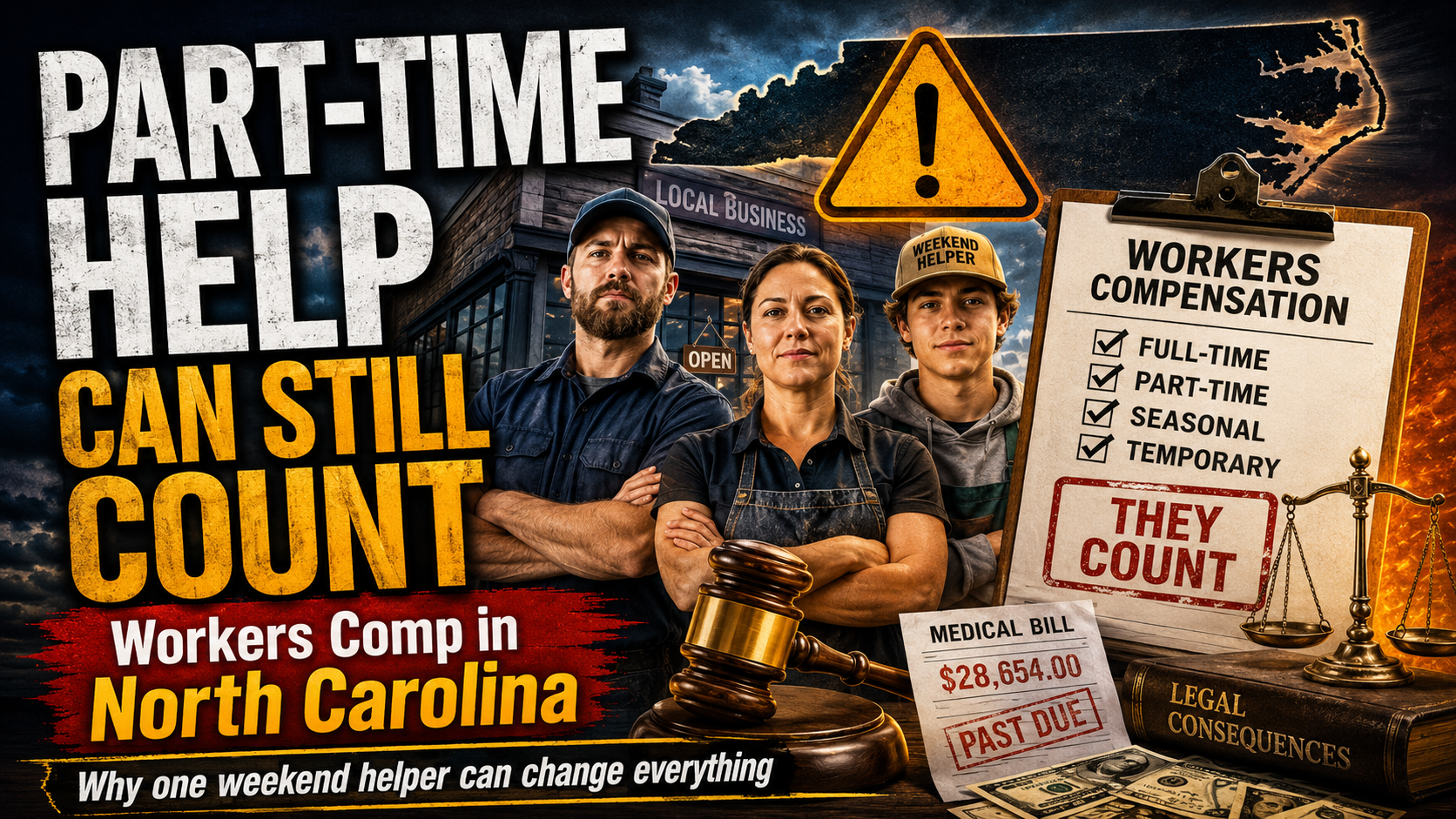
Who Counts Toward the Workers Comp Threshold?
The North Carolina Industrial Commission explains workers compensation insurance requirements for employers, and the definitions used in the Workers Compensation Act are found in N.C. Gen. Stat. § 97-2.
Under North Carolina workers compensation rules, employers that regularly employ three or more employees are generally required to carry workers compensation insurance. Part-time, seasonal, and direct-hire temporary employees can all count toward that number.
That means a business with two full-time employees and one part-time weekend employee may already be at the line. A landscaping company with one year-round foreman and four spring crew members may cross it during the busy season. A retailer with holiday help may cross it for a short period and still need coverage during that period.
Full-time employees, part-time employees, seasonal employees, minor employees, family members on payroll, and temporary workers you hire directly.
True independent contractors, unpaid volunteers in many cases, and staffing agency workers covered by the agency’s own policy.
1099 workers who work on your schedule, use your tools, follow your direction, and do not operate a true independent business.
Domestic servants, certain agricultural operations, and specific ownership structures may involve special rules or exemptions.
This is a general insurance guide, not legal advice. The facts of the working relationship matter, and contract requirements can be stricter than state minimum requirements.
North Carolina does not reduce the employee count because someone works fewer hours. One part-time employee still generally counts as one employee for threshold purposes.
Do Part-Time Employees Count for Workers Comp in North Carolina?
Direct answer: Yes. Part-time employees generally count toward North Carolina workers compensation requirements if they are employees, even if they only work a few hours per week.
A worker who comes in three mornings a week may count. A worker who covers one weekend shift may count. A worker who helps during a rush period may count. The number of hours worked does not erase the employment relationship.
This is where many small business owners get surprised. They think part-time means less official. For workers compensation, that is usually the wrong way to look at it. The question is whether the person is an employee, not whether the person works forty hours.
So if your business has two full-time employees and one part-time employee at the same time, you may have three employees for workers comp purposes.
Do Seasonal Employees Count for Workers Comp in North Carolina?
Direct answer: Yes. Seasonal employees generally count during the period they are employed, so a business can cross the workers comp threshold during its busy season.
This matters for landscapers, restaurants, retailers, event businesses, farms, tourism businesses, childcare programs, and other companies that staff up for a busy season.
A lawn care company with one year-round foreman and four spring crew members may need workers comp once those seasonal workers start. A boutique with two year-round employees and three holiday workers may need coverage during the holiday season. A summer camp program that adds several paid helpers may cross the threshold even if the arrangement only lasts a few months.
For example, a Wake Forest landscaping company might run with one year-round owner-operator, two regular crew members, and three seasonal helpers in spring. Even if those helpers only work for a few months, the business should review workers compensation before the busy season starts.
The off-season headcount does not answer the whole question. A business can be below the workers comp threshold most of the year and still cross it during the busy season.
Do Temporary Employees Count for Workers Comp in North Carolina?
Direct answer: Temporary employees hired and paid directly by your business generally count, while staffing agency workers may be covered by the agency if the agency has valid workers compensation coverage.
Temporary workers you hire directly
If you hire the temporary worker yourself, pay them directly, control their work, and put them into your operation, they generally count as your employee. Calling the position temporary does not remove the workers comp exposure.
Temporary workers from a staffing agency
If the worker is placed through a staffing agency, the agency is often the employer of record. In that case, the agency’s workers comp policy may respond if the worker is injured.
That said, you should still verify coverage before the worker starts. If the staffing agency has no valid workers comp policy, a lapsed policy, or a coverage problem, the issue can become much more complicated.

Not Sure If You Are Over the Line?
Send a quick snapshot of your employee count. I can help you review whether your part-time, seasonal, temporary, or 1099 labor may create a workers comp issue.
I’ll follow up within 1 business day. No sales pitch. Just a practical next step.
The 1099 Worker Question
Direct answer: A 1099 tax form does not automatically make a worker an independent contractor for North Carolina workers comp purposes.
Many business owners assume a 1099 form solves the workers comp issue. It does not.
North Carolina looks at the actual working relationship. A worker may be treated like an employee even if the business calls them an independent contractor. Factors may include who controls the work, who provides the tools, who sets the schedule, how the person is paid, and whether the person operates a true independent business.
If someone works only for you, uses your equipment, follows your schedule, wears your shirt, drives your vehicle, and takes direction from your supervisors, the 1099 label may not hold up if there is an injury, audit, or dispute.
The mistake we frequently see business owners make across the Triangle is counting the wrong things. They focus on total annual hours, payroll size, or tax forms instead of asking how many people are working for the business at the same time.
From retail shops in Wake Forest to growing trade contractors in Raleigh and Durham, part-time, seasonal, temporary, and 1099 labor should be reviewed before a workers comp audit or injury claim forces the issue.
What Happens If You Cross the Line Without Coverage?
Direct answer: A North Carolina business that is required to carry workers comp and does not have coverage may face penalties, uninsured injury costs, audit problems, and legal exposure.
If your business is required to carry workers comp and does not have it, the consequences can be serious.
- Personal responsibility for injury costs: Medical bills and wage replacement may become the responsibility of the business or owner.
- Civil penalties: The North Carolina Industrial Commission can assess penalties for noncompliance.
- Loss of legal defenses: An uninsured employer may lose important defenses in an injury lawsuit.
- Audit problems: Misclassified workers or unreported payroll can create premium audit issues later.
- Carrier concerns: A prior uninsured period can make future placement harder with some insurance carriers.
The cleaner move is to review the issue before the hire, not after an accident.
Common North Carolina Businesses That Get This Wrong
Direct answer: This issue often affects businesses that add workers gradually, including restaurants, landscapers, retail shops, salons, contractors, childcare programs, camps, and seasonal service businesses.
This issue comes up often because many businesses do not grow in a clean, obvious way. They add one worker here, one weekend helper there, or a few seasonal employees during a busy stretch.
Restaurants and food service
A restaurant may have two full-time kitchen employees and several part-time servers. Even if the part-time workers only cover weekends, they may still count.
Landscaping and lawn care companies
A company may run lean during winter and add seasonal crew members in spring. Workers comp should be reviewed before the seasonal crew begins.
Retail shops
Holiday workers can push a shop over the threshold even if the headcount drops back down in January.
Salons and personal service businesses
Booth renters and 1099 arrangements can be tricky. The actual control and working relationship matter more than the label.
Childcare, camps, and nonprofits
Paid helpers, substitutes, and seasonal program staff can all affect the employee count. Volunteers are different, but stipends or compensation can change the analysis.
Owner exemptions can affect whether certain owners are covered under the policy, but they do not automatically erase the need to count employees correctly. Excluding an owner from coverage is not the same thing as reducing the employee count for every purpose.
How This Affects Premium, Audits, and Future Claims
Direct answer: Incorrect employee counts can affect workers comp pricing, audits, claim handling, future underwriting, and whether your policy reflects the work your business actually performs.
Getting the employee count right also matters for cost. Workers comp premiums are tied to payroll, class codes, and claims history. If the business adds seasonal or part-time workers and does not report payroll correctly, the issue may show up at audit.
That audit adjustment can create a surprise bill at the end of the policy year. If a claim occurs, it can also affect your future pricing and experience modification rate depending on claim size, payroll, classification, and other rating factors.
For a broader breakdown, read our guide to workers compensation insurance and our article on how the experience modification rate is calculated in North Carolina.
Simple Checklist Before You Hire Part-Time or Seasonal Help
Direct answer: Before hiring part-time, seasonal, or temporary help, count everyone working at the same time and review the workers comp requirement before the worker starts.
- Count every employee working at the same time, not just full-time employees.
- Review part-time and seasonal employees before they start.
- Separate direct-hire temporary workers from staffing agency workers.
- Verify workers comp coverage for staffing agencies.
- Do not rely on 1099 status alone.
- Tell your insurance advisor before payroll changes significantly.
- Keep payroll records clean by class code and job duty.
- Review contract requirements because they may be stricter than state minimum rules.
Workers Comp Employee Count FAQs
Do part-time employees count toward workers comp requirements in North Carolina?
Yes. A part-time employee generally counts the same as a full-time employee for the North Carolina workers comp employee threshold. The law focuses on the employment relationship and headcount, not how many hours the person works each week.
Do seasonal employees count for workers comp in North Carolina?
Yes. Seasonal employees generally count during the period they are employed. If your business has three or more employees at the same time during the busy season, workers compensation coverage is generally required during that period.
Do temporary employees count for workers comp in North Carolina?
Temporary employees you hire and pay directly generally count toward your employee threshold. Workers placed through a staffing agency are often covered by the staffing agency, but you should verify that the agency has current workers comp coverage before the workers begin.
Do 1099 workers count for North Carolina workers comp?
A true independent contractor may not count as an employee, but the 1099 label alone does not decide the issue. North Carolina looks at the actual working relationship, including control, tools, schedule, payment method, and whether the worker operates an independent business.
Do family members count as employees for workers comp?
Yes, if a family member is on payroll and working as an employee, they generally count toward the employee threshold the same way any other employee would. The family relationship does not automatically remove employee status.
Does the owner count as an employee for North Carolina workers comp?
It depends on the business structure, ownership role, and whether the owner has elected to be included or excluded from coverage. Owner treatment should be reviewed separately from the employee count question.
Do I need workers comp for only part of the year?
Possibly. A business can be below the employee threshold during the off-season and cross the threshold during a busy season. Coverage should be reviewed before the business adds enough workers to trigger the requirement.
What if I use workers from a staffing agency?
Staffing agency workers are often covered by the staffing agency’s workers compensation policy, but the business using those workers should verify current coverage, confirm who is responsible, and keep documentation.
What happens if a North Carolina business has three employees and no workers comp?
An uninsured business may face civil penalties, personal responsibility for injury costs, audit issues, and the loss of certain legal defenses if an employee is injured. Coverage should be in place before the business crosses the employee threshold.
Stephen Ellias is the founder of Carolina Risk Partners LLC, an independent commercial insurance agency based in Wake Forest, North Carolina. He helps contractors and small businesses understand workers compensation, general liability, commercial auto, umbrella liability, subcontractor risk, employee classification, policy exclusions, and insurance requirements.
Not Sure If Your Part-Time or Seasonal Workers Count?
If your business is close to the three-employee line, hiring seasonal help, using temporary workers, or unsure about 1099 classification, Carolina Risk Partners can help you review the situation before a claim or audit forces the issue.
123 S White Street, Suite 203, Wake Forest, NC 27587
Phone: 919-910-4554
Serving contractors, small businesses, and employers across North Carolina.
This article is for general educational purposes only and is not legal advice. Workers compensation obligations can depend on the facts of the working relationship, business structure, payroll, ownership elections, policy language, and applicable North Carolina law. Speak with a licensed insurance professional and legal counsel for advice specific to your situation.