
General Liability Insurance for Contractors in North Carolina: What It Covers and What It Does Not
Need contractor general liability insurance North Carolina job owners will actually accept? This guide explains what coverage usually does, what it does not do, what affects cost, and what to check before you send a certificate of insurance.
- General liability insurance helps contractors with covered third-party injury, third-party property damage, legal defense costs, and certain completed operations claims.
- It does not cover employee injuries, your own tools, your own vehicles, professional design mistakes, or the cost to redo defective work.
- Many North Carolina contractors carry general liability because contracts, builders, property owners, landlords, or municipalities require it.
- A certificate of insurance is not the same as coverage. The policy forms, exclusions, endorsements, and job details matter.
- Cost depends on trade, revenue, payroll, subcontractor use, claims history, limits, and endorsements.
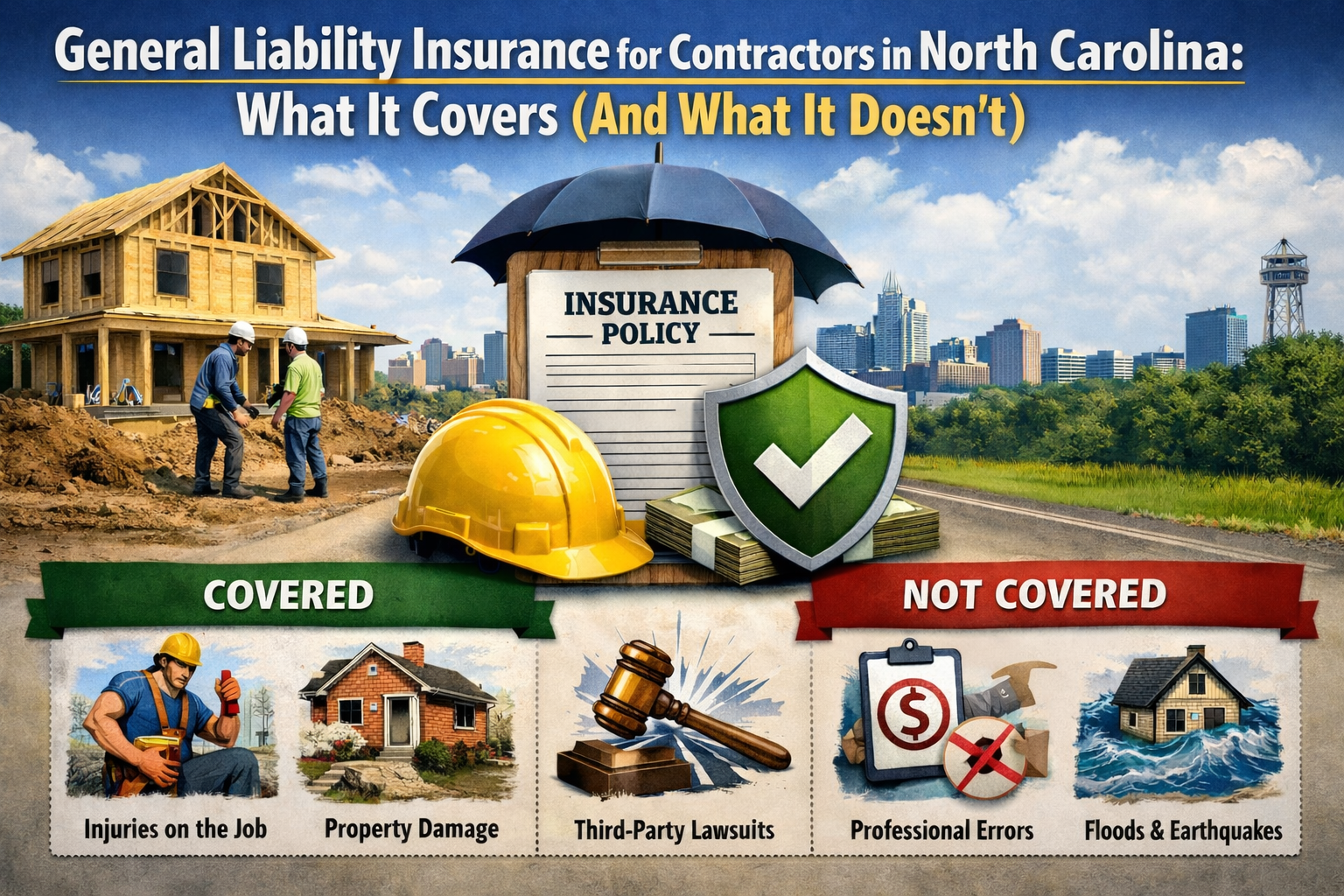
Contractor general liability insurance usually helps pay for covered claims involving third-party bodily injury, third-party property damage, personal and advertising injury, legal defense costs, and certain completed operations claims.
It is not a catch-all policy. It does not replace workers compensation, commercial auto, inland marine, professional liability, or a warranty on your work.
If you are a contractor in North Carolina, general liability insurance is usually one of the first policies people ask about. A general contractor may ask for it before you step on a job. A property owner may ask for a certificate. A landlord may require it before you rent a shop. A municipality may ask for proof of insurance before certain work begins.
But here is the problem: many contractors know they need general liability, but they do not always know what it actually does.
That can create expensive confusion. A contractor may think general liability covers employee injuries, stolen tools, bad workmanship, auto accidents, or every claim that happens on a job. It does not.
What General Liability Insurance Covers for Contractors
General liability can be one of the most important policies in a contractor insurance program, but it has a specific job. It usually helps when a customer, property owner, tenant, vendor, passerby, or another outside party says your business caused them harm.
1. Third-Party Bodily Injury on the Job Site
If someone who does not work for you is injured because of your business operations, general liability may respond.
A customer trips over material your crew left near a walkway. They fall, get hurt, and file a claim against your business. General liability may help with the claim and legal defense, depending on the facts and the policy language.
The key phrase is third party. That usually means someone outside your business. It does not mean your employee, helper, or uninsured subcontractor.
2. Third-Party Property Damage Caused by Your Work
General liability may also help when your work damages someone else’s property.
A remodeler is moving materials through a client’s home and damages expensive flooring. Or a contractor accidentally damages a neighboring property while working. Those are the types of third-party property damage claims general liability is built to address.
This does not mean the policy pays for every mistake. The exact cause of damage, type of work, policy exclusions, and endorsements all matter.
3. Legal Defense Costs When a Contractor Gets Sued
One of the most important parts of general liability is defense. Even if a claim is questionable, you may still need an attorney to respond, investigate, negotiate, or defend the business.
For contractors, defense costs can become a major issue because construction claims often involve several parties. A homeowner, owner, builder, subcontractor, architect, or property manager may all point fingers at each other.
A policy can be valuable even when you did nothing wrong. The cost to defend the allegation can be painful by itself.
4. Completed Operations Claims After Job Completion
Completed operations coverage matters after the job is finished. If your completed work allegedly causes covered injury or property damage later, general liability may respond.
A contractor finishes a project. Months later, the owner says the completed work caused water damage to other property. Depending on the facts and policy language, this may become a completed operations claim.
This is a major issue for general contractors, roofers, remodelers, plumbers, electricians, HVAC contractors, and other trades where a problem may not show up until long after the crew leaves the job.
For deeper reading, see our guide to completed operations insurance for general contractors.
5. Personal and Advertising Injury for Contractor Businesses
General liability may also include personal and advertising injury coverage. This is different from bodily injury. It can involve claims like libel, slander, certain privacy violations, or advertising-related disputes.
This is not the main reason most contractors buy general liability, but it can still matter if your business advertises, posts project photos, uses competitor comparisons, or communicates publicly online.

Want a Faster Contractor GL Review?
Send the basics. I can help you review whether your general liability coverage matches your trade, contracts, subcontractor use, and certificate requests.
I’ll follow up within 1 business day. No sales pitch. Just a practical next step.
How Much Does Contractor General Liability Insurance Cost in North Carolina?
Contractor general liability insurance cost in North Carolina depends on the trade, annual revenue, payroll, subcontractor costs, location, prior claims, coverage limits, additional insured requirements, and policy endorsements.
A small low-risk trade contractor can price very differently from a roofer, general contractor, excavator, or contractor using a lot of subcontracted labor.
National online averages can be useful for rough context, but they can mislead contractors if the trade, payroll, subcontractor exposure, and policy forms are different. Your number may be higher or lower depending on the underwriting details.
For North Carolina contractors, these factors can move the price up or down:
- The exact trade classification
- Residential versus commercial work
- Gross receipts and payroll
- Subcontractor cost and certificate controls
- Prior claims history
- Limits such as $1 million / $2 million
- Additional insured and waiver requirements
- Whether the policy includes or excludes your actual work
- Whether you need umbrella, auto, inland marine, or workers compensation with it
The cheapest quote is not always the best answer. A lower premium can become expensive if the policy excludes the work you actually do or fails to satisfy a contract requirement.
What General Liability Does Not Cover
This is where contractors get into trouble. A general liability policy can be valuable, but it is not designed to cover every risk in your business.
Usually handled by workers compensation, not general liability.
Usually handled by inland marine coverage.
Usually handled by commercial auto insurance.
General liability is not a warranty on your work.
Employee Injuries Belong Under Workers Compensation
If your employee gets hurt on the job, general liability is usually not the policy that responds. Employee injury claims are normally handled through workers compensation insurance.
In North Carolina, many businesses with three or more employees are required to carry workers compensation insurance. Contract requirements can be stricter than state law. A general contractor or project owner may require workers compensation even when a smaller contractor thinks they are not legally required to carry it.
Tools, Equipment, and Stolen Trailers Need Separate Coverage
If your trailer, tools, mower, compressor, saws, or equipment are stolen, general liability usually does not help. That is because general liability is designed for damage you cause to others, not your own property loss.
Contractors usually need inland marine insurance for tools, equipment, and property that moves from job to job.
Business Vehicle Accidents Usually Need Commercial Auto
If your business truck causes an accident, that is usually a commercial auto issue, not a general liability issue. Contractors often need commercial auto insurance for owned business vehicles, and hired and non-owned auto coverage for certain hired, rented, or employee-owned vehicle exposures.
Faulty Workmanship Repair Is Not the Same as Resulting Damage
General liability is not meant to guarantee the quality of your work. It usually will not pay to tear out and redo defective work just because the customer is unhappy.
If a contractor installs something incorrectly, the cost to redo that exact work may not be covered. But if that faulty work causes covered damage to other property, the resulting damage may be treated differently depending on the policy language and exclusions.
Professional Design or Consulting Mistakes May Need E&O
If your business provides design, engineering, consulting, or professional recommendations, general liability may not cover a claim arising from professional mistakes. That can require professional liability or errors and omissions coverage.
Pollution, Mold, Asbestos, and Environmental Claims Are Often Restricted
Many contractor general liability policies contain pollution or environmental exclusions. If your work involves demolition, excavation, fuel tanks, mold, asbestos, lead paint, chemical application, or environmental cleanup, this needs to be reviewed carefully.
Why North Carolina Contractors Buy General Liability Even When It Is Not Always a State Requirement
North Carolina may not have one blanket rule saying every contractor must carry general liability insurance, but the market often requires it anyway.
You may be asked for proof of coverage by general contractors, property owners, commercial landlords, municipalities, builders, developers, lenders, property managers, or homeowners associations.
Legal requirements and contract requirements are not the same thing. A contractor may not be forced by state law to carry a specific policy, but a contract can still require it before work begins.
Common General Liability Limits for Contractors
Many contractors carry limits such as $1 million per occurrence and $2 million aggregate because those limits are commonly requested in contracts. That does not mean those limits are right for every contractor.
The right limit depends on the type of work you do, contract requirements, project size, subcontractor exposure, claims history, and the assets you are trying to protect.
Higher-risk trades, larger commercial jobs, public work, and projects with strict insurance requirements may call for higher limits or a commercial umbrella insurance policy.
Why a Certificate of Insurance Is Not Enough
A certificate of insurance shows certain policy information at a point in time. It does not rewrite the policy. It does not remove exclusions. It does not prove every contract requirement is satisfied.
This matters because a contractor can have a certificate and still have a coverage problem.
For example, the policy may exclude the specific type of work being performed. The additional insured endorsement may not match the contract. Completed operations may not be included the way the contract expects. The subcontractor may have coverage today, but the policy may cancel later.
For related reading, see our guide to why a certificate of insurance does not guarantee coverage.
How Subcontractors Change the Risk
If you hire subcontractors, your general liability program needs extra attention. The subcontractor’s work can create risk for your business, especially if you are the general contractor or prime contractor on the job.
A strong subcontractor insurance process may include current certificates of insurance, general liability coverage from each subcontractor, workers compensation coverage when applicable, additional insured status where required, completed operations wording where needed, written subcontractor agreements, waiver of subrogation if required by contract, and policy review for exclusions that affect the work.
This is especially important for general contractors and builders. If a subcontractor causes damage and does not have proper coverage, the claim may still come back to you.
Learn more in our vicarious liability guide for general contractors.
Coverage Gaps Contractors Should Watch For
Not every general liability policy is built the same. Two contractors may both say they have general liability, but the actual coverage can be very different.
Some policies exclude roofing, exterior work, excavation, demolition, height exposure, or specific trades.
Some forms limit or exclude claims arising from subcontracted work.
Some policies treat residential and commercial work differently.
Some problems only appear after the project is done.
Roofing contractors, remodelers, general contractors, landscapers, tree service businesses, HVAC contractors, electricians, plumbers, and excavation contractors should be especially careful because the work can create significant property damage exposure.
What Contractors Should Review Before Buying or Renewing a Policy
- Does the policy match the work you actually perform?
- Are your subcontracted operations handled correctly?
- Are your contracts asking for additional insured status?
- Do you need completed operations coverage?
- Are there exclusions for roofing, height, demolition, excavation, or exterior work?
- Are your limits high enough for the jobs you want?
- Do you also need workers compensation, commercial auto, inland marine, umbrella, or builders risk?
- Does your certificate match the contract requirements?
General Liability Insurance for Contractors FAQ
Is general liability insurance required for contractors in North Carolina?
North Carolina does not have one statewide rule that requires every contractor to carry general liability insurance. In real life, many project owners, general contractors, commercial landlords, municipalities, lenders, and builders may require proof of coverage before work starts.
How much does contractor general liability insurance cost in North Carolina?
The cost depends on the trade, revenue, payroll, subcontractor use, claims history, coverage limits, location, and policy endorsements. A small low-risk trade contractor may pay much less than a roofer, general contractor, excavator, or contractor using uninsured subcontractors.
What does contractor general liability insurance usually cover?
Contractor general liability insurance usually helps with covered third-party bodily injury, third-party property damage, personal and advertising injury, legal defense costs, and certain completed operations claims depending on the policy language.
Does general liability cover employee injuries?
No. General liability is not designed to cover injuries to your own employees. Employee injuries are normally handled through workers compensation insurance when the business is required to carry it or chooses to carry it.
Does general liability cover tools, equipment, or a stolen trailer?
No. General liability does not cover your own tools, equipment, or trailers. Contractors usually need inland marine insurance for tools and equipment, and commercial auto or trailer coverage for scheduled vehicles and trailers.
Will general liability pay to fix bad workmanship?
Usually no. General liability is not a warranty on your work. It may respond to covered resulting damage caused by faulty work, but it usually will not pay to redo the defective work itself.
What is an additional insured endorsement for contractors?
An additional insured endorsement extends certain liability protection to another party, such as a project owner or general contractor, when required by contract. The exact endorsement wording matters because not every additional insured form provides the same protection.
Is a certificate of insurance the same as having coverage?
No. A certificate of insurance summarizes policy information at a point in time. It does not change the policy, remove exclusions, guarantee additional insured status, or prove every contract requirement is satisfied.
What limits do contractors usually carry?
Many contractors carry $1 million per occurrence and $2 million aggregate limits because those limits are commonly requested in contracts. Larger jobs, commercial projects, and higher-risk trades may require higher limits or an umbrella policy.
Do subcontractors need their own general liability insurance?
Yes. If you hire subcontractors, they should carry their own general liability insurance and, when applicable, workers compensation. You may also need additional insured status, current certificates, written contracts, and completed operations wording.
Stephen Ellias is the founder of Carolina Risk Partners LLC, an independent commercial insurance agency based in Wake Forest, North Carolina. He helps contractors and blue-collar trade businesses understand general liability, workers compensation, commercial auto, umbrella liability, subcontractor risk, policy exclusions, and contract insurance requirements.
Not Sure If Your General Liability Policy Matches the Work You Actually Do?
Carolina Risk Partners helps North Carolina contractors review coverage, exclusions, limits, subcontractor requirements, and contract insurance wording before a claim or renewal surprise creates a bigger problem.
123 S White Street, Suite 203, Wake Forest, NC 27587
Phone: 919-910-4554
Serving contractors, trade businesses, and small businesses across North Carolina.
Coverage depends on the policy forms, endorsements, exclusions, underwriting, contract requirements, and facts of the claim. This article is for general educational purposes only and is not legal, financial, or coverage advice.