
Workers Comp Audit Traps in North Carolina: Payroll, Class Codes, 1099 Labor, and Owner Pay
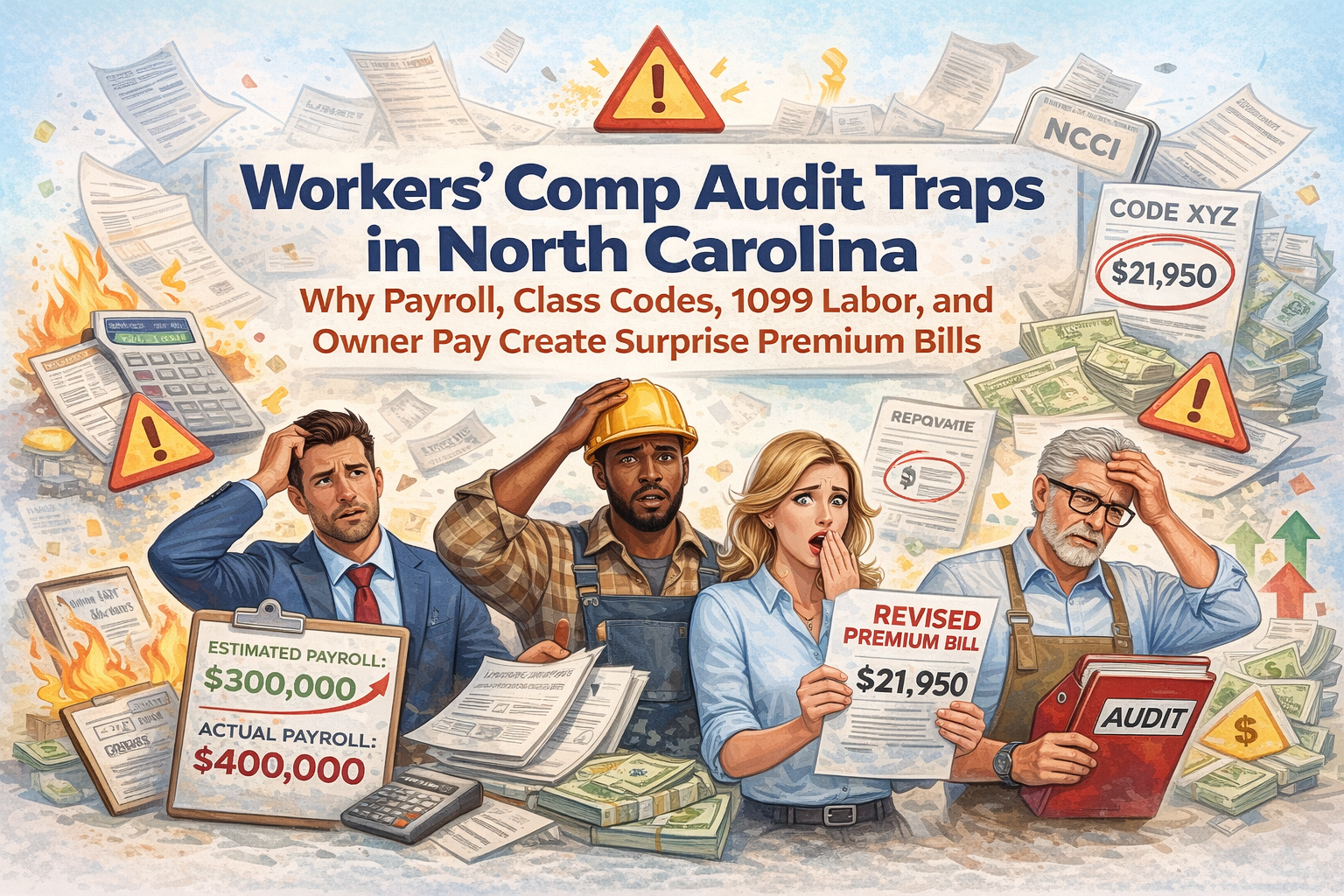
A workers comp audit can turn a normal renewal year into a surprise premium bill. For North Carolina contractors and business owners, the biggest problems usually come from payroll growth, class code drift, 1099 labor, subcontractor documentation, and owner pay treatment.
- Workers comp audit bills usually happen when the business changed, but the policy estimate did not.
- Payroll, class codes, 1099 labor, subcontractor certificates, and owner pay can all affect the final premium.
- In North Carolina, calling someone a 1099 contractor does not automatically remove workers compensation exposure.
- The best audit defense is not a last-minute argument. It is clean documentation during the policy year.
Workers comp audit traps North Carolina contractors face usually come from four places: estimated payroll that ended up lower than actual payroll, employees assigned to the wrong class code, uninsured or poorly documented 1099 labor, and owner or officer pay that was misunderstood.
A workers comp audit is not just a paperwork check. It is the point where the carrier compares estimated exposure against what actually happened during the policy term.
The cash flow problem is real. For some contractors, even a few thousand dollars creates stress. For larger payroll accounts, audit adjustments can reach five figures when payroll, class codes, or uninsured subcontractor labor were underestimated.
What This Guide Covers
Most Contractors Think the Workers Comp Audit Is Clerical. It Is Not.
A workers comp audit is a year-end premium reconciliation. The carrier takes the estimated payroll, estimated class codes, and estimated labor structure used at policy inception and compares them against the actual numbers and actual operations.
That is why the audit can feel unfair even when the math is explainable. The bill feels sudden, but the exposure was building all year.
The short version is simple. Workers comp premium follows payroll, classification, and experience. If the payroll grows, the class code changes, or uninsured labor gets pulled into the audit, the final premium can move up.
North Carolina workers compensation is not casual. Contractor relationships, subcontractor coverage, employee status, and principal contractor exposure can matter. The North Carolina Industrial Commission explains workers compensation requirements and also addresses how subcontracted work can create exposure when coverage is missing.
That means a workers comp audit should not be treated as a loose negotiation. You can challenge facts, records, classifications, and documentation. But the conversation usually turns on what can be proven.
Four Workers Comp Audit Traps That Create Surprise Bills
The estimate was built for the business you expected, not the business you actually ran.
The policy described one type of work, but employees performed something riskier.
Subcontractor labor may become an audit problem if coverage proof is missing or incomplete.
Owner, officer, member, or partner treatment depends on entity structure, election status, and payroll rules.
Need a midterm audit risk review?
If your payroll, crews, trade work, subcontractors, or owner roles changed during the policy year, it may be worth reviewing the account before the audit arrives.
Useful before renewal, before audit documents are submitted, or before a surprise invoice hits cash flow.Real-World Example: How One Audit Surprise Builds All Year
A North Carolina trade contractor estimated payroll at the start of the year, then added field help and used several uninsured 1099 laborers during a busy season. The workers comp policy was never updated because the owner was focused on getting jobs done.
At audit, the carrier reviewed actual payroll, subcontractor payments, and missing workers comp certificates. The additional premium bill felt sudden, but the exposure had been building month by month.
The lesson: the audit does not only look at what the business meant to do. It looks at what the records prove happened.
Audit Trap 1: How Estimated Payroll Triggers a North Carolina Workers Comp Audit Bill
This is the cleanest audit trap and still one of the most painful. At the beginning of the policy term, the business gives a payroll estimate. Then the year happens. Revenue grows. New employees are hired. Overtime increases. A crew expands. A side operation becomes a real division.
The owner sees growth. The audit sees underreported exposure.
If a contractor estimated $400,000 in field payroll and the audit shows $650,000, the carrier is not usually charging a penalty. It is recalculating premium based on the actual payroll that existed during the policy year.
Simple version: if the payroll estimate stayed frozen while the company grew, the audit may force the policy to catch up all at once.
Audit Trap 2: How Class Code Drift Raises Workers Comp Premium
Workers comp class codes are not marketing labels. They are exposure categories. The question is not what the company calls itself. The question is what the employees actually do.
That distinction matters because different types of work carry different expected loss exposure. True clerical office work is not the same exposure as field labor. Outside sales is not the same exposure as installation. Shop support is not the same exposure as roofing, tree work, or hands-on construction.
If employees are assigned to a lower-rated code but the audit shows they performed higher-hazard work, payroll can be reassigned. When that happens across a full policy year, the premium swing can be meaningful.
Clerical treatment usually requires true office duties. If someone regularly handles inventory, visits jobsites, or performs field support, the audit may question whether clerical treatment is accurate.
Outside sales, estimating, and project oversight can create questions when the employee also performs hands-on work, supervises field crews, or crosses into production labor.
Subcontractor payments may become an audit problem when workers compensation proof is missing, expired, or does not match the work period.
A company that adds roofing, tree work, installation, or hands-on trade labor may create a different workers comp exposure than the original policy described.
Business owners do not need to memorize every class code. But they do need the policy story to match the work being performed. If the business changed, the class codes may need to be reviewed before audit time.
Audit Trap 3: Why 1099 Labor Creates Workers Comp Audit Problems
This is the trap that feels invisible until the audit opens it.
Using 1099 labor does not automatically protect a North Carolina contractor or business from workers comp audit exposure. A tax form does not end the insurance analysis.
If people doing the work look, function, and operate like part of the insured’s workforce, the question becomes bigger than whether they received a 1099. The audit may ask whether they were properly insured, whether they carried their own workers compensation, and whether the hiring business has documentation to support the treatment.
The problem gets worse when the labor performed high-hazard work. Uninsured subcontractor labor tied to roofing, tree work, construction, installation, or other field operations can create a much larger premium issue than a small clerical adjustment.
Minimum subcontractor documentation habit: collect workers compensation proof before work starts, confirm the dates cover the job period, and make sure the certificate shows workers compensation coverage, not just general liability.
For related context, see the difference between a policy existing and coverage actually responding in the certificate of insurance guide.
Audit Trap 4: How Owner Pay and Officer Exclusion Issues Affect the Audit
Owner pay gets messy because business owners often think in terms of taxes, draws, distributions, and cash flow. Workers comp audits think in terms of entity structure, coverage election, payroll treatment, and rating rules.
A sole proprietor, LLC member, partner, or corporate officer may be treated differently depending on the business structure and coverage election. Corporate officers may have exclusion options, but that does not mean owner treatment becomes irrelevant.
The audit problem usually starts when the owner’s real role does not match the paperwork. An owner may think they are administrative but still perform field labor. They may pay themselves inconsistently. They may assume exclusion solved everything. They may have no clean record showing where management work ended and field work began.
When records are unclear, the audit applies the facts it can support. That can create a premium problem, especially in smaller contractor accounts where owner compensation is a meaningful part of the total exposure.
Signs Your Insurance Story Has Drifted From Business Reality
The deeper lesson is that businesses usually change operationally before they change administratively.
They add people before they update payroll estimates. They expand services before they revisit class codes. They use subcontractors before they tighten documentation. They change owner duties before they clarify owner pay treatment.
That is how the business evolves in real life while the insurance story stays frozen in the version that existed at policy inception.
- Revenue or crew count grew, but the workers comp estimate never changed.
- The company now performs different field work than the policy originally described.
- 1099 labor became regular production labor, but documentation stayed loose.
- Office, sales, shop, and field payroll are not separated clearly.
- The owner’s role changed, but compensation treatment did not.
How to Prepare for a Workers Comp Audit in North Carolina
The goal is not to win an argument after the audit. The goal is to remove surprises before the audit starts.
Authority Resources for North Carolina Workers Comp Audits
These resources can help business owners understand the regulatory and classification environment behind workers compensation audits.
Workers Comp Audit Traps North Carolina Business Owners Ask About
What triggers a workers comp audit in North Carolina?
A workers comp audit is usually triggered because the policy was issued using estimated payroll, estimated class codes, and estimated labor exposure. At the end of the policy term, the carrier reviews actual payroll, actual work performed, subcontractor documentation, and owner or officer treatment.
Why do workers comp audits create surprise premium bills?
Surprise premium bills usually happen when actual exposure is higher than the original estimate. Payroll may have grown, labor may have been assigned to a higher-rated class code, uninsured 1099 labor may be added back into the audit, or owner pay may be treated differently than expected.
Does 1099 labor count in a North Carolina workers comp audit?
Not automatically, but using 1099 labor does not automatically remove workers comp exposure. If the subcontractor or labor source is uninsured, poorly documented, or functions like part of the insured workforce, the labor cost may become an audit issue.
Can a contractor be charged for uninsured subcontractor labor at audit?
Yes, it can happen. If a contractor cannot show proper workers compensation documentation for subcontracted labor, the carrier may treat some or all of that labor as exposure under the contractor’s policy, depending on the facts and policy rules.
Why do class codes matter so much in a workers comp audit?
Class codes matter because workers comp premium is tied to the type of work being performed. Clerical payroll, outside sales, shop labor, field labor, roofing, and other trade operations may carry very different rates. If the audit finds that employees performed higher-hazard work than originally classified, premium can increase.
Can corporate officers exclude themselves from workers comp in North Carolina?
Corporate officers may be able to elect exclusion from coverage, but exclusion does not make the issue disappear. Entity structure, election status, payroll treatment, and whether the officer is counted for threshold purposes all matter.
Are sole proprietors, LLC members, and partners automatically counted as employees in North Carolina?
Sole proprietors, LLC members, and partners are generally not automatically counted as employees for the basic North Carolina workers compensation threshold. The exact treatment depends on entity structure, coverage election, and how the policy is written.
What records should I keep for a workers comp audit?
Keep payroll reports, overtime detail, job duty records, subcontractor payment records, current workers compensation certificates for subcontractors, owner compensation records, and documentation that separates clerical, sales, shop, and field labor.

Stephen Ellias is the founder of Carolina Risk Partners LLC, an independent commercial insurance agency based in Wake Forest, North Carolina. He is a licensed North Carolina insurance professional, license number , with a CLCS, Commercial Lines Coverage Specialist, designation. Stephen helps contractors and business owners understand workers compensation, general liability, commercial auto, subcontractor risk, policy audits, and renewal issues in clear, practical terms.
Not sure if your workers comp audit risk is clean?
Carolina Risk Partners helps North Carolina contractors and business owners review payroll, class codes, subcontractor documentation, owner pay treatment, and renewal concerns before they become expensive surprises.
This article is for general educational purposes only and is not legal, tax, payroll, or claims advice. Workers compensation rules, rating treatment, audit decisions, and coverage outcomes depend on the facts, records, policy language, carrier underwriting, and applicable law. Speak with a licensed insurance professional, attorney, CPA, or payroll advisor for advice specific to your situation.