How Insurance Changes When an Excavation Contractor Starts Taking Larger Site Development Projects
Excavation contractor insurance can change quickly when a North Carolina contractor moves from smaller grading and trenching jobs into larger commercial, subdivision, utility, or full site development projects. Equipment values rise, underground utility exposure increases, fleets grow, subcontractor use expands, pollution becomes more important, and larger contracts may require higher liability limits and bonding.
Key Takeaways
- Larger site development work can change the contractor’s risk even if the basic trade still looks like excavation.
- Heavy equipment schedules should be reviewed as values, attachments, rented equipment, and jobsite concentration increase.
- Underground utility strikes can create property damage, service interruption, pollution, delay, and contractual claims.
- Commercial auto becomes more important as pickups, service trucks, dump trucks, trailers, and drivers increase.
- Subcontractor controls matter more when trucking and specialty work are pushed downstream.
- Umbrella limits and bonding capacity may need to grow with contract size and project complexity.
Quick Answer
Excavation contractor insurance should be reviewed when a contractor starts taking larger site development projects because the underlying exposure changes. Larger jobs can increase heavy equipment values, underground utility risk, commercial auto activity, subcontractor use, pollution exposure, contractual requirements, umbrella limits, and bonding needs.
Bottom line: moving upstream into larger site work may require a broader insurance and surety program, not simply a higher general liability limit.
Three Terms That Matter as Excavation Contractors Grow
Inland Marine
Inland marine insurance is commonly used for contractors equipment and other mobile property that moves between jobsites rather than remaining at one fixed location.
Umbrella or Excess Liability
Commercial umbrella or excess liability provides additional liability limits above specified underlying policies, subject to the excess policy’s own terms, exclusions, and attachment requirements.
Contract Surety Bond
A contract surety bond is not liability insurance. It is a financial guarantee involving the contractor, the surety, and the project owner or other obligee.
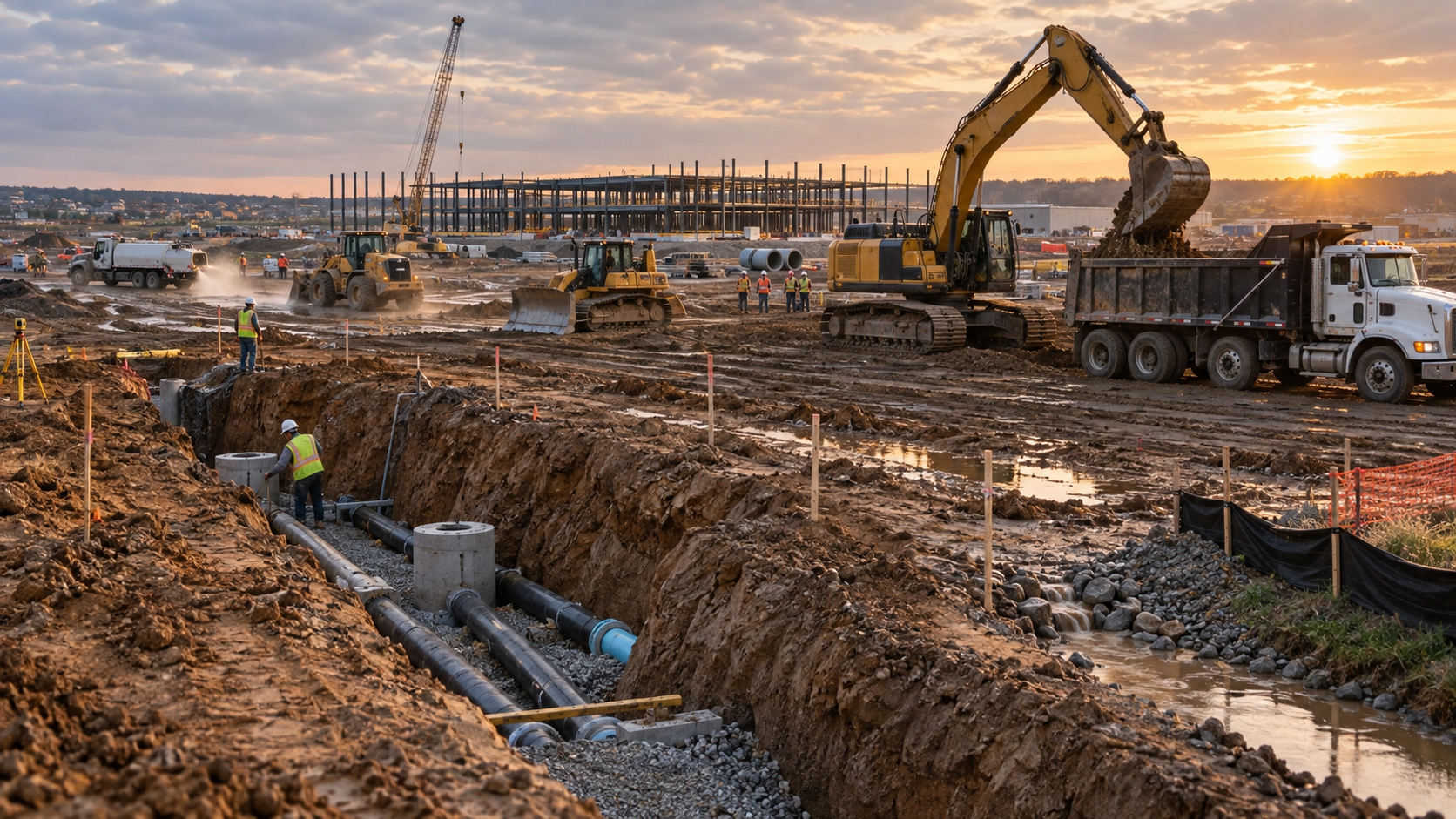
An excavation company working around Wake Forest or Raleigh may begin with clearing lots, grading pads, drainage work, trenching, and smaller foundations. As the company grows, a general contractor, developer, municipality, or utility contractor may ask it to handle a much larger portion of the site.
The equipment may look familiar and the crews may still be moving dirt, but the insurance exposure can be materially different.
That is especially true for contractors moving into larger commercial projects around Raleigh, Durham, Cary, the Triangle, Charlotte, Greensboro, or other growing North Carolina markets where a single site package can involve substantial equipment, multiple underground utilities, heavier vehicle use, subcontractors, and more demanding contract requirements.
Instead of asking only whether the contractor has general liability insurance for excavation contractor operations, the review should look at the entire program.
What Changes When Excavation Becomes Full Site Development?
The biggest change is often the amount of exposure concentrated into one contract.
A contractor may move from grading a house pad or digging localized trenches to responsibility for mass grading, storm drainage, sanitary sewer, water lines, erosion control, road preparation, utility trenching, retaining work, or a complete commercial or subdivision site package.
More Equipment Value
Larger excavators, loaders, dozers, attachments, GPS systems, rented equipment, and support equipment increase the property exposure.
More Utility Exposure
Deeper excavation and broader underground scopes increase the potential consequences of damaging existing utilities.
More Vehicle Exposure
Growth can bring more pickups, service trucks, dump trucks, equipment trailers, drivers, and hired transportation.
More Contract Risk
Larger owners and general contractors may require higher limits, additional endorsements, pollution coverage, or surety bonds.
| Exposure | Smaller Excavation Operation | Larger Site Development Operation |
|---|---|---|
| Equipment | Fewer units and lower total equipment value | More equipment, attachments, GPS systems, rented machines, and higher jobsite concentration |
| Utilities | Localized trenching or occasional underground work | Frequent work around water, sewer, gas, electric, communication, and storm infrastructure |
| Pollution | Potentially limited depending on the work | Greater soil disturbance, runoff, fuel, sewer, disposal, and contaminated-soil exposure |
| Commercial Auto | Pickups and smaller trailers with fewer drivers | More vehicles, heavier units, trailers, drivers, hired vehicles, and jobsite movement |
| Subcontractors | Limited outside labor | More trucking, specialty work, and downstream contractual exposure |
| Umbrella | Existing limits may satisfy smaller contracts | Larger project owners may require substantially higher total liability limits |
| Bonding | Little or no surety requirement | Bid, performance, payment, subdivision, or site-improvement bonds may become part of bidding |
How Should Heavy Equipment Insurance Change?
Excavation contractors can accumulate a large equipment schedule gradually. A new attachment here, another skid steer there, a replacement excavator, a rented loader, and additional GPS equipment can materially increase the property at risk without creating one obvious moment when someone says the insurance program has changed.
Inland marine insurance for excavation contractors and heavy equipment commonly addresses mobile equipment such as excavators, loaders, skid steers, dozers, compactors, attachments, pumps, generators, and other machinery that moves between jobsites.
The review should go beyond simply confirming that the machine appears on a schedule.
Important equipment questions include:
- Are the scheduled values still accurate?
- What valuation basis applies after a covered total loss?
- Are buckets, hammers, grapples, GPS units, and other attachments included correctly?
- Is newly acquired equipment automatically covered for a temporary period?
- How much equipment is rented or leased from others?
- What limit applies to equipment rented from others?
- Are smaller tools handled under a blanket limit?
- Are theft protections or security requirements important to the policy?
- What deductibles apply?
- How much equipment could be concentrated at one project after hours?
The growth problem: an excavation contractor can become materially underinsured without purchasing one enormous machine. Several smaller additions can create a large difference between the equipment actually exposed to loss and what the policy schedule reflects.
Why Does Underground Utility Damage Become a Bigger Insurance Issue?
Underground utility exposure is one of the defining risks of excavation and site development.
A damaged line can create consequences far beyond the physical cost of repairing the pipe or cable. Depending on the utility and the circumstances, a strike can lead to service interruption, emergency response, damage to surrounding property, construction delay, environmental cleanup, and claims from multiple parties.
North Carolina’s Underground Utility Safety and Damage Prevention Act creates the state’s framework for locating underground facilities and safe excavation practices.
North Carolina also designated April 2026 as Safe Digging Month. The Governor’s proclamation cited service interruption, environmental damage, personal injury, and other consequences that can result when underground infrastructure is damaged.
Those operational requirements help control the risk. They do not answer the separate insurance question.
Review the policy for:
- Third-party underground property damage.
- Damage to property being worked on directly.
- Care, custody, or control restrictions.
- Pollution arising from a damaged utility.
- Contractual liability.
- Damage to the contractor’s own work.
- Excavation, subsidence, earth movement, or underground-property exclusions and endorsements.
“We have general liability” is not enough information to determine whether a utility-strike claim is covered. The answer can depend on the actual policy language, endorsements, exclusions, ownership of the damaged property, what the contractor was hired to do, and the damages being alleged.
Review the Program Before You Bid the Bigger Site Package
If your company is moving into larger grading, commercial site development, subdivision, utility, or municipal work, Carolina Risk Partners can review the existing insurance program against the new operation and contract requirements.
When Does Contractors Pollution Liability Become More Important?
An excavation company does not have to market itself as an environmental contractor to create pollution exposure.
Contractors pollution liability is liability coverage designed to address certain pollution conditions arising from contracting operations, subject to the policy’s terms, exclusions, limits, and coverage triggers.
Site development can create pollution concerns through damaged sewer or fuel lines, hydraulic-fluid releases, contaminated soil, runoff, transported spoil, or contractual responsibility for environmental conditions.
Examples include:
- An excavator ruptures a fuel line.
- A sewer line is damaged during trenching.
- Previously contaminated soil is disturbed.
- Diesel or hydraulic fluid is released from equipment.
- Excavated material is transported to the wrong disposal location.
- Runoff carries sediment or contaminants off the project.
- A contract assigns environmental responsibilities to the site contractor.
Standard commercial general liability policies commonly contain pollution exclusions. Limited exceptions may exist, but those exceptions should not automatically be treated as a substitute for dedicated pollution coverage.
Why Can Commercial Auto Become a Much Bigger Part of the Program?
Larger excavation projects rarely happen without greater vehicle exposure.
A growing North Carolina site contractor may add superintendent pickups, foreman trucks, mechanic trucks, service vehicles, dump trucks, equipment trailers, or additional employee drivers. It may also use rented vehicles or hired trucking more frequently.
That makes commercial auto insurance for excavation contractors and site development fleets increasingly important.
2026 commercial auto context: national commercial insurance pricing continued to moderate in early 2026, but commercial auto remained one of the more difficult casualty lines. According to WTW’s Q1 2026 Commercial Lines Insurance Pricing Survey, commercial auto and excess or umbrella liability continued to experience some of the largest increases, although commercial-auto increases fell below double digits for the first time since the third quarter of 2023.
That is a national pricing trend, not a prediction for every North Carolina excavation contractor. Driver history, vehicle type, loss history, operating radius, fleet size, safety controls, and carrier appetite can produce very different results.
A growing excavation fleet should be reviewed for:
- Vehicle type and use.
- Gross vehicle weight and configuration.
- Driver eligibility and motor vehicle records.
- Operating radius.
- Owned, hired, and non-owned auto exposure.
- Trailer physical damage values.
- Equipment transported on trailers.
- Employees using personal vehicles for business.
- Vehicles or trailers that are rented, borrowed, or leased.
- Contract requirements for auto liability limits.
One Trip Can Involve Three Different Policies
An excavation contractor sends a company truck pulling an equipment trailer with a skid steer to a Raleigh-area project. The truck can fall under commercial auto. Physical damage to the trailer may be handled separately depending on the policy structure. The skid steer is generally addressed through inland marine or contractors equipment coverage.
Growth exposes problems when nobody has reviewed how those pieces work together.
How Does Subcontractor Use Change the Risk?
Larger contracts can force an excavation contractor to scale faster than its own payroll and equipment allow.
Trucking may be subcontracted. Clearing, blasting, erosion control, traffic control, utility work, concrete work, or other specialty operations may also be pushed downstream.
That makes the subcontractor process part of the contractor’s insurance program rather than just an accounts-payable issue.
A stronger subcontractor process can include:
- Written subcontract agreements.
- General liability requirements.
- Workers compensation requirements.
- Commercial auto requirements when vehicles are involved.
- Pollution liability where the subcontracted work creates environmental exposure.
- Additional insured requirements when appropriate.
- Waiver of subrogation requirements when contractually required.
- Certificates and supporting endorsements.
- Renewal tracking.
- Controls for subcontractors that hire additional subcontractors.
A certificate of insurance is evidence of insurance at a point in time. It is not the insurance policy and does not create rights or coverage that the policy and endorsements do not provide.
When Should an Excavation Contractor Increase Umbrella or Excess Liability?
There is no universal umbrella limit for excavation contractors.
The appropriate limit depends on the contracts being pursued, the underlying policies, fleet exposure, project size, public exposure, owner requirements, loss potential, and the contractor’s own risk tolerance.
Commercial umbrella insurance for excavation contractors becomes especially relevant when:
- A project requires more total liability insurance.
- The contractor adds heavier commercial vehicles.
- Jobs involve greater third-party or public exposure.
- Work occurs around expensive infrastructure.
- A single accident could involve several injured parties or multiple claimants.
- The company has grown materially in revenue or balance-sheet strength.
The underlying policies matter just as much as the umbrella limit. A high excess limit does not automatically cure an exclusion or missing underlying exposure.
Why Does Bonding Become Part of the Growth Strategy?
Insurance and surety bonds solve different problems.
As an excavation contractor pursues larger subdivisions, commercial developments, municipal projects, and public work, bid bonds, performance bonds, payment bonds, and site-improvement bonds can become part of the bidding process.
A bid bond supports the contractor’s bid obligation. A performance bond guarantees performance of the bonded contract according to the bond terms. A payment bond supports payment obligations to qualifying subcontractors and suppliers. A site-improvement or subdivision bond may guarantee completion of required infrastructure or development improvements.
That makes commercial bonds and contract surety for North Carolina contractors something to plan before the bid deadline.
Surety underwriting may consider:
- Financial statements.
- Working capital.
- Liquidity.
- Net worth.
- Existing backlog.
- Largest completed projects.
- Largest current projects.
- Profitability and job performance.
- Experience with the type of work being bid.
- Management and organizational capacity.
- Indemnity requirements.
Waiting until the contractor finds a large bonded project to begin discussing surety capacity can create an avoidable problem. Bonding is better developed alongside the company’s growth plan.
Can an Excavation Contractor Outgrow Its Insurance Without Doubling Revenue?
Yes.
Revenue is only one measure of exposure.
A contractor could produce similar annual sales while moving from dozens of smaller grading jobs into a handful of larger commercial or subdivision packages.
That change can create:
- Higher individual contract values.
- More underground utility exposure.
- Greater equipment concentration.
- Longer job durations.
- More subcontractor use.
- More vehicles and drivers.
- Higher umbrella requirements.
- Bonded work.
The company’s top-line revenue may not look dramatically different, while its insurance and surety profile has changed considerably.
What Should an Excavation Contractor Review Before Bidding Larger Work?
- Project scope: grading, utilities, storm drainage, sewer, water, road preparation, clearing, demolition, or complete site packages.
- Largest project: current largest contract and expected largest contract during the upcoming policy period.
- Heavy equipment: owned, leased, rented, and borrowed equipment with current values.
- Commercial auto: trucks, trailers, drivers, operating radius, hired auto, and non-owned auto.
- Underground utilities: frequency, depth, and types of infrastructure encountered.
- Pollution: soil, fuel, sewer, runoff, disposal, and environmental-contract exposure.
- Subcontractors: what is subcontracted and how insurance requirements are enforced.
- General liability: exclusions and endorsements affecting actual excavation operations.
- Umbrella: required limits and the policies over which excess coverage applies.
- Surety: upcoming bid, performance, payment, subdivision, or site-improvement bond requirements.
- Contracts: additional insured, primary and noncontributory, waiver, indemnification, and insurance-limit requirements.
The best time to find an insurance or bonding problem is before the contract is signed. Once a project has been awarded, the contractor may have less flexibility to solve a carrier, exclusion, limit, or surety-capacity issue.
What Should a Growing Excavation Contractor Tell Its Insurance Agent?
Do not report only the projected increase in sales.
Explain how the actual operation is changing.
- Current and projected revenue.
- Payroll by operation.
- Percentage of work subcontracted.
- Residential versus commercial work.
- Public and municipal work.
- Maximum excavation depth.
- Utility installation exposure.
- Demolition or blasting, if any.
- Equipment list and values.
- Vehicle and driver schedule.
- Largest completed project.
- Largest current project.
- Largest expected project.
- Typical contract size.
- Bonding requirements.
- Loss history.
A strong underwriting submission helps the carrier understand the contractor the way the contractor actually operates instead of forcing an underwriter to fill in missing information with assumptions.
Does Moving Into Larger Site Development Automatically Make Insurance More Expensive?
No. Growth changes the underwriting inputs, but it does not create one automatic pricing result.
Premium can be affected by revenue, payroll, subcontractor cost, equipment values, vehicle count, driver history, radius, project type, limits, deductibles, claims history, pollution exposure, prior insurance, and carrier appetite.
A larger contractor may also become more attractive to certain markets or program structures that were not a fit when the business was smaller.
Carolina Risk Partners can compare available carrier options while also reviewing policy exclusions, limits, equipment values, auto exposures, subcontractors, contract requirements, pollution issues, and surety needs.
What Is the Bottom Line for an Excavation Contractor Moving Upmarket?
Larger site development can be a major growth opportunity. It can also expose weaknesses in an insurance program that was perfectly adequate for the contractor’s previous work.
The real question is not whether the company owns general liability, commercial auto, and equipment policies.
The question is whether those policies, limits, endorsements, exclusions, and surety relationships still match the contractor the company has become.
Frequently Asked Questions About Excavation Contractor Insurance
Why does an excavation contractor’s insurance change when projects get larger?
Larger site development projects can increase equipment values, underground utility exposure, commercial auto activity, subcontractor use, pollution risk, contractual requirements, umbrella limits, and bonding needs. The solution may involve more than increasing the general liability limit.
Does general liability cover underground utility damage?
General liability may respond to some third-party utility damage, but coverage depends on the policy language, exclusions, endorsements, damaged property, contractor’s scope of work, and facts of the loss.
Does an excavation contractor need pollution liability insurance?
Pollution liability becomes more important when excavation can disturb contaminated soil, damage fuel or sewer lines, create runoff issues, or involve environmental work. Standard general liability policies commonly contain pollution exclusions.
What insurance covers excavators, skid steers, loaders, and other heavy equipment?
Contractors equipment coverage, commonly written as inland marine insurance, can cover mobile equipment such as excavators, loaders, skid steers, compactors, attachments, and related machinery, subject to the policy’s valuation, deductibles, exclusions, and coverage terms.
Why do larger excavation projects create more commercial auto exposure?
Larger jobs may require more pickups, service trucks, dump trucks, trailers, drivers, hired vehicles, and travel between projects. Those changes can materially affect commercial auto exposure and underwriting.
When should an excavation contractor consider higher umbrella limits?
Higher umbrella or excess limits may become appropriate when contract requirements increase, fleet exposure grows, projects become larger, or the contractor’s work creates greater public or third-party liability exposure.
When does an excavation contractor need bonding?
Bonding often becomes more important when contractors pursue larger private developments, municipal projects, subdivisions, and public work. Bid, performance, payment, and site-improvement bonds may be required depending on the project.
Who helps excavation and site development contractors review insurance in Raleigh and North Carolina?
Stephen Ellias, CLCS, founder of Carolina Risk Partners and holder of North Carolina insurance license 20374030, helps excavation and site development contractors in Wake Forest, Raleigh, Durham, Cary, the Triangle, and throughout North Carolina review general liability, commercial auto, heavy equipment, pollution, umbrella, subcontractor, and bonding exposures.

About Stephen Ellias, CLCS
Stephen Ellias is the founder of Carolina Risk Partners, an independent commercial insurance agency based in Wake Forest, North Carolina. He helps contractors throughout Raleigh, Durham, Cary, the Triangle, Charlotte, Greensboro, and across North Carolina review general liability, commercial auto, contractors equipment, umbrella, pollution, bonds, contract requirements, and broader commercial insurance programs. North Carolina Insurance License 20374030.
Moving Into Larger Excavation or Site Development Work?
Review the program before the bigger job exposes a gap. Carolina Risk Partners can compare available carrier options and look at the insurance and bonding structure as a whole.
Coverage descriptions are general and for educational purposes only. Actual coverage depends on the insurance policy, endorsements, exclusions, limits, deductibles, carrier underwriting, contract requirements, and facts of a particular claim. Surety approval and bonding capacity are subject to underwriting.