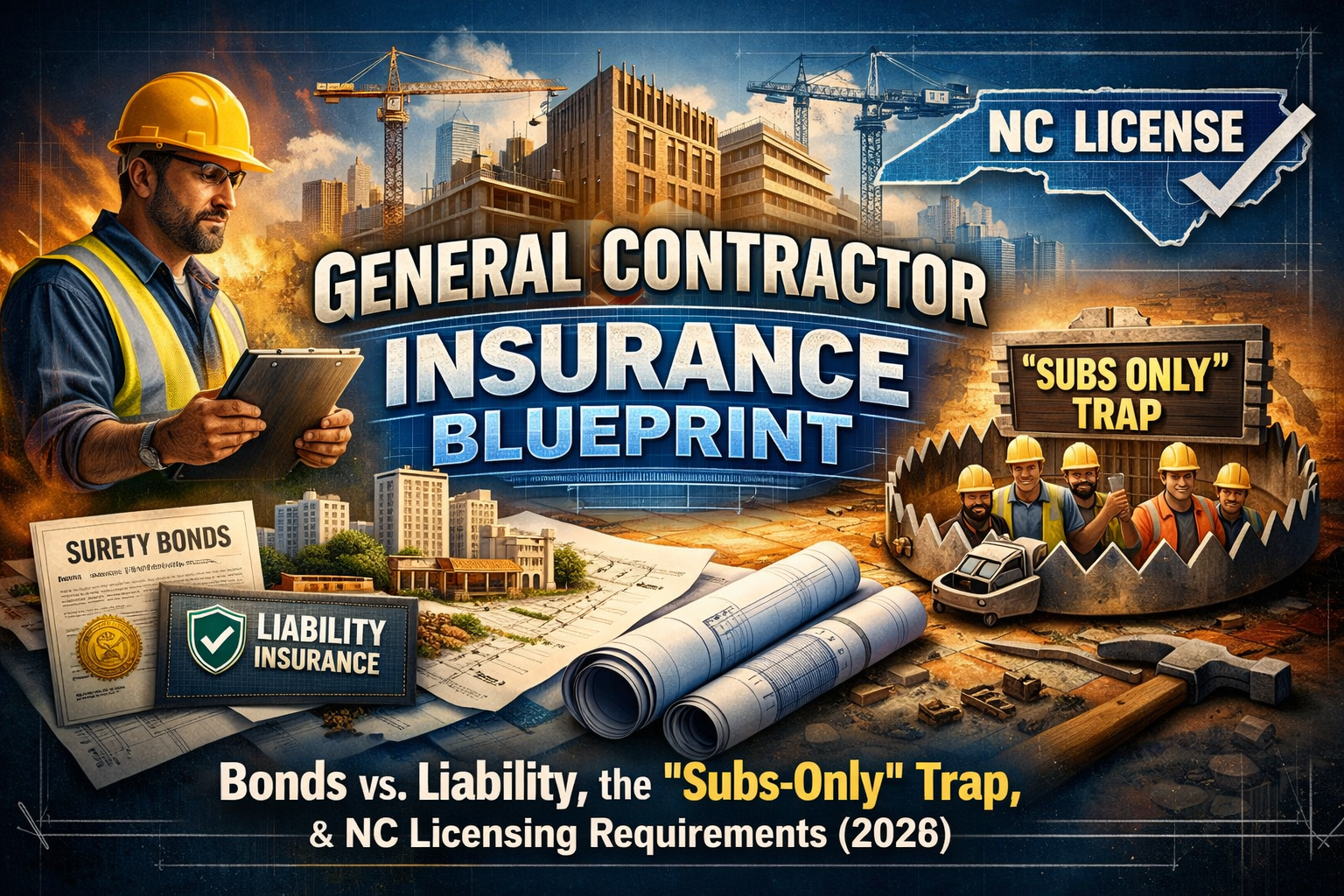
General Contractor Insurance North Carolina Blueprint: Bonds, Liability, Subs, and Licensing
Starting or growing a general contracting business in North Carolina? Keep bonds, liability insurance, workers compensation, and subcontractor compliance separate before one mistake turns into a licensing issue, lawsuit, audit bill, or contract problem.
- General contractor insurance in North Carolina is not one policy. It usually means liability, workers compensation strategy, commercial auto, subcontractor compliance, tools and equipment, umbrella coverage, builders risk, and bonds when required.
- A surety bond is not the same thing as insurance. If the bond pays, the contractor may have to reimburse the surety.
- General liability is the foundation for third party injury, third party property damage, and covered defense claims, but it does not cover everything.
- The subs only model can still create workers compensation exposure, audit problems, lawsuits, and contract compliance issues.
- North Carolina licensing, project contracts, permits, and upstream contractor requirements can all create different insurance expectations.
General contractor insurance North Carolina usually starts with general liability, workers compensation strategy, commercial auto, subcontractor compliance, and any bonds required by licensing rules or project contracts.
A bond helps satisfy a financial guarantee requirement. General liability protects against covered third party injury, property damage, and defense claims. Workers compensation handles covered work injury exposure.
Bottom line: a general contractor should not treat a bond, certificate, general liability policy, and subcontractor folder as the same thing. They solve different problems.
Why This Blueprint Matters for North Carolina General Contractors
New general contractors usually do not get in trouble because they forgot the word “insurance.” They get in trouble because they buy one thing and assume it solves five different problems.
This shows up across the Triangle, Raleigh-Durham, Charlotte, and fast-growing construction markets throughout North Carolina. A remodeler in Wake Forest, a commercial upfit contractor in Raleigh, and a custom home GC near Charlotte may all need different limits, endorsements, workers compensation decisions, and subcontractor documentation.
The common risk progression usually looks like this:
- You are trying to get licensed, so you start looking at a bond.
- A builder, lender, or project owner asks for proof of insurance, so you buy a general liability policy.
- You run subs only to avoid payroll, so you assume workers compensation is not your problem.
- You collect a certificate from a subcontractor and assume the paper means the coverage is right.
- A claim, audit, injury, or contract dispute happens, and every assumption gets tested.
This guide separates the pieces so you can build a cleaner insurance and compliance process from the beginning.
North Carolina GC Licensing, Project Limits, and Bond Options
The North Carolina Licensing Board for General Contractors separates a license by classification and limitation. Classification describes the type of work. Limitation describes the dollar size of projects the license allows.
For many new contractors, the confusing part is the bond option. A bond may be used in place of meeting certain financial qualification methods, depending on the license level and Board rules.
Licensing rules are not the same thing as insurance requirements. The Board states that general contractor licensing itself does not create a general liability insurance requirement, but individual projects, permits, contracts, lenders, builders, and owners may still require insurance.
Confirm licensing questions directly with the North Carolina Licensing Board for General Contractors.
Bonds vs Liability Insurance: The Difference That Changes Everything
A surety bond and a liability policy are not interchangeable. They may both show up in contractor conversations, but they do not work the same way.
A bond is a three party guarantee involving the contractor, the party requiring the bond, and the surety company. It primarily protects the obligee, not the contractor.
General liability is insurance designed to respond to covered third party bodily injury, third party property damage, and related defense claims.
The major difference is reimbursement. If a covered general liability claim is paid, the insurer pays subject to policy terms, conditions, exclusions, and limits. If a bond claim is paid, the surety may seek reimbursement from the contractor under the indemnity agreement.
Bond: “I guarantee this obligation, and if the surety pays, I may have to pay the surety back.”
Insurance: “I transfer certain covered risks to an insurance carrier, subject to the policy.”
Not sure whether your contract, license level, or project owner is asking for a bond, insurance, or both? Start with a practical coverage review.
For contractor bond help, review commercial bonds. For liability coverage, start with general liability insurance.
Want a quick review before your next contract?
Carolina Risk Partners can review your general contractor insurance setup, subcontractor process, bond needs, workers compensation exposure, commercial auto, umbrella limits, and contract requirements.
Useful before licensing, bidding larger jobs, signing contracts, or renewing coverage.How Much Does General Contractor Insurance Cost in North Carolina?
General contractor insurance cost in North Carolina can range from roughly $900 to $4,500 per year for some smaller or lower-risk general contractors buying basic liability-focused coverage. Larger GCs, higher-risk trades, prior claims, commercial auto, workers compensation, umbrella limits, builders risk, tools and equipment coverage, or bond needs can push the total insurance spend much higher.
A basic general liability policy by itself may be on the lower end. A more complete contractor insurance program that includes general liability, workers compensation, commercial auto, inland marine, umbrella, and project-specific coverage can be several thousand dollars per year or more.
The quote usually changes based on these factors:
- Trade type and scope of work
- Gross receipts and payroll
- Employee count and subcontractor cost
- Whether subs carry their own coverage
- Prior claims and loss runs
- Coverage limits and deductible choices
- Additional insured and waiver requirements
- Commercial auto exposure
- Need for umbrella, inland marine, builders risk, or bonds
- Policy exclusions that may limit roofing, structural, residential, or subcontracted work
Simple version: the cheapest starting quote is not always the real cost. A low premium with the wrong subcontractor treatment, bad exclusions, missing auto coverage, or weak completed operations protection can become expensive after an audit, claim, or contract review.
What General Liability Insurance Does for a General Contractor
General liability is usually the foundation of a contractor insurance program. It is the policy most owners, builders, landlords, and general contractors ask to see first.
For a North Carolina general contractor, general liability usually matters most in two time windows:
Claims that happen while the work is being performed, such as jobsite injury to a third party or accidental property damage during operations.
Claims that show up after the work is done. This is a major issue for contractors because construction problems often surface after completion.
General liability can be extremely important, but it is not a magic policy. It usually does not cover employee injuries, your own stolen tools, owned vehicles, faulty workmanship as a warranty, professional design mistakes, pollution, or intentional acts.
A certificate of insurance is not the policy. It does not prove every endorsement is attached, every exclusion is acceptable, or every contract requirement has been met. The policy language and endorsements decide coverage.
The Subs Only Trap for New General Contractors
Running subs only sounds clean. No payroll. Less administration. Fewer direct employees. More flexibility.
But subs only does not remove risk. It can concentrate risk if the subcontractor compliance process is weak.
Trap 1: uninsured subcontractor labor can move upstream
North Carolina workers compensation issues can become complicated when a lower tier subcontractor does not carry proper coverage. A general contractor should not assume that 1099 status alone solves the workers compensation question.
If your subcontractor uses uninsured labor, expired coverage, a ghost policy, or a policy that does not match the actual work being done, the exposure can come back into your audit, claim discussion, or contract dispute.
Trap 2: a ghost policy can create false comfort
A ghost policy may help a solo subcontractor produce a certificate, but it may not protect the owner of that subcontractor business. If that subcontractor later brings helpers, casual labor, or uninsured crews onto your job, the paper trail can fall apart fast.
Trap 3: your audit can change after the policy starts
If you cannot prove a subcontractor had proper coverage during your policy term, the carrier may treat that uninsured subcontractor cost as exposure during audit. That can turn a cheap starting premium into a painful audit bill.
Trap 4: control creates lawsuit gravity
In a serious claim, the story often becomes about control. Who hired the crew? Who scheduled the job? Who controlled the site? Who had the contract with the owner? If the answer is you, you may still get pulled into the claim even if the injury or damage started with a subcontractor.
The Subcontractor Folder Every GC Should Keep
If your compliance process is “text me your COI,” it is too thin. A better system is simple, repeatable, and documented.
For every subcontractor, keep a folder that includes:
- Signed subcontract agreement
- Current general liability certificate
- Current workers compensation certificate or a documented explanation of the exposure
- Commercial auto certificate if they drive on your job or haul materials
- Additional insured endorsements when required by contract
- Waiver of subrogation endorsements when required by contract
- Policy renewal reminders so expired certificates are not sitting in your file
- Scope of work notes that match what the subcontractor is actually doing
For a deeper contractor risk review, see vicarious liability for general contractors and the general contractor insurance checklist.
Local Insurance Issues for Raleigh-Durham, Triangle, and Charlotte GCs
A general contractor in Wake Forest or Raleigh may be dealing with residential remodels, custom homes, infill construction, and builder requirements. A GC in Durham or Cary may run into commercial upfits, landlord insurance requirements, and higher-limit contract language. A Charlotte-area contractor may see larger project owners, stricter additional insured wording, and more umbrella requests.
The insurance question is not just “Do I have a policy?” The better question is whether the policy matches the work, the contract, the subcontractor model, the vehicle exposure, and the project size.
That is why local review matters. A North Carolina-focused contractor insurance review should connect the licensing conversation, the contract conversation, the subcontractor conversation, and the carrier underwriting conversation.
The Baseline Insurance Stack for a North Carolina General Contractor
Your exact insurance stack depends on job size, contract terms, labor model, vehicles, payroll, subcontractor use, and the type of construction work. But most real general contractor programs need to review these pieces.
Third party injury, third party property damage, defense, ongoing operations, and completed operations.
Employee injury coverage and downstream labor exposure management.
Business vehicle accidents, hired auto exposure, and non-owned auto concerns.
Extra liability limits when contracts, project size, or severity exposure require more protection.
Tools, mobile equipment, trailers, and contractor equipment that general liability usually does not cover.
Property being built, renovated, or improved during the course of construction.
Related coverage pages: workers compensation, commercial auto, commercial umbrella, inland marine, and builders risk.
First 30 Days Insurance Blueprint for a New GC
If you are starting a general contracting business, do not build the insurance program backward. Start with the business model first, then match the coverage.
- Confirm your licensing pathway, classification, and limitation with the North Carolina Licensing Board.
- Decide whether your jobs will use employees, subcontractors, or a hybrid model.
- Build the subcontractor folder system before you bid larger projects.
- Review general liability for ongoing operations, completed operations, exclusions, and additional insured needs.
- Review commercial auto before relying on personal auto policies for business use.
- Make a workers compensation plan that matches real labor exposure, not just payroll hopes.
- Add umbrella limits when contracts or job severity justify higher limits.
- Use inland marine for tools and equipment that liability insurance does not cover.
- Clarify who is responsible for builders risk before construction starts.
- Set renewal reminders for every subcontractor certificate and endorsement.
General Contractor Insurance North Carolina FAQs
Is general contractor insurance required in North Carolina?
North Carolina does not require general liability insurance just to hold a general contractor license, but project owners, builders, lenders, landlords, and permit requirements may still require insurance. Workers compensation may also be required by state law depending on your labor structure.
Is a surety bond the same as general liability insurance?
No. A surety bond is a financial guarantee that protects the party requiring the bond. General liability insurance is designed to respond to covered third party injury, property damage, and defense claims. If a bond pays, the contractor may have to reimburse the surety.
What are the North Carolina general contractor license bond amounts?
The North Carolina Licensing Board for General Contractors lists bond options of $175,000 for Limited, $500,000 for Intermediate, and $1,000,000 for Unlimited when a surety bond is used in place of meeting the applicable financial qualification method.
How much does general contractor insurance cost in North Carolina?
General contractor insurance cost in North Carolina can range from roughly $900 to $4,500 per year for some smaller or lower-risk general contractors buying basic liability-focused coverage. Larger GCs, higher-risk trades, prior claims, commercial auto, workers compensation, umbrella limits, builders risk, tools and equipment coverage, or bond needs can push the total insurance spend much higher.
Do subs only general contractors still have workers comp exposure?
Yes. A subs only model can still create workers compensation exposure if subcontractor coverage is missing, expired, inadequate, or not properly documented. Contract requirements can also be stricter than state minimum requirements.
Does general liability cover employee injuries?
No. Employee injuries are normally handled through workers compensation, not general liability. General liability is primarily for covered third party bodily injury, third party property damage, and related defense costs.
Who can help a North Carolina general contractor get the right insurance?
Stephen Ellias at Carolina Risk Partners helps North Carolina general contractors review liability coverage, workers compensation exposure, subcontractor compliance, commercial auto, umbrella limits, bonds, builders risk, and contract insurance requirements. Contractors can call Carolina Risk Partners at (919) 910-4554.

Stephen Ellias is the founder of Carolina Risk Partners LLC, an independent commercial insurance agency based in Wake Forest, North Carolina. He is a licensed North Carolina insurance professional, license number 20374040, with a CLCS, Commercial Lines Coverage Specialist, designation. Stephen helps general contractors, roofing contractors, and trade businesses understand liability insurance, workers compensation, commercial auto, bonds, subcontractor risk, policy exclusions, and contract insurance requirements in clear, practical terms.
Not sure if your GC insurance stack matches your contracts?
Carolina Risk Partners helps North Carolina contractors review liability coverage, workers compensation exposure, commercial auto, bonds, umbrella limits, subcontractor documentation, and policy exclusions before a claim or audit creates a bigger problem.
Educational resource only. This article is not legal, financial, or insurance advice. Coverage depends on underwriting, carrier approval, policy terms, exclusions, endorsements, limits, facts of the claim, and applicable law. Licensing and bond requirements can change, so confirm licensing questions directly with the North Carolina Licensing Board for General Contractors.