
Inland Marine Insurance for Roofers: The Tool Theft Gap
A roofer can have a million dollars of general liability and still be exposed when tools, ladders, compressors, generators, or jobsite equipment disappear. Tool theft is usually not a liability problem. It is an own-damage property problem.
Key Takeaways
- General liability is usually the wrong bucket. It is generally built for third-party injury or property damage claims, not theft of your own tools.
- Inland marine insurance for roofers may help protect mobile tools, equipment, ladders, compressors, generators, and materials moving between jobsites.
- Tool theft claims are structure problems. Limits, deductibles, valuation, scheduled items, unscheduled tool caps, locked vehicle conditions, and documentation decide how the claim feels.
- A trailer is not the same as the contents. The trailer can be insured one way while the tools inside it are limited or handled differently.
- Unscheduled tools are a common pain point. Low per-item caps can turn a covered theft into a disappointing payout.
- Replacement cost and actual cash value are not the same. One may help replace the tool. The other may feel like used-tool pricing after depreciation.
Inland Marine Insurance for Roofers: Quick Answer
Inland marine insurance for roofers may cover mobile business property such as tools, ladders, generators, compressors, nail guns, harnesses, specialty equipment, and materials that move between jobsites, trucks, trailers, yards, and temporary locations.
For roofers, the key issue is not whether a policy says “inland marine.” The key issue is how the policy is built.
Bottom line: a roofer can technically have inland marine coverage and still lose thousands because of low limits, high deductibles, depreciation, missing schedules, or theft conditions.
Inland marine insurance for roofers matters because most roofing tool theft losses are not really liability problems.
They are own-damage problems.
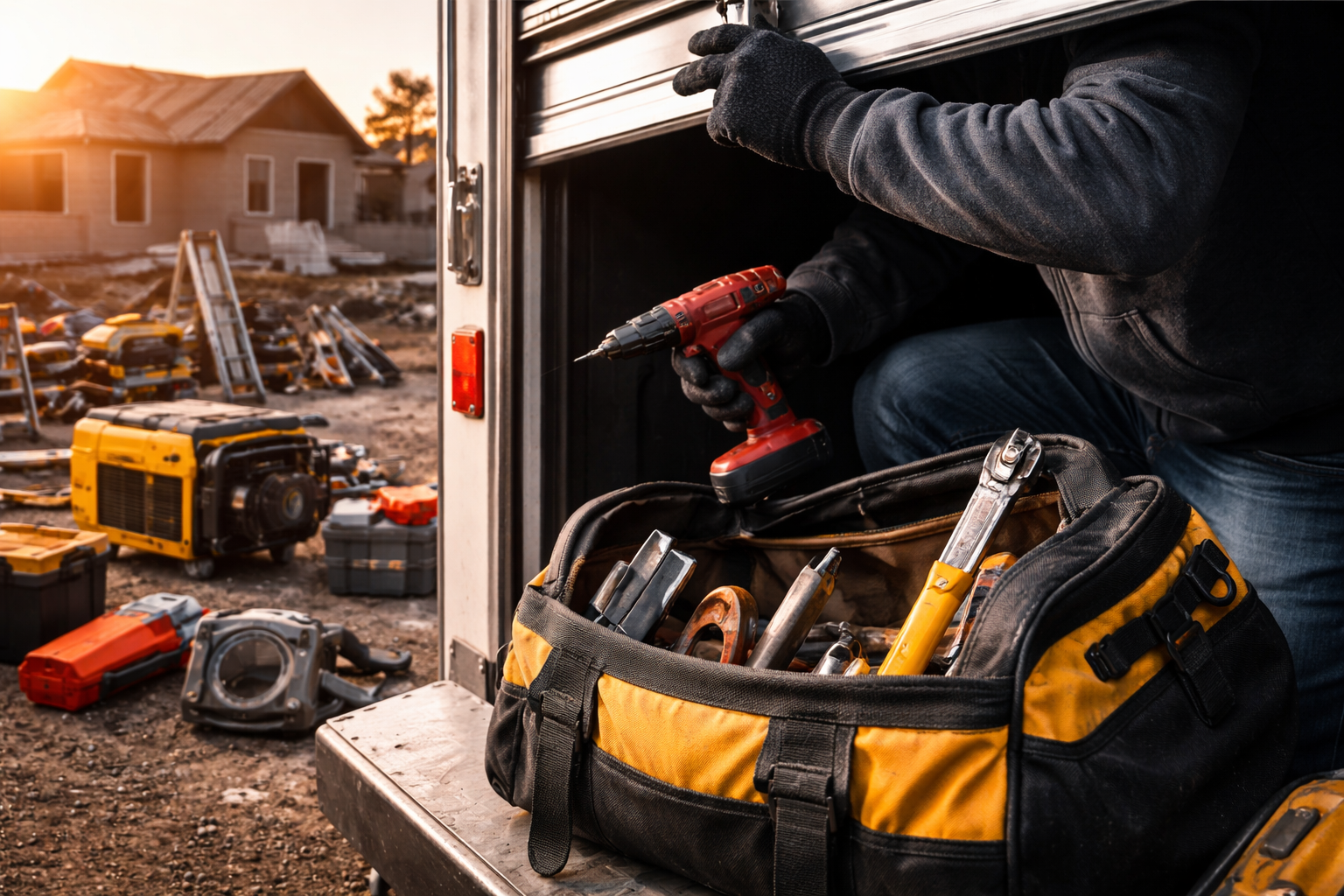
A crew finishes for the day. Ladders are strapped down. Compressors, nail guns, tear-off tools, harnesses, and hand tools are locked up. The next morning, part of the setup is gone.
The owner thinks, “Good thing I have a million dollars of liability insurance.”
But that is usually the wrong bucket.
Simple point: general liability is usually about injury or damage you cause to other people or their property. Inland marine insurance is often the coverage conversation for covered loss to mobile property you own, use, rent, borrow, or depend on to do the roofing work.
Want your tool and equipment coverage reviewed?
Carolina Risk Partners can help review your inland marine insurance, scheduled equipment, unscheduled tool limits, trailer exposure, rented equipment, employee tools, deductibles, valuation, locked vehicle conditions, and documentation before the next theft happens.
- Tool and equipment limit review
- Trailer and contents discussion
- Scheduled equipment review
- Theft deductible and valuation review
I’ll follow up within 1 business day.
Why Roofers Are Different
Roofing creates more theft exposure because the property moves all the time.
A retail business may keep most property at one address. A roofing company spreads property across trucks, trailers, temporary jobsites, storage yards, shops, supplier pickups, and sometimes employee homes.
Whether your crew is loading up near a roofing distributor in Raleigh, staging materials outside Charlotte, working a storm-response job near Greensboro, or parking trailers overnight near Wake Forest, the problem is the same: the tools move, and the risk moves with them.
That creates more questions after the loss:
- Where was the property located?
- Was it in a truck, trailer, yard, building, or jobsite?
- Was it locked?
- Was there visible forced entry?
- Was the item scheduled?
- Was it employee-owned, rented, borrowed, leased, or owned by the company?
- Was it subject to a blanket tools limit?
- Was there a theft from unattended vehicle condition?
- Was the deductible larger than the loss?
A tool theft claim is rarely just a property problem.
It becomes a downtime problem, a job-delay problem, a cash-flow problem, and sometimes a customer problem because the crew cannot work normally until the gear is replaced.
The 2026 Theft Environment Roofers Should Not Ignore
This is not a made-up edge case.
Verisk CargoNet reported that estimated cargo theft losses surged 60% to nearly $725 million in 2025, with confirmed cargo theft incidents increasing 18% and the average theft value rising 36% to $273,990. That is cargo data, not roofing-only data, but it shows the broader theft environment is more organized and expensive. CargoNet 2025 theft trends
CONEXPO-CON/AGG has also reported that nearly 1,000 pieces of construction equipment are reported stolen each month to the National Crime Information Center, and that equipment theft can create downtime, delays, higher insurance costs, and deductible pain. CONEXPO construction equipment theft guidance
Roofers understand the downtime piece immediately.
The stolen property hurts. But the interruption can hurt too.
One missing setup can knock out a crew. One missing specialty tool can stall a job. One week of disruption can cost more than the property itself.
What Inland Marine Actually Means for Roofing Tools
The phrase “inland marine” sounds strange, which is part of the problem.
Many business owners hear the word “marine” and think about boats. That is not what this means in roofing.
For a roofer, inland marine usually points to mobile property coverage. That may include:
- Hand tools.
- Ladders.
- Generators.
- Compressors.
- Nail guns.
- Harnesses.
- Specialty roofing equipment.
- Materials in transit or at temporary locations, depending on the form.
- Leased, rented, or borrowed equipment, depending on the form.
Travelers explains that inland marine contractors equipment insurance typically covers tools and equipment a contractor uses to complete a project, and that it may cover owned, leased, rented, or borrowed equipment. Travelers also notes that coverage can include theft, vandalism, fire, accidents, flood, lightning, and other covered causes of loss depending on the policy. Travelers contractors equipment insurance explanation
Coverage bucket: general liability is about damage you cause to others. Inland marine is often about covered loss to mobile property you rely on to do the work.
The Tool Theft Decision Tree
When a roofer has tools stolen, do not start with “do I have insurance?”
Start with the claim path.
If Tools Are Stolen From a Trailer
- Check whether the trailer itself has physical damage coverage.
- Check whether the contents inside the trailer are covered separately.
- Check inland marine or contractors equipment wording.
- Check theft from unattended vehicle wording.
- Check locked vehicle or forced entry requirements.
- Check whether the stolen items were scheduled or unscheduled.
- Check the deductible and valuation method.
If Equipment Is Rented
- Check rented equipment coverage.
- Check the rental agreement.
- Check temporary coverage limits.
- Check whether the deductible applies.
- Check whether theft is covered at that location.
If Employee Tools Are Stolen
- Check whether employee tools are covered at all.
- Check the employee tools sublimit.
- Check the per-item limit.
- Check whether the employee has proof of ownership.
- Check whether the business has a reimbursement policy if insurance does not respond the way the worker expects.
If Materials Are Stolen From a Jobsite
- Check whether the materials belonged to the roofer, owner, builder, supplier, or general contractor.
- Check whether the materials were project materials, contractor-owned materials, or builder’s risk property.
- Check whether inland marine, builder’s risk, or another property coverage should be reviewed.
- Check storage location restrictions and documentation.
This decision tree matters because “stolen from the job” is not specific enough. The coverage path depends on what was stolen, who owned it, where it was located, how it was secured, and how the policy is written.
Three Places Roofers Usually Get This Wrong
1. They Think the Trailer Means the Contents Are Covered
Not always.
A trailer can be covered one way, and the contents can be covered another way.
That means a roofer can have a scheduled trailer and still have weak or limited protection for the tools inside it. Or the roofer may have some tools coverage but no proper physical damage setup for the trailer itself.
This is one of the most common own-damage misunderstandings in roofing.
A trailer is not the same thing as the equipment inside it.
2. They Think “I Have Inland Marine” Means Everything Is Covered
Also not always.
The real question is not whether inland marine exists.
The real question is how it is built.
A policy with a low per-item cap on unscheduled tools can leave a roofer disappointed after a real theft claim. A missing compressor, generator, specialty tool, or nail gun setup may cost far more than the unscheduled item limit.
Some policies rely heavily on scheduled equipment. Some include blanket or miscellaneous tools coverage. Some have small sublimits for unscheduled tools. Some value property at actual cash value. Some are better for replacement cost. Some are broader on theft from vehicles, trailers, yards, or temporary sites than others.
That means two roofers can both say, “I have inland marine,” and still have very different claim outcomes.
3. They Miss the Locked Vehicle and Forced Entry Trap
Some policies may contain wording that changes how theft from trucks, trailers, or unattended vehicles is handled.
The policy may ask whether the vehicle was locked, whether there was visible forced entry, where the vehicle was parked, when the theft happened, and whether the tools were stored according to the policy conditions.
That is why “my tools were stolen from the truck” is not enough detail. The claim may turn on how the theft happened and what the policy says about unattended vehicles.
Do not wait until the theft to learn whether your policy has a locked vehicle condition.
4. They Think a Small Theft Is Not Worth Planning For
This is where the deductible crushes people.
If a crew loses $4,500 to $8,000 worth of tools but the policy has a deductible that eats most of the loss, the owner still feels uninsured.
If the missing property was unscheduled and subject to lower limits, the payout can feel even worse.
That is why many roofers do not just need coverage. They need the right structure for the size and type of loss they are most likely to have.
The Policy Details That Decide Whether You Feel Protected
If you are a North Carolina roofer, these are the details that matter more than the phrase “tools coverage.”
Scheduled Equipment
Scheduled equipment is property specifically listed on the policy.
If you have larger-ticket equipment, scheduling it clearly can help with valuation, proof, and claim handling. It also gives less room for confusion after a loss.
Examples may include larger generators, compressors, specialty equipment, high-value tools, trailers, lifts, or other items that would create a serious cash-flow hit if stolen.
Unscheduled or Miscellaneous Small Tools
This is where many roofing companies get surprised.
Small tools are common, mobile, and easy to lose. They are also the exact items many owners do not inventory carefully enough.
The issue is not just the total tool limit. It is also the per-item limit.
A policy may look good if it has a total tools limit, but that does not mean each stolen item is covered at its full replacement cost. Per-item caps can quietly create the gap.
Employee-Owned Tools
Some forms give limited protection for employee-owned tools, but you should never assume that without confirming the actual policy language.
If your crew brings personal tools to the job, you need a clear answer before the theft happens.
Who owns the tools? Who is responsible for them? Are they covered? What is the limit? Is there a per-item cap? Is there a deductible? Does the company reimburse the worker if the policy does not?
Borrowed, Leased, or Rented Equipment
Roofers borrow and rent more than they think.
That can include specialty equipment, lifts, trailers, temporary jobsite equipment, or items borrowed from another contractor.
The policy should be reviewed for how borrowed, rented, or leased equipment is handled. Do not wait until someone else’s equipment is stolen from your jobsite to figure it out.
Theft From Unattended Vehicles
This is one of the most practical policy wording checks for roofers.
If your crews leave tools in trucks, trailers, vans, or beds while they grab supplies, stop for lunch, work another side of the building, or park overnight, you need to know how the policy treats unattended vehicles.
Look for wording about locked vehicles, visible forced entry, unattended vehicle theft, unlocked storage, trailers, and theft from vehicle exclusions or limitations.
These terms can decide whether a normal roofing theft claim is clean, limited, disputed, or denied.
Theft Deductible
A $1,000 or $2,500 deductible changes how a claim feels.
If your most common theft loss is a smaller cleanout, deductible strategy matters just as much as total limit.
A policy can technically cover theft and still leave the owner eating too much of a common loss.
Replacement Cost vs Actual Cash Value
Replacement cost and actual cash value are not the same thing.
A compressor that costs $1,800 new may pay much less on actual cash value after depreciation. That gap is yours.
This is where a cheap policy can feel expensive after the claim. The roofer expected money to replace the tool. The claim check feels more like used-tool pricing.
If your crew depends on the tool tomorrow morning, that difference matters.
Theft Conditions and Documentation
Locked storage. Forced entry. Serial numbers. Photos. Receipts. Police report. Inventory list.
These details matter once the claim starts.
Documentation does not create coverage, but it can make claim handling cleaner and faster.
The North Carolina Angle Roofers Should Not Ignore
North Carolina roofers work in a state with storms, storm-response work, reroofs, repairs, coastal exposure, inland growth, and fast-moving crews.
That means tools and equipment are often moving between:
- Active jobsites.
- Temporary staging points.
- Storage yards.
- Trucks.
- Trailers.
- Supplier pickups in Raleigh, Charlotte, Greensboro, Durham, Cary, and Wake Forest.
- Emergency-response locations after storms.
- Employee homes.
That does not automatically create a coverage problem.
But it creates more places for a coverage problem to hide.
In a storm-prone state, theft and damage issues can show up at the same time owners are already dealing with weather pressure, compressed schedules, and property left in motion longer than expected.
Your property moves.
Your risk moves with it.
Your policy has to move with it too.
How Tool Theft Creates the Own Damage Gap
The own damage gap is the gap between what a roofer thinks is protected and what the policy actually pays when the roofer’s own property is stolen or damaged.
It is not always one dramatic denial.
Sometimes it is smaller, ugly losses that quietly drain profit:
- The deductible eats most of the claim.
- The stolen item was not scheduled.
- The unscheduled tool cap is too low.
- The policy pays actual cash value instead of replacement cost.
- The employee’s tools are barely covered.
- The rented equipment is not handled the way the roofer assumed.
- The trailer is covered but the contents are not protected well enough.
- The theft from unattended vehicle wording creates a problem.
- The owner cannot prove what was stolen.
- The crew loses work time while replacing gear.
That is why a roofer can have insurance and still feel uninsured after a tool theft.
Questions Roofers Should Answer Before the Next Theft
1. Do We Have Separate Clarity on the Truck, the Trailer, and the Contents?
Those are often different coverage questions, and one being insured does not automatically mean the others are insured the same way.
2. What Property Is Scheduled?
Make a list of larger-ticket equipment and specialty items that would hurt badly if stolen.
Then compare that list to the actual equipment schedule.
3. What Is Only Covered Under a Blanket or Miscellaneous Tools Limit?
This distinction often decides whether a theft feels manageable or expensive.
4. Are Claims Paid on Replacement Cost or Actual Cash Value?
Replacement cost and depreciated value can produce very different claim checks.
5. What Is the Theft Deductible?
Ask whether a normal loss would still hurt too much after the deductible.
6. Are Borrowed, Leased, or Rented Tools Covered?
Some forms may cover these items. Some may limit them. Some may require scheduling or separate treatment.
7. Are Employee-Owned Tools Covered?
Some policies provide only small limits for employee tools, which may not come close to a real loss.
8. Does the Policy Restrict Theft From Unattended Vehicles?
Search for wording about unattended vehicles, locked vehicle requirements, visible forced entry, theft from trailers, and vehicle storage conditions.
If the policy requires the vehicle to be locked or requires visible forced entry, that matters before the crew leaves tools in the truck overnight.
9. Do We Have Updated Inventory Records?
Good documentation does not create coverage, but serial numbers, photos, receipts, and estimated values can make the claim much cleaner.
If you cannot answer these questions quickly, the gap is still there.
What a Smart Roofer Does Next
You do not need a 40-page insurance lecture.
You need a fast review of the moving parts.
Start here:
- Make a list of every larger tool and higher-value mobile item your crews rely on.
- Separate company-owned property from employee-owned, borrowed, leased, or rented property.
- Compare that list against the inland marine schedule.
- Review the blanket tools limit and per-item cap.
- Check the theft deductible.
- Confirm replacement cost vs actual cash value.
- Search for “theft from unattended vehicles,” “locked vehicle,” “forced entry,” and “employee tools.”
- Confirm whether the trailer and contents are handled separately.
- Build a photo and serial-number inventory before the next loss.
If your current insurance setup was built like a generic contractor package, there is a good chance this part was glossed over.
When this part gets glossed over, the loss may not show up as one giant uncovered disaster.
It may show up as repeated smaller losses caused by deductibles, sublimits, depreciation, locked vehicle conditions, and assumptions.
That is the own damage gap.
Related Roofing Insurance Resources
- Roofing insurance coverage and requirements
- Inland marine insurance
- General liability insurance
- Commercial auto insurance
- Roofing Insurance Complete Guide for Roofing Contractors
- Workers Comp for Roofers
- Roofing Insurance Non-Renewal
- Builders Risk vs Roofers Insurance
- Roofing General Liability Exclusions
Frequently Asked Questions About Inland Marine Insurance for Roofers
Does general liability cover stolen tools for roofers?
Usually no. General liability is generally designed for third-party injury or third-party property damage claims, not theft of your own mobile tools and equipment.
What is inland marine insurance for roofers?
Inland marine insurance for roofers may protect mobile business property such as tools, ladders, compressors, generators, equipment, and materials that move between job sites, trucks, yards, and temporary locations.
Are tools stolen from a truck or trailer covered?
They may be, but it depends on the inland marine policy, trailer coverage, contents coverage, theft from unattended vehicle wording, forced entry requirements, deductibles, limits, valuation, and documentation.
Is inland marine the same as trailer coverage?
Not necessarily. The trailer and the contents inside it may be handled differently. A roofer may have coverage for the trailer but weak or limited protection for the tools inside it.
Do roofers need scheduled equipment and blanket tools coverage?
Often yes. Many roofing companies need a mix of both because they have some larger-ticket items that should be specifically scheduled and many smaller tools that move constantly.
Are employee tools covered under inland marine?
Sometimes, but you should never assume that. Some carrier forms provide limited coverage for employee tools, often with low per-item and per-occurrence caps.
Why do roofers still lose money even when the theft is covered?
Because the deductible, valuation method, unscheduled tool limits, locked vehicle conditions, documentation problems, and downtime can still leave a large out-of-pocket hit.
What documentation do roofers need for a tool theft claim?
The cleaner your records are, the cleaner the claim usually is. Serial numbers, photos, receipts, inventory lists, and a police report can all matter once the carrier starts verifying what was taken.
Can Carolina Risk Partners review inland marine insurance for my roofing business?
Yes. Carolina Risk Partners can help North Carolina roofers review inland marine insurance, tool floater limits, scheduled equipment, unscheduled tool caps, deductibles, valuation, employee tools, rented equipment, locked vehicle conditions, and overall roofing insurance structure.

Stephen Ellias is the founder of Carolina Risk Partners LLC, an independent commercial insurance agency based in Wake Forest, North Carolina. He is a licensed North Carolina insurance professional, license number 20374040, with a CLCS, Commercial Lines Coverage Specialist, designation. Stephen helps roofing contractors, general contractors, and blue-collar trade businesses understand inland marine, general liability, workers compensation, commercial auto, builders risk, tool theft, policy exclusions, and contractor insurance requirements in direct language.
Do not wait until the trailer is empty.
A roofer can have insurance and still lose thousands because the wrong property was unscheduled, capped, depreciated, excluded, undocumented, or subject to a deductible that eats the claim. Carolina Risk Partners can help review your inland marine setup before theft creates a cash-flow problem.
Review My Tool and Equipment CoverageEducational resource only. This article is not legal, claim, underwriting, safety, risk management, or insurance advice. Coverage depends on the actual policy language, endorsements, exclusions, conditions, covered causes of loss, valuation terms, deductibles, schedules, documentation, location of the property, ownership of the property, security conditions, and claim handling.