
Vicarious Liability for General Contractors: Why a Subcontractor COI Is Not Enough
A subcontractor certificate of insurance can look clean and still leave a general contractor exposed. The real protection lives in the subcontract, endorsements, policy wording, workers compensation structure, legal entity match, and your internal review process.
Key Takeaways
- A COI is not risk transfer. It can show that a policy may exist, but it does not prove the claim will be covered.
- Certificate holder is not enough. Being listed on a COI is not the same as being added as an additional insured by endorsement.
- Vicarious liability is fact-specific. A general contractor can still get pulled into a claim because it hired, coordinated, supervised, or controlled work performed by a subcontractor.
- Completed operations can be missed. Some additional insured endorsements apply only during ongoing operations, not after the job is finished.
- Workers compensation is a major trap. Uninsured subcontractor labor can create serious exposure for North Carolina contractors.
- The goal is a system. General contractors need a subcontractor insurance review process, not a folder full of certificates.
Vicarious Liability for General Contractors: Quick Answer
Vicarious liability for general contractors means a GC can be pulled into a claim because of work performed by a subcontractor. The GC may not have directly caused the injury or damage, but the GC can still be named because of its role in hiring, coordinating, supervising, or controlling the project.
A subcontractor COI is not enough by itself. It does not automatically make the general contractor an additional insured, confirm completed operations coverage, prove waiver wording, override exclusions, or guarantee workers compensation compliance.
Bottom line: the subcontractor trap happens when a general contractor mistakes incomplete proof for complete protection.
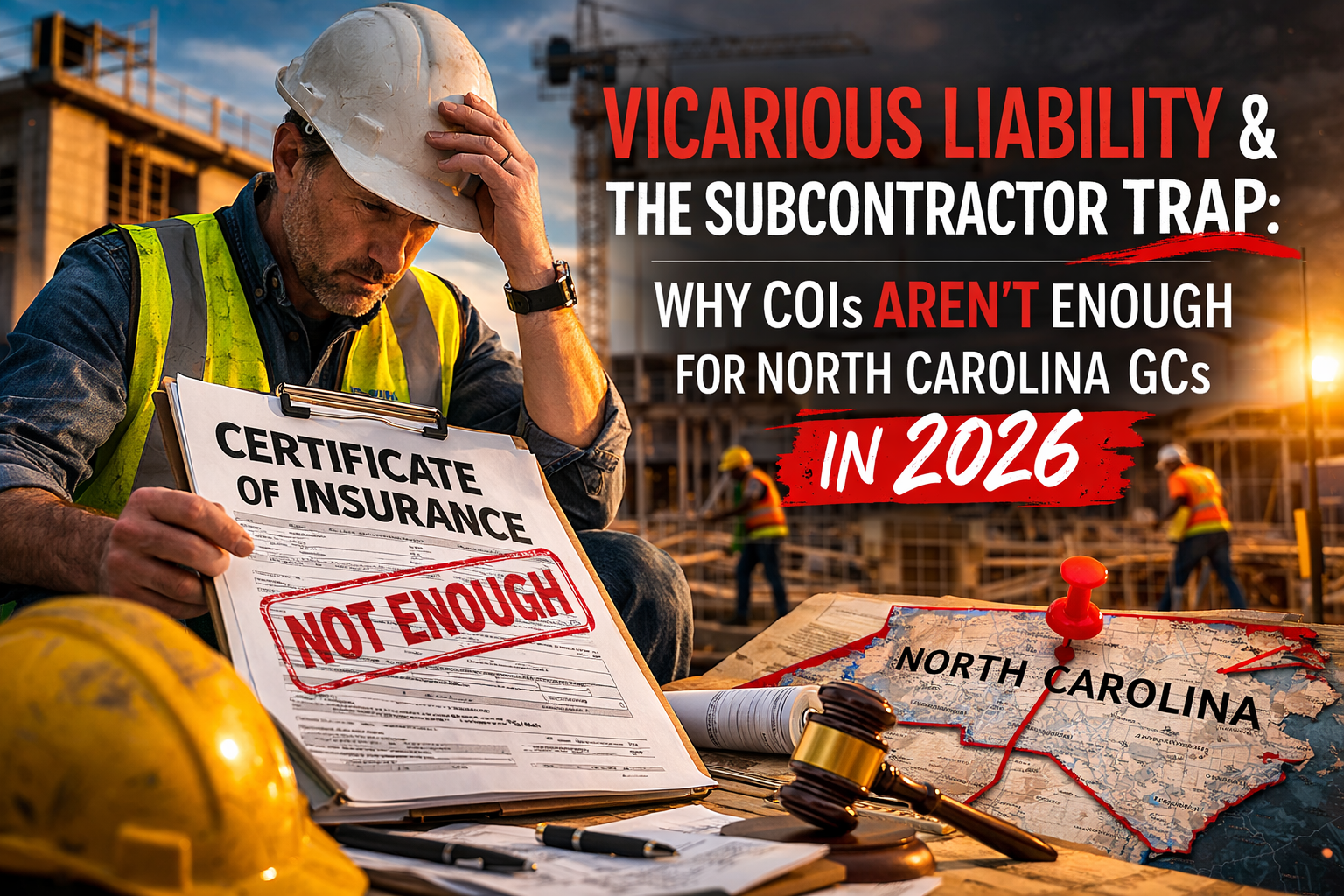
Vicarious liability for general contractors is one of the biggest reasons a subcontractor problem becomes your problem.
A roofing subcontractor leaves part of a roof exposed and water gets inside. A framing subcontractor drops material and injures someone. A grading subcontractor causes runoff that damages the neighbor’s property. An electrical subcontractor contributes to a fire.
The subcontractor may have caused the direct damage, but the general contractor still gets named in the claim.
Why? Because the GC hired the trade, coordinated the project, supervised the site, controlled the schedule, signed the owner contract, or simply looked like the deeper recovery target.
Simple point: you do not have to swing the hammer that caused the damage to get pulled into the lawsuit. You only need to be connected to the job strongly enough that someone wants your company in the claim.
Why This Is a North Carolina General Contractor Insurance Problem
General contractors in North Carolina often coordinate multiple trades, changing schedules, layered contracts, site supervision, subcontractor crews, owner requirements, and tight project timelines.
That creates a simple problem: the GC may not perform every trade, but the GC is still tied to the whole job.
OSHA’s fall protection guidance says falls are among the most common causes of serious work-related injuries and deaths. That matters for contractors because jobsite injury severity can be high, especially when work involves ladders, roofs, framing, scaffolding, open edges, and elevated work.
North Carolina workers compensation rules also create real subcontractor exposure. The North Carolina Industrial Commission employer guidance says businesses with three or more employees generally must carry workers compensation insurance, and it warns that subcontracting work to an uninsured subcontractor may create liability for work-related injuries to that subcontractor’s employees.
That is why subcontractor review is not just an admin step. It is part of your general contractor insurance strategy.
Want your subcontractor COI process reviewed?
Carolina Risk Partners can help review your subcontractor insurance requirements, additional insured wording, waiver requirements, workers compensation concerns, commercial auto exposure, and overall general contractor insurance structure.
- COI and endorsement review
- Additional insured and waiver review
- Workers comp and subcontractor exposure review
- Commercial auto and umbrella discussion
I’ll follow up within 1 business day.
The False Belief That Creates the Subcontractor Trap
The false belief sounds like this:
“My subcontractor sent a certificate of insurance, so I am protected.”
That is not how this works.
A certificate of insurance is useful. It can show the named insured, carrier, policy numbers, effective dates, coverage lines, stated limits, and certificate holder.
But a COI is not the policy. It is not the endorsement. It is not the subcontract. It is not a guarantee that a claim will be covered.
For general contractors, that distinction matters because real risk transfer usually depends on four things working together:
- The subcontract.
- The endorsement.
- The actual policy language.
- The internal process used to verify subcontractor insurance before work starts.
If one of those pieces is missing, the COI may give you false comfort.
What a COI Does and Does Not Do
What a COI Can Help Show
- The subcontractor’s named insured.
- The insurance carrier.
- The policy numbers.
- The effective and expiration dates.
- The listed lines of coverage.
- The stated limits.
- Whether your company was listed as certificate holder.
What a COI Does Not Prove
- It does not make you an additional insured by itself.
- It does not prove completed operations coverage applies.
- It does not confirm waiver of subrogation wording.
- It does not prove the policy covers the exact trade being performed.
- It does not show every exclusion or endorsement.
- It does not prove the legal entity matches the subcontract.
- It does not guarantee workers compensation compliance.
- It does not override the subcontract or the policy wording.
A certificate is a screening document. It is not a policy review.
This is the same core issue explained in Additional Insured vs. Certificate Holder for General Contractors.
What Vicarious Liability Looks Like in Real Life
Vicarious liability sounds like courtroom language, but on a construction job, it usually starts with a practical problem.
Claim Story 1: The Roofing Subcontractor
A roofing subcontractor leaves an opening exposed. Rain comes through. Interior water damage follows. The owner sues the general contractor because the GC hired the roofer, controlled the project schedule, and was responsible for delivering the finished job.
The GC tenders the claim to the roofing subcontractor’s carrier. The carrier asks for the additional insured endorsement and the policy wording. The certificate looked fine, but now the real documents control the outcome.
Claim Story 2: The Framing Subcontractor
A framing subcontractor drops material and injures a visitor or neighboring worker. The injured party names the subcontractor and the GC. Even if the subcontractor caused the direct injury, the GC may still face defense costs, claim reporting, discovery, and renewal questions.
Claim Story 3: The Grading Subcontractor
A grading subcontractor creates runoff that damages nearby property. The property owner sues everyone tied to the project. The GC is now forced to prove the subcontractor’s insurance, contract language, and endorsements actually work.
That is the subcontractor trap. The loss starts with one trade, but the claim spreads into your insurance program.
The Four Things General Contractors Should Verify Before a Sub Starts
1. Additional Insured Status
Being listed as a certificate holder is not enough.
If you want access to a subcontractor’s liability policy, you usually need to be added as an additional insured by endorsement. The endorsement matters more than the certificate language.
In many construction insurance conversations, the technical difference often comes down to endorsement wording. Common industry forms such as CG 20 10 are often associated with ongoing operations, while CG 20 37 is commonly associated with completed operations. The exact form, edition date, carrier wording, and contract requirement all matter.
You also need to know whether the endorsement applies to:
- Ongoing operations only.
- Completed operations only.
- Both ongoing and completed operations.
- Only work required by written contract.
- Only certain parties or certain project relationships.
This is where claims get ugly months later. The GC thought there was protection after the work was done. The endorsement only applied while work was active.
2. Workers Compensation Compliance
Workers compensation should never be treated as a throwaway line on the certificate.
North Carolina generally requires workers compensation coverage when a business has three or more employees. The North Carolina Industrial Commission also warns that an employer is not relieved of responsibility just because workers are called independent contractors or issued 1099s.
The common problems are:
- The subcontractor has workers but no active workers compensation coverage.
- The crew is called 1099 but functions like employees.
- Labor-only subs are treated like separate businesses when they are not.
- A one-person subcontractor adds workers without updating coverage.
- Payroll is underreported.
- Class codes do not match the actual work.
When an injury happens, the questions become very specific: Who employed the worker? Who controlled the work? Who had coverage? Who should have had coverage?
That is why workers compensation insurance is part of subcontractor control, not just payroll compliance.
3. Contract Transfer Language
A subcontract agreement matters. A lot.
But contract wording cannot be reviewed in isolation from insurance wording. North Carolina Chapter 22B includes rules affecting certain indemnity and defense agreements in construction and real property contracts. That means contract language should be reviewed by qualified legal counsel, and the insurance requirements should match the actual endorsements you are requesting.
Use the North Carolina General Statutes Chapter 22B page as a starting reference, but do not treat it as a substitute for legal advice.
The insurance point is simple: if the subcontract says one thing, the COI suggests another, and the endorsement says something else, the endorsement usually controls the insurance outcome.
4. Auto and Equipment Exposure
General contractors often focus on general liability and forget the auto side.
That can be a mistake.
If a subcontractor causes a serious crash while hauling materials, towing a trailer, moving equipment, or driving between jobsites, the claim can become large fast.
Ask whether the subcontractor has commercial auto coverage that fits the work. Also review your own commercial auto insurance and commercial umbrella insurance strategy.
The Legal Entity Match Most Contractors Miss
This is one of the quietest paperwork problems.
The name on the subcontract should match the name on the insurance documents. The name on the license should match the entity doing the work. The payment name should not create more confusion.
If the subcontract says one entity, the COI shows another, and the license belongs to someone else, you may not know who you actually hired until after the claim.
That creates avoidable friction.
Subcontractor file rule: match the subcontract, COI, endorsement, license, W-9, and payment name before work starts. If the names do not match, stop and clarify.
What General Contractors Should Require Instead of Just a COI
Do not just collect certificates.
Create a subcontractor insurance review standard.
That standard should usually include:
- Proof of general liability with limits that fit the job.
- Proof of workers compensation when applicable.
- Proof of commercial auto when vehicles are part of the work.
- Additional insured endorsement, not just certificate language.
- Completed operations support when the subcontract requires it.
- Waiver of subrogation wording when contractually required.
- Verification that the named insured matches the legal entity signing the subcontract.
- Verification that coverage dates span the actual project timeline.
- Review of exclusions that could affect the trade being hired, such as residential restrictions, height limitations, roofing exclusions, open roof wording, exterior work restrictions, subcontractor warranty requirements, or multi-family limitations.
- A re-check process for renewals on long-running jobs.
- Central documentation before mobilization, not after the loss.
A good contractor insurance agent should be comfortable helping you review the insurance side of this process, not just sending certificates after the contract is signed.
The Subcontractor Trap That Hurts GCs the Most
Here is how the trap usually unfolds.
- A general contractor hires a subcontractor based on price and availability.
- The subcontractor sends a COI.
- The GC files it and starts the job.
- A loss happens.
- The GC gets sued.
- The subcontractor’s carrier disputes additional insured status, limits the claim, or points to an exclusion.
- The subcontractor has weak limits, wrong entity name, no completed operations support, or no real workers compensation structure behind the labor.
- The GC’s own policy gets pulled into the problem.
Now the GC may face defense costs, loss history impact, renewal friction, harder underwriting, tighter carrier terms, and weaker leverage next year.
That is how a cheap subcontractor becomes an expensive insurance problem.
North Carolina General Contractor Playbook
Here is the practical move for North Carolina general contractors.
- Require the COI before work starts.
- Also require the additional insured endorsement.
- Require completed operations wording when the contract calls for it.
- Require waiver of subrogation wording when applicable.
- Match the insurance requirements to the subcontract.
- Verify the legal entity.
- Verify workers compensation compliance.
- Review trade-specific exclusions.
- Review auto exposure.
- Store everything in one place.
- Re-check renewals on long jobs.
- Escalate unusual contract language before the loss, not after it.
The biggest mindset shift is this: stop acting like a certificate file is the same thing as a risk transfer system.
Paperwork is not protection unless the paperwork matches the policy, contract, endorsement, job, entity, and actual work being performed.
Related Contractor Insurance Resources
- General contractor insurance
- Contractor insurance
- General liability insurance
- Workers compensation insurance
- Commercial auto insurance
- Commercial umbrella insurance
- Additional Insured vs. Certificate Holder for General Contractors
- General Contractor Insurance Checklist
- North Carolina Contractors Insurance Guide
Frequently Asked Questions About Vicarious Liability and Subcontractor COIs
What is vicarious liability for general contractors?
Vicarious liability for general contractors means a GC can be pulled into a claim because of work performed by a subcontractor. It is fact-specific and can depend on allegations, contract language, jobsite control, supervision, project coordination, and state law.
Is a subcontractor certificate of insurance enough to protect a general contractor?
No. A certificate of insurance can show that a policy may exist, but it does not make the general contractor an additional insured by itself, confirm completed operations coverage, override exclusions, prove workers compensation compliance, or guarantee that a claim will be covered.
What should a general contractor request from a subcontractor besides a COI?
A general contractor should usually request the COI, additional insured endorsement, waiver of subrogation endorsement when required, workers compensation proof, commercial auto proof when vehicles are involved, legal entity confirmation, policy dates, and trade-specific exclusion review.
Why does additional insured status matter for general contractors?
Additional insured status can give a general contractor access to defense and coverage under a subcontractor’s liability policy when the claim arises from the subcontractor’s work. Being listed as a certificate holder is not the same as being added by endorsement.
What is the difference between ongoing operations and completed operations?
Ongoing operations generally refers to liability connected to work while the subcontractor is still performing the job. Completed operations generally refers to liability that appears after the work is finished. A general contractor can have a major gap if the subcontractor’s additional insured endorsement only applies to ongoing operations.
Can a general contractor be responsible for an uninsured subcontractor’s injured worker in North Carolina?
It can happen. The North Carolina Industrial Commission warns that if a business subcontracts work to a subcontractor without workers compensation insurance, it may be liable for work-related injuries to that subcontractor’s employees.
Does North Carolina law affect contractor indemnity agreements?
Yes. North Carolina Chapter 22B includes rules affecting certain indemnity and defense agreements. General contractors should have construction contracts reviewed by qualified legal counsel and should make sure insurance requirements match the actual endorsements being required.
Can Carolina Risk Partners review subcontractor insurance requirements for a general contractor?
Yes. Carolina Risk Partners can help North Carolina general contractors review subcontractor insurance requirements, certificates, additional insured wording, waiver requirements, workers compensation concerns, commercial auto exposure, and overall contractor insurance structure.

Stephen Ellias is the founder of Carolina Risk Partners LLC, an independent commercial insurance agency based in Wake Forest, North Carolina. He is a licensed North Carolina insurance professional, license number 20374030, with a CLCS, Commercial Lines Coverage Specialist, designation. Stephen helps general contractors, roofing contractors, and blue-collar trade businesses understand general liability, workers compensation, commercial auto, umbrella liability, certificates of insurance, subcontractor risk, audits, policy exclusions, and contract insurance requirements in direct language.
Want a second set of eyes on your subcontractor insurance process?
Carolina Risk Partners can help review your subcontractor insurance requirements, certificate process, additional insured wording, waiver wording, workers compensation exposure, commercial auto concerns, and overall general contractor insurance program.
Review My Subcontractor Insurance ProcessEducational resource only. This article is not legal, claim, underwriting, risk management, safety, or insurance advice. Coverage depends on the actual policy language, endorsements, exclusions, conditions, facts of the claim, contract terms, state law, carrier interpretation, and claim handling. Contract language should be reviewed by qualified legal counsel.