
Contractors Pollution Liability Insurance for Restoration Companies: Why General Liability May Not Cover Mold, Bacteria, or Contaminated Water
Restoration companies are hired to enter buildings after water, sewage, mold, smoke, and other contaminants have already created a problem. That makes pollution liability one of the most important coverage questions to resolve before a difficult claim exposes a gap in the general liability policy.
Key Takeaways
- A general liability policy should not automatically be assumed to cover mold, bacteria, sewage, fungi, or other contamination.
- A pollution exclusion matters especially for restoration companies because contaminated materials are often the reason the contractor was hired.
- Contractors pollution liability, often called CPL, can address certain pollution conditions arising from covered restoration operations.
- Mold, microbial matter, bacteria, asbestos, lead, contaminated water, transportation, disposal, and professional services should be reviewed individually.
- The policy name is not enough. Definitions, exclusions, endorsements, retroactive dates, reporting provisions, and described operations matter.
Quick Answer
Contractors pollution liability insurance for restoration companies is designed to address certain liability exposures involving pollution conditions that may be excluded or restricted under a commercial general liability policy.
For restoration contractors, that can matter when work involves mold, microbial growth, bacteria, sewage, contaminated water, chemicals, hazardous materials, or pollutants disturbed during remediation.
Bottom line: if your company performs water mitigation, mold remediation, sewage cleanup, fire restoration, demolition, or environmental cleanup, do not assume the GL policy and certificate of insurance tell the whole coverage story.
Why Pollution Liability Is Different for Restoration Companies
A typical contractor is trying to avoid accidentally creating damage during a job. A restoration company often walks into a building because serious damage or contamination already exists.
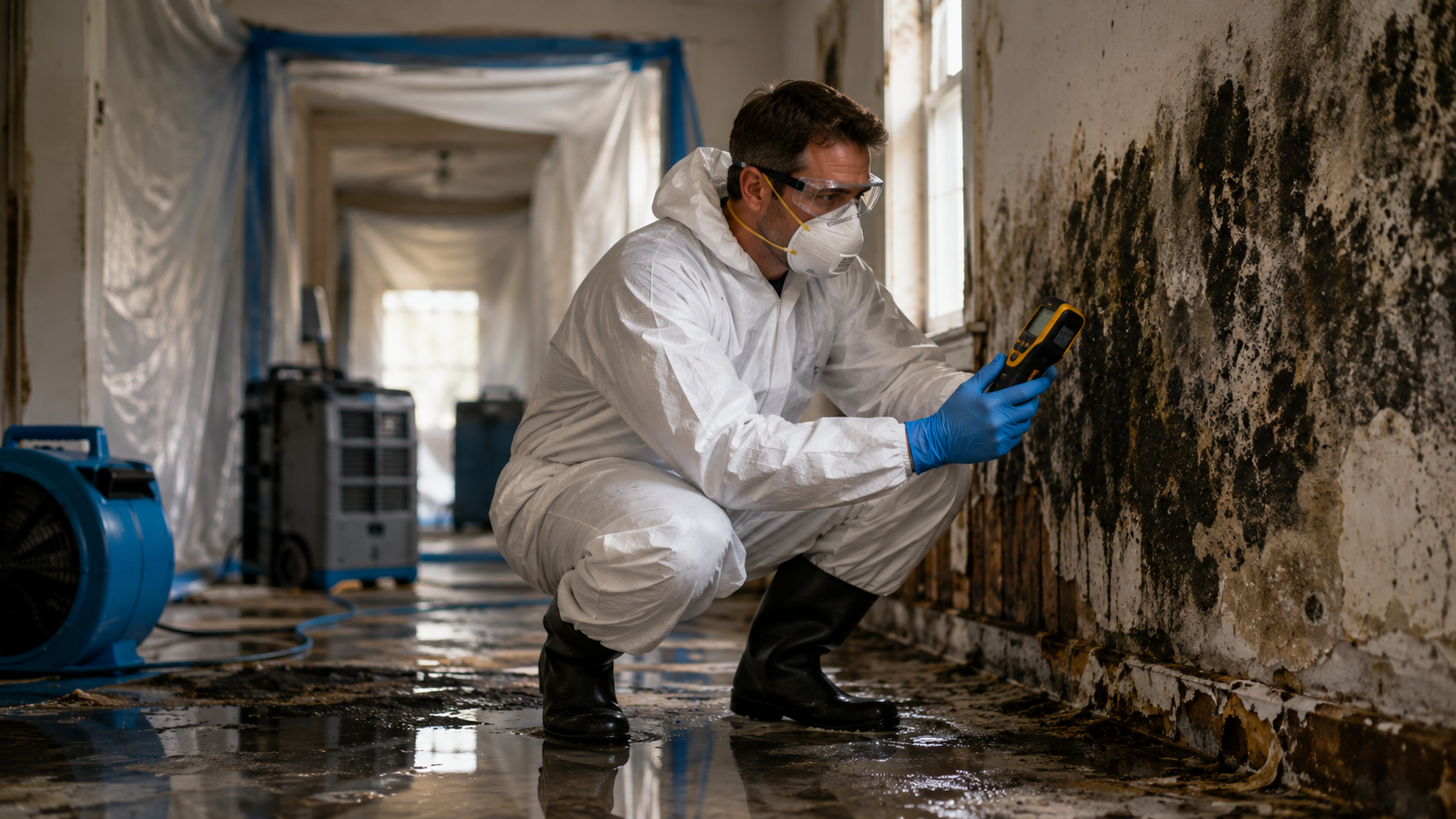
Crews may be extracting water, removing wet drywall, cutting into walls, setting containment, running negative-air equipment, handling contaminated contents, removing damaged materials, applying antimicrobial products, or working around mold and microbial growth.
Those operations create a different liability profile from ordinary remodeling.
The question is not simply whether the contractor caused property damage. The harder question can be whether the alleged injury, damage, cleanup expense, or loss arises from a pollution condition that the general liability policy excludes or restricts.
For the broader insurance structure behind these exposures, see our restoration contractor insurance in North Carolina guide.
A North Carolina Mold Exposure Restoration Companies Should Know
10 to 1,000 times higherThe North Carolina Division of Public Health says airborne mold counts can be 10 to 1,000 times higher than normal during a mold removal or cleaning project.
That is important for restoration firms because a remediation job can create allegations involving containment, airborne spread, employee procedures, occupants, adjacent rooms, contents, or areas that were not originally part of the loss.
North Carolina’s guidance reinforces a practical insurance point: mold remediation is not simply ordinary property cleanup. Contractors should confirm how their general liability, pollution liability, workers compensation, and any professional liability coverage respond to the operations they actually perform.
Review North Carolina Division of Public Health mold cleanup guidance
Does General Liability Cover Mold for a Restoration Company?
Do not assume that it does.
Commercial general liability insurance is designed primarily to respond to covered third-party bodily injury and property damage claims. But GL policies can contain pollution exclusions, fungi or bacteria exclusions, mold limitations, endorsements, or other provisions that change how contamination-related claims are handled.
The exact result depends on the policy.
That distinction is especially important for a remediation contractor because a mold-related claim may involve allegations such as:
- The contractor failed to contain mold spores during demolition.
- Contamination spread into previously unaffected areas.
- Building occupants allege bodily injury or respiratory problems.
- Remediation was incomplete and additional cleanup is required.
- Wet material was not removed or dried properly and microbial growth developed later.
- A contractor disturbed pre-existing contamination while performing restoration work.
Whether a particular allegation is covered depends on the facts and the actual insurance contract. Those are exactly the types of allegations that make a dedicated pollution-liability review important.
General contractors face a related but broader set of environmental exposures. See Does a General Contractor Need Pollution Liability Insurance? for the construction-side discussion.
Why Sewage and Category 3 Water Create a Bigger Coverage Question
Water restoration is not one uniform exposure.
A clean-water supply-line loss is materially different from a sewage backup, floodwater intrusion, or another loss involving significant biological contamination.
Sewage and highly contaminated water can involve bacteria, microorganisms, debris, and other substances that create both safety and liability concerns.
From an insurance standpoint, the presence of bacteria, sewage, microbial matter, or other contaminants can move the claim beyond an ordinary water-damage scenario.
What Contractors Pollution Liability Insurance May Cover
Contractors pollution liability is generally designed to address certain pollution exposures arising from contracting operations. Depending on the carrier and policy form, coverage may include some combination of:
- Third-party bodily injury arising from a covered pollution condition.
- Third-party property damage caused by a covered pollution condition.
- Cleanup or remediation costs when triggered by the policy.
- Defense costs for covered pollution claims.
- Pollution conditions arising from completed operations, depending on the form.
- Transportation-related pollution exposure, if specifically included.
- Non-owned disposal-site exposure, if provided by the policy.
- Mold, fungi, bacteria, microbial matter, or biological contaminants, when included within the applicable definitions and not otherwise excluded.
This list is not a promise of coverage. CPL policies vary substantially.
One carrier may offer broader microbial coverage while another restricts it. Another may exclude asbestos entirely. Some policies contain retroactive dates. Others are claims-made and require careful attention to when a claim is first made and reported.
Seven Things to Check on a Restoration Company’s Pollution Policy
1. What does the policy define as a pollutant or pollution condition?
Do not stop at the declarations page. Mold, fungi, bacteria, microbial matter, sewage, chemicals, smoke residue, lead, and asbestos may be treated differently.
2. Are your actual restoration operations disclosed?
Water mitigation, structural drying, mold remediation, fire and smoke restoration, contents work, demolition, sewage cleanup, trauma cleanup, and environmental remediation are not interchangeable exposures.
3. Does coverage apply to completed operations?
A contamination allegation may surface after your crew leaves the job. Review whether the policy addresses covered pollution conditions arising from completed work.
4. Are mold and microbial matter specifically addressed?
Never assume the word “pollution” automatically means unrestricted mold coverage.
5. How are asbestos and lead handled?
These exposures may be excluded, limited, separately endorsed, or require specialized underwriting. This matters even when the company does not intentionally perform abatement because restoration crews can encounter suspect materials during demolition.
6. Is transportation or disposal-site liability included?
If contaminated debris or material is transported away from the loss site, determine what protection exists during transportation and after material reaches a disposal facility.
7. Is the policy claims-made?
If it is, review the retroactive date, continuity, reporting requirements, and what happens if the company changes carriers.
Have Me Check the Coverage Structure Before You Need It
If you perform mold remediation, sewage cleanup, water mitigation, fire restoration, packout, demolition, or related restoration work in North Carolina, I can help review how your GL and pollution coverage fit together.
A Restoration Claim Can Involve More Than One Insurance Policy
One reason restoration insurance gets complicated is that the same loss can raise several different coverage questions.
Imagine a water-mitigation company responds to a severe sewage backup in a commercial building. The crew removes damaged materials, runs drying equipment, treats affected surfaces, and completes the job.
Weeks later, the building owner alleges contamination spread behind a wall and additional areas now need to be demolished and remediated.
That dispute could potentially raise different issues:
- Was there third-party property damage?
- Was the alleged damage caused by a pollutant or microbial condition?
- Is there a pollution or fungi/bacteria exclusion in the GL?
- Does the CPL policy contemplate the contaminant involved?
- Does completed-operations coverage apply?
- Is part of the allegation faulty workmanship rather than covered resulting damage?
- Is there an allegation that the contractor failed to follow a remediation protocol or professional standard?
The important distinction
General liability, contractors pollution liability, and professional liability do different jobs. A restoration company’s program should be evaluated as a coordinated coverage structure, not as interchangeable policy names.
Pollution Liability vs Professional Liability for Restoration Contractors
Pollution and professional liability are frequently discussed together for restoration companies, but they address different allegations.
| Contractors Pollution Liability | Professional Liability |
|---|---|
| Primary issue A covered pollution condition causes bodily injury, property damage, cleanup expense, or another insured loss. | Primary issue An alleged error, omission, or failure occurs in a covered professional or technical service. |
| Typical restoration allegation Mold spores, bacteria, sewage, chemicals, or other contaminants spread during covered remediation work. | Typical restoration allegation The contractor allegedly gave incorrect technical advice, assessment, protocol, recommendation, or documentation. |
| Potential loss Third-party bodily injury, property damage, cleanup costs, defense costs, and certain completed-operations pollution claims. | Potential loss Financial loss or damages arising from a covered professional error or omission. |
| Key wording to review Pollution-condition definition, microbial matter, mold, bacteria, completed operations, transportation, disposal sites, retroactive date, and exclusions. | Key wording to review Definition of professional services, covered activities, retroactive date, exclusions, reporting requirements, and who performs the service. |
| Does it replace GL? No. It generally supplements rather than replaces general liability. | Does it replace CPL? No. An errors-and-omissions allegation and a pollution-condition allegation can exist in the same dispute. |
Some restoration programs combine pollution and professional liability. Others separate them. Either structure requires reviewing the actual insuring agreements, definitions, exclusions, and described operations.
What About Mold Remediation?
Mold deserves its own review.
North Carolina public-health guidance emphasizes moisture control and precautions during mold cleanup. For a restoration business, however, the insurance question is separate from the remediation technique.
You want to know:
- Does the policy explicitly contemplate mold or fungi?
- Is microbial matter defined?
- Are bacteria treated separately?
- Are there mold-specific sublimits?
- Are there exclusions that effectively remove the work you perform?
- Is testing or consulting covered?
- Does coverage continue after the remediation job is completed?
If mold remediation represents a meaningful percentage of revenue, it should not be an afterthought on an application.
What About Asbestos and Lead?
Asbestos and lead create another important distinction.
A restoration contractor may encounter suspect building materials during demolition even when the company does not advertise itself as an asbestos-abatement contractor.
That does not mean a standard restoration CPL policy necessarily covers asbestos or lead.
Depending on the program, these exposures may be:
- Excluded entirely.
- Covered only under specific conditions.
- Subject to separate underwriting.
- Restricted to incidental exposure.
- Dependent on properly licensed specialty subcontractors.
Why This Matters for Raleigh, Durham, Cary, and Wake Forest Restoration Contractors
Restoration companies throughout Wake Forest, Raleigh, Durham, Cary, and the broader Research Triangle work in a mix of homes, apartment communities, offices, retail locations, healthcare facilities, schools, industrial properties, and other occupied buildings.
That mix matters because the severity of a contamination allegation can change substantially when a loss involves occupants, tenants, neighboring businesses, sensitive environments, expensive contents, or interrupted operations.
A Triangle water-mitigation contractor performing clean-water extraction may present a different underwriting profile from a company that routinely handles sewage losses, mold remediation, demolition, contaminated contents, or environmental cleanup.
The insurance application, policy forms, and endorsements should reflect that actual work rather than a generic description such as “restoration contractor.”
The General Liability Certificate Does Not Prove Pollution Coverage
A certificate showing $1 million of general liability does not tell you whether the underlying policy excludes fungi, bacteria, pollutants, contaminated water, or specific restoration operations.
Likewise, simply adding “pollution liability” to a certificate does not create coverage that the policy itself does not provide.
The evidence that matters is in the actual policy, endorsements, schedules, definitions, exclusions, and applicable coverage forms.
This becomes especially important when restoration companies work for:
- Property managers.
- General contractors.
- Healthcare organizations.
- Schools.
- Municipalities.
- Commercial property owners.
- National restoration networks.
- Franchises or referral programs with specific insurance requirements.
Common Pollution Insurance Mistakes Restoration Companies Make
Assuming GL automatically includes the exposure
A strong GL policy is still important, but pollution needs to be reviewed separately.
Buying a CPL policy without checking what it calls a pollutant
The definitions drive the contract.
Not telling the underwriter about sewage work
Contaminated-water work can materially change the exposure.
Calling every water loss “water mitigation”
Clean-water extraction, sewage cleanup, flood response, mold remediation, and environmental remediation are not identical risks.
Ignoring completed operations
Restoration allegations often surface after the crew has left.
Ignoring professional services
Pollution coverage does not necessarily replace professional liability.
Focusing only on premium
A cheaper policy that removes the operation creating the largest exposure may not be a meaningful bargain.
What Should a Restoration Contractor Send for a Pollution Insurance Review?
You do not need to rebuild the entire underwriting file before asking whether the current structure makes sense.
A useful first review usually starts with:
- Current general liability policy or quote.
- Current pollution liability policy or quote.
- Professional liability policy, if carried.
- A short description of operations.
- Approximate revenue split by major service.
- Whether you perform mold remediation.
- Whether you accept sewage or contaminated-water losses.
- Whether you perform asbestos or lead work.
- Whether environmental work is subcontracted.
- Any customer or referral-network insurance requirements.
The goal is not simply to ask, “Do you have pollution insurance?”
How Contractors Pollution Liability Fits Into a Restoration Insurance Program
Pollution liability is usually one piece of the larger program.
A restoration contractor may also need to coordinate:
- General liability insurance for ordinary third-party bodily injury and property damage exposures.
- Workers compensation insurance for employee injury exposures.
- Commercial auto insurance for company vehicles and drivers.
- Inland marine insurance for mobile tools and equipment.
- Commercial property insurance for owned property and business personal property.
- Commercial umbrella or excess liability when higher limits are needed.
- Professional liability when the company performs covered professional or technical services.
The objective is to reduce avoidable gaps between policies, especially where one policy excludes an exposure the contractor assumes another policy covers.
Frequently Asked Questions
Does general liability insurance cover mold remediation?
Not necessarily. Many commercial general liability policies contain pollution exclusions or other limitations that can affect claims involving mold, fungi, bacteria, or contaminated materials. Restoration contractors should review the actual policy forms and endorsements instead of assuming the general liability policy covers remediation work.
What does contractors pollution liability insurance cover for a restoration company?
Depending on the policy, contractors pollution liability may respond to certain third-party bodily injury, property damage, cleanup costs, and legal defense arising from pollution conditions connected with covered contracting operations. Exact coverage depends on definitions, exclusions, retroactive dates, reporting requirements, and endorsements.
Can contractors pollution liability cover sewage or Category 3 water?
Potentially, but the policy language needs to be reviewed carefully. Sewage, bacteria, and other contaminants associated with heavily contaminated water can create pollution exposures. Coverage varies by carrier and form.
Is mold coverage the same as pollution liability coverage?
Not always. Some policies specifically address mold, microbial matter, bacteria, or fungi while others define covered pollution conditions differently. Buying a policy labeled “pollution liability” does not automatically mean unrestricted mold coverage.
Does pollution liability cover asbestos work?
It depends on the policy and the contractor’s actual operations. Asbestos may be excluded, restricted, separately underwritten, or require specialized coverage.
Should a restoration contractor carry both general liability and contractors pollution liability?
Often, yes. The policies address different categories of liability exposure. General liability remains important for ordinary premises, operations, and completed-operations liability, while contractors pollution liability may address qualifying pollution conditions that fall outside or are restricted by the general liability policy.
Who can review pollution liability insurance for a North Carolina restoration contractor?
Stephen Ellias, founder of Carolina Risk Partners and North Carolina Insurance License 20374030, works with restoration contractors and other North Carolina businesses to review general liability, contractors pollution liability, professional liability, commercial auto, workers compensation, equipment, and related commercial insurance exposures.
About Stephen Ellias
Stephen Ellias, CLCS, is the founder of Carolina Risk Partners, an independent commercial insurance agency based in Wake Forest, North Carolina. He works with restoration companies, contractors, and business owners across Raleigh, Durham, Cary, the Triangle, and throughout North Carolina on general liability, workers compensation, commercial auto, pollution liability, professional liability, equipment, umbrella, and related commercial coverage.
North Carolina Insurance License 20374030.
Learn more about Stephen ElliasDo You Know What Your Pollution Policy Actually Covers?
If mold remediation, water mitigation, sewage cleanup, fire restoration, demolition, or contaminated-material work is part of your business, it is worth reviewing the coverage before a claim forces everyone to interpret the exclusions.
This article is for general educational purposes and is not legal advice or a guarantee of insurance coverage. Coverage depends on the specific policy language, endorsements, exclusions, facts of a claim, underwriting information, and applicable law. Review actual policy documents with a qualified insurance professional and consult legal counsel when appropriate.