
Restoration Contractor Insurance North Carolina
Carolina Risk Partners helps water, fire, mold, contents, and property restoration companies review the insurance exposures that ordinary contractor policies can miss, including pollution, customer property, professional services, commercial vehicles, equipment, subcontractors, and reconstruction work.
Multiple carrier options · North Carolina focused · Practical response within 1 business day
Key Takeaways
- Restoration companies can have materially different insurance exposures than ordinary construction contractors.
- General liability alone may not adequately address mold, pollution, professional services, or customer contents being packed out, transported, cleaned, or stored.
- Water mitigation, fire cleanup, mold remediation, reconstruction, contents handling, vehicles, equipment, and subcontractors should all be accurately disclosed.
- A restoration insurance program may require several coordinated policies rather than one broad contractor policy.
- North Carolina restoration companies performing reconstruction should understand the state’s general contractor licensing threshold.
- Price matters, but exclusions, endorsements, and operational fit can matter just as much.
Quick Answer: Restoration Contractor Insurance North Carolina
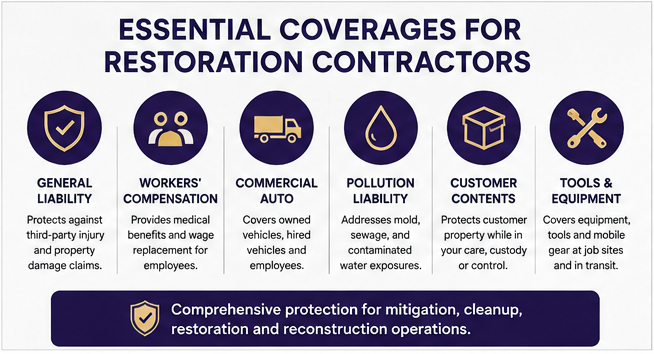
Restoration contractor insurance North Carolina businesses should consider starts with the normal contractor foundation of general liability insurance, workers compensation insurance, commercial auto insurance, tools and equipment coverage, and commercial umbrella insurance. Restoration firms may also need specialized protection for pollution or mold, professional services, customer contents, storage, hired and non-owned vehicles, and other exposures created by the way the company actually operates.
Restoration businesses should also distinguish emergency mitigation from reconstruction. Under North Carolina General Statute § 87-1, a general contractor license is generally required when the cost of the construction undertaking is $40,000 or more, subject to statutory exceptions.
Bottom line: a contractor policy that works for a painter, roofer, or remodeler is not automatically a good fit for a restoration company. The insurance program should reflect the exact operations being performed.
Insurance Built Around Restoration Operations
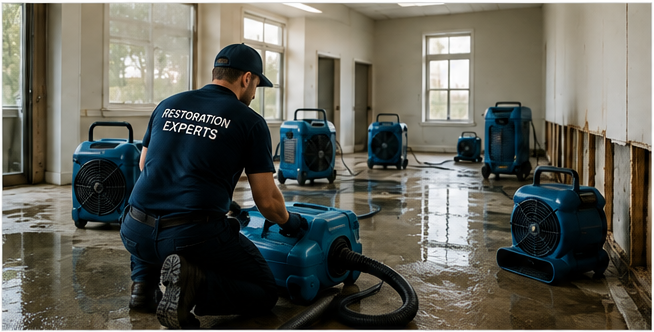
Restoration companies frequently move from emergency mitigation to demolition, drying, cleaning, contents handling, storage, remediation, and reconstruction. Each part of that process can create a different insurance exposure.
- Water damage mitigation
- Structural drying
- Fire and smoke restoration
- Mold remediation
- Contents packout
- Contents cleaning
- Contents storage
- Sewage and contaminated-water cleanup
- Emergency board-up
- Demolition and tear-out
- Reconstruction work
- Commercial restoration
- Residential restoration
- Catastrophe response
Core Insurance for Restoration Contractors
The right combination depends on the company’s operations, employees, subcontractors, vehicles, equipment, property handled, contracts, and actual policy language.
General Liability
General liability insurance can respond to certain third-party bodily injury and property damage claims arising from covered operations. Restoration companies should review pollution, fungi, bacteria, professional-services, and care-custody-control exclusions.
Workers Compensation
Restoration employees may perform demolition, lifting, water extraction, drying, cleaning, remediation, driving, and reconstruction. Workers compensation insurance should be reviewed alongside payroll, class codes, employee duties, subcontractors, and audit practices.
Commercial Auto
Vans, pickups, box trucks, trailers, and other vehicles may move technicians, drying equipment, tools, supplies, and customer contents. Commercial auto insurance should reflect the actual vehicles, drivers, use, and radius.
Contractors Pollution Liability
Contractors pollution liability can be particularly important for mold, sewage, contaminated water, microbial matter, and environmental conditions that may be excluded or restricted by general liability insurance. Request a restoration coverage review if those exposures are part of the operation.
Professional Liability
Firms providing moisture assessments, remediation protocols, consulting, recommendations, specifications, or other professional services should review whether a professional liability exposure exists outside traditional general liability coverage. Have the current program reviewed before assuming those services are covered.
Bailee & Customer Contents Coverage
Restoration firms taking possession of customer contents for packout, transport, cleaning, storage, or restoration should specifically review how that property is insured while in their care.
This differs from protecting the company’s own property through commercial property insurance or mobile equipment through inland marine insurance.
Inland Marine & Contractors Equipment
Dehumidifiers, air movers, moisture meters, extractors, air scrubbers, generators, and other mobile equipment may spend most of their time at customer locations. Inland marine insurance can be important for equipment moving between job sites.
Commercial Property
Offices, warehouses, cleaning facilities, owned business personal property, and permanently located equipment may create commercial property insurance needs.
Commercial Umbrella
Larger projects, contract requirements, vehicle fleets, and severe-loss potential may create a need for higher liability limits. Commercial umbrella insurance can be reviewed as part of the overall liability structure.
Where Restoration Insurance Programs Need a Closer Look
Mold and Microbial Exclusions
A restoration company may perform mold-related work while carrying a general liability policy that excludes or materially limits fungi, bacteria, microbial matter, or pollution.
Care, Custody, or Control
Customer contents can create a different exposure once the restoration company takes possession of them for packing, transportation, cleaning, or storage.
Professional Services
Recommendations about drying, remediation, contamination, moisture, scope, or restoration methodology may create allegations that differ from ordinary bodily injury or property damage claims.
Subcontractor Exposure
Reconstruction and specialty trades may be subcontracted. Certificates, written agreements, workers compensation status, additional insured requirements, and risk transfer should be reviewed.
Personal Vehicles Used for Work
Employees may use personal vehicles to inspect losses, travel between jobs, or pick up supplies. Hired and non-owned auto should be considered when this exposure exists.
Equipment Away From the Shop
High-value drying and restoration equipment may spend most of its time at customer locations rather than the company’s warehouse or office.
Packout and Customer Contents Deserve Their Own Review
Contents restoration creates one of the most important differences between a restoration company and an ordinary construction contractor.
At the Loss Location
Employees may inventory, photograph, wrap, move, pack, and handle property belonging to the customer.
In Transit
Customer contents may travel between the loss location, cleaning facility, warehouse, temporary storage, and eventual return location.
At Your Facility
Customer property may remain in the restoration company’s possession for days, weeks, or months while being cleaned, restored, inventoried, or stored.
Mold, Sewage and Pollution Liability
Restoration contractors frequently work in environments containing contaminants that an ordinary contractor may try to avoid altogether.
Mold remediation, sewage losses, contaminated water, microbial contamination, smoke residue, chemicals, and other environmental conditions can create insurance issues that should not be evaluated solely through a standard general liability policy.
Contractors pollution liability policies can differ substantially. The review should consider actual operations, covered pollution conditions, exclusions, completed work, transportation, subcontracted work, and professional services.
Pollution questions worth asking
- Does the company perform mold remediation?
- Does it work with sewage or contaminated water?
- Does the GL policy contain fungi or bacteria exclusions?
- Does the GL policy contain a pollution exclusion affecting operations?
- Is the pollution policy occurrence-based or claims-made?
- Is completed work addressed?
- Are subcontracted operations addressed?
- Are transportation exposures relevant?
- Are professional services also being provided?
Commercial Auto Can Become a Major Part of the Account
Restoration work is mobile. Crews may be dispatched with little notice and travel between losses, supply houses, warehouses, customer locations, and job sites.
Owned Vehicles
Pickups, cargo vans, box trucks, and other company-owned vehicles should be scheduled and classified correctly.
Drivers
Driver eligibility, motor vehicle records, youthful drivers, assignments, radius, and loss history can materially affect underwriting and pricing.
Hired & Non-Owned Auto
Rental vehicles and employee-owned vehicles used for company business may create liability exposures beyond the company’s owned-auto schedule.
Reconstruction and Subcontractors Change the Risk
A mitigation company that also performs reconstruction can begin looking much more like a general contractor from an insurance and risk-management standpoint.
Subcontractor Insurance
Review certificates, limits, workers compensation, written agreements, additional insured status, waiver requirements, and the actual work being subcontracted.
Completed Operations
Claims can surface after reconstruction work is finished. Completed operations coverage and exclusions should be evaluated alongside the work performed.
Contract Requirements
Commercial clients, property managers, general contractors, and third-party administrators may impose requirements beyond statutory minimums.
Operations Disclosure
Reconstruction, roofing, structural work, electrical, plumbing, HVAC, mold remediation, demolition, and other specialized activities should be accurately disclosed.
Mitigation vs. Reconstruction Matters in North Carolina
Restoration companies often enter a property to perform emergency services such as water extraction, structural drying, contents handling, demolition, contamination cleanup, or temporary protection. The exposure can change when the company moves into rebuilding the damaged property.
Under North Carolina General Statute § 87-1 , a general contractor license is generally required when the cost of the construction undertaking is $40,000 or more, subject to statutory exceptions.
The North Carolina Licensing Board for General Contractors also identifies $40,000 as the licensing threshold for projects requiring a state-licensed general contractor.
Emergency Mitigation
Water extraction, drying, cleaning, contents handling, tear-out, mold work, sewage cleanup, and similar services create pollution, customer-property, equipment, workers compensation, and auto exposures.
Reconstruction
Once the company contracts for substantial rebuild work, the operation can introduce licensing issues, subcontractor management, completed operations exposure, contractual risk transfer, and additional insurance requirements.
What Affects Restoration Contractor Insurance Cost?
There is no reliable flat price because two restoration companies with similar revenue can create very different exposures.
- Annual revenue
- Employee payroll
- Type of restoration work
- Mold remediation exposure
- Sewage or contaminated-water work
- Pollution exposure
- Reconstruction work
- Subcontractor cost
- Loss history
- Number and type of vehicles
- Driver records
- Vehicle radius
- Value of tools and equipment
- Customer contents handled
- Warehouse and storage exposure
- Commercial versus residential work
- Catastrophe work
- Professional services
- Requested liability limits
- Contract requirements
What I Want to See During a Restoration Insurance Review
You do not need to complete a giant online application before we talk. A few existing documents can usually tell me where the review should start.
Current Policies
General liability, workers compensation, commercial auto, pollution, professional liability, property, inland marine, umbrella, and customer-property coverage.
Loss Runs
Current carrier loss history helps establish claims experience and is commonly needed when approaching alternative markets.
Operations Breakdown
Water, fire, mold, contents, cleaning, storage, demolition, reconstruction, roofing, catastrophe work, and other services should be separated.
Payroll and Subcontractors
Employee payroll, subcontractor cost, certificates, agreements, and work types help identify GL and workers compensation exposures.
Vehicle Schedule
Vehicles, drivers, use, radius, trailers, employee-owned vehicles, and rented vehicles help establish commercial auto exposure.
Equipment and Customer Contents
Drying equipment, tools, customer contents, warehouse values, transit, cleaning, and storage help determine where inland marine, property, or bailee coverage may belong.
Why Carolina Risk Partners for Restoration Contractors?
Restoration is the type of business where an insurance review needs to go further than confirming that the company has general liability and workers compensation.
Do you perform mold remediation? Do you work with sewage or contaminated water? Who transports customer contents? Where are they stored? Are employees using personal vehicles? Is reconstruction subcontracted? Do you provide assessments or remediation recommendations?
Those details can determine which coverages, exclusions, classifications, endorsements, and insurance markets deserve attention.
Carolina Risk Partners is an independent commercial insurance agency. Where appropriate markets are available, we can compare multiple carrier options rather than forcing every restoration company into a single insurer’s appetite.
The goal is to compare pricing, coverage, exclusions, limits, and operational fit, then give you a practical next step.
Related Insurance for Restoration Companies
Restoration Contractor Insurance FAQ
What insurance does a restoration contractor need in North Carolina?
Coverage commonly considered includes general liability, workers compensation, commercial auto, inland marine or equipment coverage, commercial umbrella, and property coverage. Depending on operations, pollution liability, professional liability, bailee or customer-property coverage, and hired and non-owned auto may also be important.
When does restoration reconstruction work require a North Carolina general contractor license?
North Carolina General Statute § 87-1 generally requires a general contractor license when the cost of the construction undertaking is $40,000 or more, subject to statutory exceptions.
Does general liability cover mold remediation?
Not necessarily. General liability policies may contain pollution, fungi, bacteria, mold, or related exclusions or limitations. Restoration contractors should review contractors pollution liability and the exact policy language.
What insurance protects customer contents during packout and storage?
A standard general liability policy may not adequately protect customer property while it is in the restoration company’s care, custody, or control. Bailee, inland marine, warehouse, or other customer-property coverage may need to be reviewed.
Do restoration contractors need professional liability insurance?
It depends on the services performed. Moisture assessments, remediation protocols, consulting, recommendations, testing-related services, specifications, and other professional advice may create exposures that general liability does not fully address.
Does a restoration company need commercial auto insurance?
Companies using vans, trucks, trailers, or other vehicles for restoration operations generally need commercial auto coverage for owned business vehicles. Hired and non-owned auto should also be reviewed when applicable.
Who can review restoration contractor insurance in North Carolina?
Stephen Ellias, CLCS, founder of Carolina Risk Partners, helps North Carolina restoration contractors review existing policies, renewal pricing, pollution and mold exposures, customer contents, vehicles, equipment, subcontractors, professional liability concerns, and other insurance issues. Stephen holds North Carolina insurance license 20374030.
Want Me to Review Your Restoration Insurance?
If you already have coverage, send me what you have. If you’re approaching renewal, we can review the existing program, identify the restoration exposures that matter, and determine whether it makes sense to compare other carrier options.
Coverage availability, eligibility, limits, exclusions, endorsements, pricing, and claim outcomes depend on the insurer, policy language, underwriting information, applicable law, and facts of each situation. North Carolina contractor licensing requirements also depend on the nature and value of the work and applicable statutory exceptions. This page provides general information and is not legal advice or a representation that a particular loss or exposure is covered.